By Staff Reporter
ISLAMABAD: Pakistan on Thursday categorically rejected a US intelligence assessment that its evolving missile program could one day threaten the American homeland, insisting its strategic arsenal remains strictly defensive, limited in range and focused exclusively on deterring its nuclear-armed rival India.
The rebuttal a day after Director of US National Intelligence Tulsi Gabbard told the Senate Intelligence Committee that Pakistan, alongside Russia, China, North Korea and Iran, is developing missile systems capable of putting the United States within range. In her presentation of the 2026 Annual Threat Assessment on Wednesday, Gabbard warned lawmakers that Islamabad’s long-range ballistic missile development “potentially could include ICBMs with the range capable of striking the Homeland.”
Gabbard described a broader global surge in missile threats, telling the committee that Russia, China, North Korea, Iran and Pakistan “have been researching and developing an array of novel, advanced, or traditional missile delivery systems with nuclear and conventional payloads, that put our Homeland within range.” She added that these nations “will likely seek to understand US plans for advanced missile defence” to shape their own programs and gauge American deterrence intentions. The intelligence community, she said, expects the collective missile threat to the United States to grow dramatically, expanding from more than 3,000 missiles today to more than 16,000 by 2035.
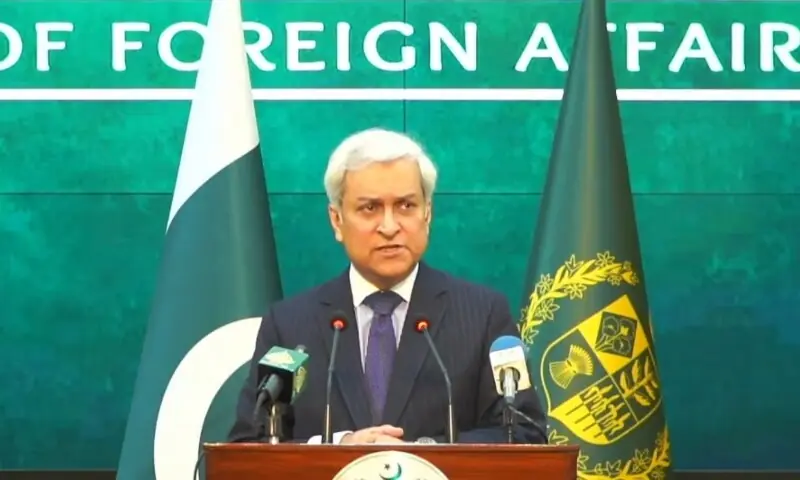
Pakistan’s Foreign Office responded with an unusually detailed and pointed statement that pushed back on both the substance of Gabbard’s remarks and what it portrayed as a broader pattern of US mischaracterization. Spokesperson Tahir Hussain Andrabi said Pakistan “categorically rejects the recent assertion by a United States official alleging a potential threat from Pakistan’s missile capabilities.”
Pakistan’s strategic capabilities “are exclusively defensive in nature, aimed at safeguarding national sovereignty and maintaining peace and stability in South Asia.” Andrabi noted that the country’s missile program “remains well below intercontinental range” and “is firmly rooted in the doctrine of credible minimum deterrence vis-à-vis India.”
In a direct contrast, Andrabi highlighted India’s own missile development, saying capabilities exceeding 12,000 kilometers “reflect a trajectory that extends beyond regional security considerations and is certainly a cause of concern for the neighbourhood and beyond.” The statement concluded with a push for better bilateral ties. “Pakistan remains committed to constructive engagement with the United States, anchored in mutual respect, non-discrimination, and factual accuracy,” Andrabi said. “We urge a more measured and considered approach that aligns with South Asia’s strategic imperatives and advances peace, security, and stability across the region.”
Earlier on Thursday Jalil Abbas Jilani, a former caretaker foreign minister, wrote on X that the assertion “that the US Homeland is within range of Pakistan’s nuclear/con missiles is not grounded in strategic reality.” Pakistan’s nuclear doctrine, he added, “is India-specific, aimed at maintaining credible deterrence in South Asia, not projecting power globally.”
Analysts described Pakistan’s inclusion in the US threat assessment as consistent with longstanding American policy concerns rather than a sharp departure. In December 2024, a senior White House official made a similar claim about Pakistan developing long-range ballistic missiles that could eventually strike beyond South Asia, including the United States. That same month, the United States imposed additional sanctions on four Pakistani entities it accused of contributing to the proliferation or delivery of ballistic missile technology.
Pakistan has long maintained that its nuclear and missile programs exist solely for deterrence purposes, particularly in response to India’s own arsenal. The two nations, which have fought multiple wars, both possess nuclear weapons but are not signatories to the Nuclear Non-Proliferation Treaty.
Separately, the Foreign Office also pushed back against comments by Israel’s ambassador to India, Reuven Azar, who described Pakistan in a television interview as a “rogue state with nuclear weapons.” “We firmly reject this baseless characterization,” Andrabi said. “The real record of aggression and rogue conduct is evident in the illegal occupation, the ongoing humanitarian catastrophe in Gaza, and the indictment of Israeli leadership in international courts. Responsible states uphold international law — not deflect from it.” Pakistan and Israel have no diplomatic relations. Islamabad has maintained a longstanding policy of non-recognition tied to its support for Palestinian statehood.
Copyright © 2021 Independent Pakistan | All rights reserved