By Staff Reporter
ISLAMABAD: Pakistan has said it will use “whatever means are available” to defend Saudi Arabia against Iran-backed Houthi rebels, signalling that the nuclear-armed country could be drawn directly into the widening Middle East conflict.
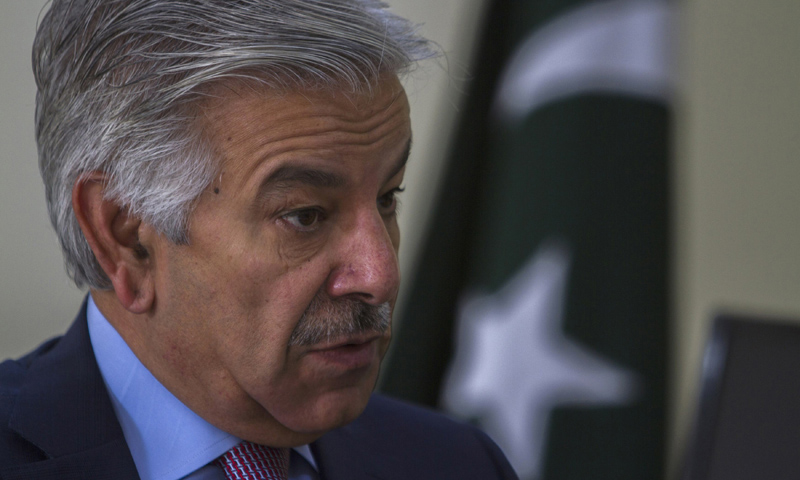
Defence minister Khawaja Muhammad Asif declined to say whether Pakistani forces had already taken part in air strikes in Yemen. He also did not say whether Riyadh had formally asked for help. He insisted, however, that the country’s military capabilities were available to the kingdom under a new mutual defence pact with Saudi Arabia and Turkey.
“I’m not going into detail, but obviously when I say that we are bound by this arrangement to defend Saudi Arabia, that means whatever means are available at our disposal, they’ll be available to Saudi Arabia also,” Asif told reporters in Rome on Tuesday. “I think that’s a categoric statement.”
He added: “Any enemy of Saudi Arabia is enemy of Pakistan. That should be very clear.”
The remarks did not explicitly confirm Pakistani involvement in any strikes. They came days after the army chiefs of Pakistan, Turkey and Saudi Arabia met in Riyadh to discuss how to respond to the Houthi attacks.
The chiefs of staff met on Friday to discuss support for the kingdom, according to the Saudi Press Agency. The agenda included arrangements for a further urgent meeting to work out how to back Riyadh under the pact. Field Marshal Asim Munir, Pakistan’s Chief of Defence Forces, attended alongside his Turkish and Saudi counterparts. The three sides said they were determined to “immediately translate” their commitments into effective military cooperation. No joint deployment or operational measures were announced.
In a separate interview with Al Jazeera, published on Wednesday, Asif went further in his language about the Houthis.
“There is absolutely no doubt in our mind that Houthis are committing aggression against Saudi Arabia, and we are there to help Saudi Arabia in any conflict, whether it is coming from Houthis or a country or any other outfit which threatens Saudi Arabia’s security,” he said. “We will be there to defend them.”
A pact yet to be tested
Saudi Arabia, Pakistan and Turkey signed the Mecca Joint Defence Agreement on 7 August. It declares that an attack on one member will be treated as an attack on all three. The governments have described the pact as defensive and not aimed at any particular state.
It brings together oil-rich Saudi Arabia, Nato member Turkey and nuclear-armed Pakistan. Asif made no mention of nuclear weapons and did not suggest they formed part of Islamabad’s commitment. He has previously appeared to hint at a nuclear dimension to Pakistan’s defence ties with Riyadh before denying it.
The full text has not been published, and the command and operational structures are still being built. Asif said the three countries were setting up a secretariat and putting the alliance’s framework in place. Other countries had expressed interest in joining, he said, but there were no immediate plans to expand it.
He said the alliance reflected a belief among its members that existing security arrangements had failed to protect Gulf states as the conflict involving Iran spread across the region. “Once you start a conflict, you cannot control the outcome of that conflict,” he said. “You cannot control the trajectory of that conflict.”
Pakistan and Saudi Arabia also signed a separate Strategic Mutual Defence Agreement in September 2025, which likewise commits each to treat an attack on the other as an attack on both. Mr Asif’s use of the word “arrangement” in his latest remarks was apparently a reference to one of the two pacts.
Houthi campaign
The Houthis have fired missiles and drones at Saudi Arabia since declaring a maritime blockade on the kingdom in July. They say the move was a response to Riyadh’s years-long blockade of Houthi-held parts of Yemen.
Earlier this month the group seized the Red Sea port of Mokha and several nearby islands. That extended its reach towards the Bab al-Mandab Strait, through which about 12 percent of global trade passes in peacetime. Houthi forces are now just 32 kilometres from Djibouti, which hosts US and other foreign military bases.
A Houthi spokesman has said shipping is safe for all companies “except for Saudi” vessels. Analysts have warned the group could widen its targets.
Last Thursday the Houthis claimed strikes on Aramco facilities at the Red Sea terminal of Yanbu and on a “sensitive target” in Riyadh. Saudi forces said they intercepted six ballistic missiles, and the authorities did not confirm any damage.
The attacks have disrupted the East-West Pipeline, which Riyadh had been using to move crude away from the Strait of Hormuz. The Saudis have been forced to switch some exports back to Hormuz, where Iran has been striking ships. Brent crude briefly topped $108 a barrel on Thursday.
Saudi Arabia’s allies have begun to line up. French president Emmanuel Macron said Paris would send “soldiers, radars, and defence systems” to Yanbu, “not to involve ourselves in any conflict, but to protect the site”. The US has not renewed its own military involvement, though Saudi foreign minister Prince Faisal bin Farhan said the kingdom was continuing to work with American partners.
Iran and the ‘rogue’ proxy
Mr Asif said Tehran did not accept the Houthis as its proxy. “Some of these proxies, they become rogue,” he said. “Some country, A, B or C, they launch a proxy, and then the proxy has its own way of multiplying and then becoming a rogue sort of entity.”
Iran has been accused of arming the Houthis, which it denies. The group says it acts independently.
Despite the strength of his language, Mr Asif said Pakistan retained ties with Iran and was pressing for negotiations to end the wider conflict. He said Islamabad also backed reviving a negotiated agreement over Iran’s nuclear programme.
Pakistan’s statement has hardened since the Houthis were accused of targeting Mecca. On 25 September the three countries’ military leaders condemned attacks on the holy city and reaffirmed their commitment to the kingdom’s collective defence. The next day Saudi defence minister Prince Khalid bin Salman met Field Marshal Munir to discuss joint efforts against attacks on Mecca and on civilian and economic sites.
Speaking on a local television channel on 16 September, after what he described as an attempted drone attack near the holy city, Asif said Pakistan would fulfil its duty under the agreement. “If Makkah is attacked, there is no need for an agreement to protect it,” he said. On 27 September he said Pakistan and Turkey would stand with Saudi Arabia “practically and diplomatically” against any aggression.
Pakistan’s deeper involvement in the kingdom’s defence would mark a shift. When Riyadh last asked Islamabad for troops, warplanes and ships for its Yemen campaign in 2015, Pakistan’s parliament unanimously voted against, arguing the country should mediate instead.
The Houthis have long struck deep into Saudi territory. In September 2019 they claimed drone attacks on the Abqaiq processing plant and Khurais oil field, which temporarily knocked out more than half of the kingdom’s crude output.
Copyright © 2021 Independent Pakistan | All rights reserved