Monitoring Desk
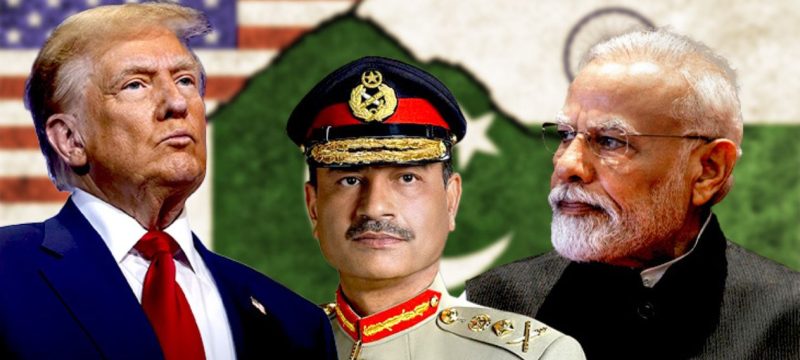
ISLAMABAD: Pakistan has mounted a shrewd diplomatic campaign to curry favor with US President Donald Trump, fostering an unforeseen revival in bilateral relations through counterterrorism aid, business overtures and lavish praise, while incensing India with unequal tariffs and rebuffed mediation efforts, the Financial Times reported Monday.
The newspaper portrayed the shift as an “unexpected resurgence” in Washington-Islamabad ties, spearheaded by Chief of Army Staff Field Marshal Asim Munir’s high-level US engagements this summer. Munir’s most recent trip took him to Florida for the retirement ceremony of Gen Michael Kurilla, commander of US military forces in the Middle East, who had earlier commended the Pakistani leader for a “phenomenal partnership” in combating terrorism. There, Munir was captured smiling arm in arm with a top American general, presenting a plaque and an invitation to visit Pakistan to Gen Dan Caine, America’s top military officer.
In a bolder coup, Munir secured a two-hour private lunch with Trump in Washington in June, only a month after Pakistan and India endured their bloodiest military clash in decades. The reception was extraordinary for a non-head of government wielding Pakistan’s most influential post, especially amid Trump’s prior accusations that the nuclear-armed country of 240 million people had given the US “nothing but lies and deceit.”
“What’s happening in US-Pakistan relations is a surprise. I would describe the relationship now as one that’s enjoying an unexpected resurgence, even a renaissance,” Michael Kugelman, a non-resident senior fellow at the Asia Pacific Foundation, told the FT. “Pakistan has very successfully understood how to engage with such an unconventional president.”
The FT linked the turnaround to a deliberate strategy from Pakistan’s senior generals, fusing counterterrorism collaboration, connections to Trump’s business allies, and pacts spanning energy, critical minerals and cryptocurrencies, complemented by a steady stream of White House flattery. Pakistani leaders rushed to ingratiate themselves with the unpredictable president and his circle, who had lambasted Islamabad for purported Taliban backing during NATO’s Afghan campaign. Project 2025, a pre-election plan guiding Trump’s initial actions, denounced Pakistan’s military-dominated system as an “intensely anti-American and corrupt” Chinese proxy.
Trump’s confidants also assailed Pakistan’s increasingly authoritarian stance toward imprisoned former prime minister Imran Khan, spurring bipartisan congressional efforts to sanction Munir over the detention. “We had no idea what to expect with him, but the general consensus was that it was likely going to be rough,” said one senior Pakistani diplomat.
Momentum built in March when Asim Malik, chief of Pakistan’s Inter-Services Intelligence agency, transferred a key ISIS-K suspect tied to the 2021 Kabul airport bombing that claimed more than 180 lives, including 13 US soldiers. The handover drew Trump’s acclaim in his State of the Union address, where he also rebuked India for high tariffs. Pakistan amplified its appeal with “crypto diplomacy.” In April, the Trump-endorsed World Liberty Financial signed a letter of intent with Pakistan’s crypto council during a co-founders’ visit. Zach Witkoff, son of US special envoy Steve Witkoff, spotlighted Pakistan’s “trillions of dollars” in mineral resources as ideal for tokenisation. Bilal bin Saqib, Pakistan’s minister for crypto and blockchain, has since functioned as an informal envoy, engaging in Washington trade discussions and promoting Pakistan’s cryptocurrency prospects to Trump family members and advisors.
Officials in Islamabad also highlighted their May conflict behavior with India, downing several Indian jets yet exercising restraint, as bolstering Trump’s confidence, with US and Gulf intermediaries facilitating a ceasefire. Pakistan attributed the truce to Trump’s intervention, going so far as to nominate him for the Nobel Peace Prize. This weekend in Tampa, swapping military attire for a suit, Munir addressed Pakistani-Americans, crediting Trump’s “strategic leadership” with averting “many wars in the world,” according to a Pakistani official. “Trump needs success stories to proclaim and Pakistan is happy to give them to him,” says Husain Haqqani, a former US ambassador to Pakistan now at the Hudson Institute, a think-tank in Washington.
Trump reciprocated by vowing a deal to exploit Pakistan’s “massive oil reserves,” while Pakistan dangles additional US investment prospects to rejuvenate its economy, reliant on bailouts.
Conversely, Narendra Modi adopted a sterner posture. The day prior to Munir’s June lunch, the Indian prime minister engaged in a contentious call with Trump over his truce involvement. Modi publicly refuted Trump’s mediation role, stating the accord stemmed from Pakistan’s initiative via established military communication lines. “Prime Minister Modi firmly stated that India does not and will never accept mediation,” India said in a summary of the call.
Munir’s presidential meeting, occurring as the US geared up for strikes on Iran, underscored military and intelligence synergies. He proffered Pakistan as a reliable intermediary with US rivals Iran and China, evoking its 1970s facilitation of Nixon’s outreach to Communist China. While censuring Washington’s Iran attacks, Pakistan persisted in mediator aspirations. In late July, Munir toured the People’s Liberation Army headquarters in Beijing, assuring Foreign Minister Wang Yi of safeguards for Chinese workers against insurgent threats in Pakistan. Amid his US interactions, Kurilla was bestowed military honors by Pakistan in late July, Munir hosted Iranian President Masoud Pezeshkian in Islamabad.
“Pakistan is a rare country that is friends with China, Iran, the Gulf states, to a lesser extent Russia, and now, again, the US,” said Marvin Weinbaum, a senior fellow at the Middle East Institute in Washington. “The US sees Munir as someone who can play a useful strategic role, and the Pakistanis keep their lines open to everyone but know to pull back when one relationship is clashing with another.”
For India, Trump’s burgeoning rapport with its foe has sparked “deep irritation,” intensified by failing to avert steep tariffs on its larger economy. Trump initially imposed 25 percent duties on India, escalating to 50 per cent over Russian oil imports, against Pakistan’s lenient 19 percent. “It will take some time to get over the lack of trust here,” said one person briefed on the events. Indian officials bristle at military-governed Pakistan reaping rewards from Washington enticements. “It’s very easy to deal with dysfunctional systems,” the person said, a reference to the ease with which Pakistan turned what looked like a weak position at the start of Trump’s term into a win. Current and former Pakistani officials and analysts caution that Trump might pivot against Islamabad if it underdelivers. Much of Pakistan’s natural resource potential is unverified or situated in turbulent provinces where insurgencies caused 2,000 deaths last year. The economy depends on a $7bn IMF bailout and debt extensions from China and Gulf partners. India and Pakistan’s divergent diplomatic trajectories hold the power to disrupt geopolitics in unstable South Asia, already influencing trade dynamics, the FT observed.
(Content courtesy FT)
Copyright © 2021 Independent Pakistan | All rights reserved