By Staff Reporter
ISLAMABAD: Pakistan and Bangladesh pledged to revive their old connections and expand trade, youth linkages and regional cooperation, Pakistan’s foreign ministry said on Sunday, capping a landmark visit by Deputy Prime Minister Ishaq Dar that marked the first trip by a Pakistani foreign minister to Dhaka in 13 years.
Dar, who doubles as foreign minister, arrived on Saturday in a bid to reset relations long scarred by the bloody 1971 civil war that saw East Pakistan secede to become independent Bangladesh. The two nations, once united, had seen ties cool under former Bangladeshi premier Sheikh Hasina, who maintained close links with India, but relations have warmed markedly since her ouster in a student-led uprising in August 2024.
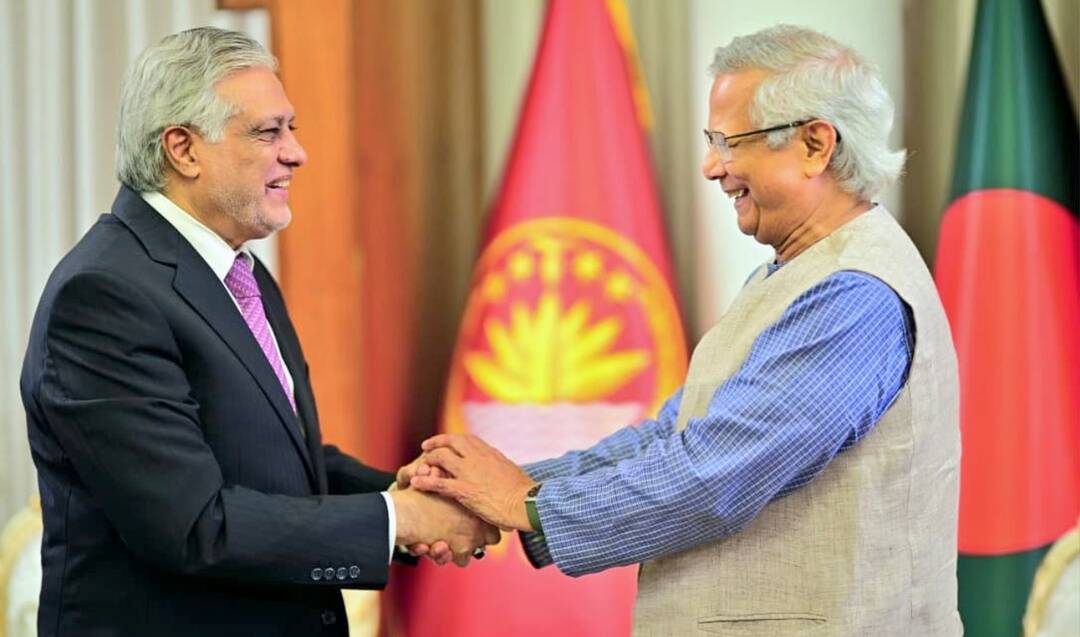
In his meeting with Bangladesh’s chief adviser Muhammad Yunus on Sunday, Dar outlined the key outcomes of his two-day engagements in Dhaka and thanked him for the “warm hospitality” extended to the Pakistani delegation, the foreign office in Islamabad said.
“The discussion covered revival of old connections between the two countries, promoting youth linkages, enhancing connectivity, and augmenting trade and economic cooperation,” the office added in a statement. “The recent developments in the region and the prospects of regional cooperation were also discussed.”
The talks reflected a broader push to institutionalise ties, with both sides exploring the rejuvenation of the South Asian Association for Regional Cooperation (SAARC) and addressing pressing issues like the Palestine and Rohingya crises. Pakistan has repeatedly condemned Israel’s military operations in Gaza since October 7, 2023, which have killed over 60,000 Palestinians in the densely populated enclave.
Earlier on Sunday, Dar held wide-ranging discussions with Bangladesh’s foreign adviser Touhid Hossain, starting with a brief one-on-one at the Pan Pacific Sonargaon Hotel before leading delegation-level talks. The session reviewed the “entire gamut of bilateral relations,” including high-level exchanges, trade and economic cooperation, people-to-people contacts, cultural exchanges, education and capacity building, as well as humanitarian matters, the Pakistani foreign office said on X.
“Regional and international issues, including rejuvenation of SAARC and resolution of Palestine and the Rohingya issues were also discussed,” it noted, describing the atmosphere as “constructive” and underscoring the “existing goodwill and cordiality between the two countries.” Both sides agreed to work toward further strengthening relations, with Hossain hosting a lunch in Dar’s honour.
The meetings culminated in the signing of six agreements to solidify cooperation. These included visa abolition for diplomatic and official passport holders, building on a pact agreed last month during Pakistani Interior Minister Mohsin Naqvi’s visit to Dhaka, and a memorandum of understanding (MoU) to establish a Joint Working Group on Trade.
Other pacts covered an MoU between the foreign service academies of Pakistan and Bangladesh for diplomat training; media cooperation between the Associated Press of Pakistan and Bangladesh Sangbad Sangstha; academic exchanges between the Institute of Strategic Studies Islamabad and the Bangladesh Institute of International and Strategic Studies; and a cultural exchange programme.
“These agreements will institutionalise and further strengthen the bilateral cooperation in trade and economics, training of diplomats, academic exchanges, media cooperation and cultural exchanges,” the foreign office said, terming Dar’s visit a “significant milestone” in relations.
In a separate session, Dar and Pakistan’s Commerce Minister Jam Kamal met Bangladesh’s commerce adviser Sheikh Bashir Uddin, along with senior officials from state institutions, for in-depth talks on bilateral trade, investment and economic ties. Attendees included Bangladesh Bank Governor Dr Ahsan H. Mansur, Bangladesh Investment Development Authority Chairman Chowdhury Ashik Mahmud Bin Harun, National Board of Revenue Chairman Abdur Rahman Khan, Bangladesh Trade and Tariff Commission Chairman Moinul Khan, and secretaries from the textile, tourism and commerce ministries, as well as the Trading Corporation of Bangladesh Chairman Brigadier General Mohammad Faisal Azad and Bangladesh’s High Commissioner to Pakistan Iqbal Hussain Khan.
The discussions emphasised ways to promote economic and commercial cooperation, with a focus on enhancing trade and connectivity. This builds on recent progress, including the launch of sea trade between the two countries last year and expanded government-to-government commerce in February.
Pakistan also unveiled the “Pakistan-Bangladesh Knowledge Corridor,” a initiative granting 500 scholarships to Bangladeshi students for higher studies in Pakistan over the next five years, with a quarter earmarked for medicine. Additionally, training will be arranged for 100 Bangladeshi civil servants, and scholarships under the Pakistan Technical Assistance Programme will rise from five to 25 annually.
Dar’s itinerary included political outreach, meeting Jamaat-i-Islami emir Dr Shafiqur Rahman at his residence to convey best wishes from himself and Prime Minister Shehbaz Sharif for Rahman’s recovery after cardiac surgery. Dar praised Rahman’s “life-long positive contribution in the fields of politics, education and social welfare,” the foreign office said.
On arrival on Saturday, Dar engaged delegations from Bangladesh’s National Citizens Party (NCP), the student-led group that spearheaded the protests against Hasina, Jamaat-i-Islami and the Bangladesh Nationalist Party (BNP). He was set to meet BNP chairperson and former prime minister Khaleda Zia later on Sunday, according to Bangladesh’s The Daily Star.
That evening, at a reception hosted by Pakistan’s High Commissioner to Bangladesh, Dar highlighted the “fraternal sentiments” of Pakistanis toward Bangladeshis. “He noted that the relations between the two countries were anchored in centuries-old shared traditions, Islamic heritage, social norms and literary expressions,” the foreign office posted on X.
Wishing Bangladeshis a “harmonious and prosperous future,” Dar voiced Pakistan’s “strong desire to forge a cooperative and forward-looking relationship with Bangladesh.” He mingled with advisers from the Bangladeshi government, bureaucrats, political leaders, vice chancellors, intellectuals, think tank members, sports figures, artists, journalists, retired generals and others.
Looking ahead, the two sides plan to convene the long-stalled Joint Economic Commission in September or October, two decades after its last session, with Pakistan’s Finance Minister Muhammad Aurangzeb possibly visiting Dhaka, The Daily Star reported, citing unnamed foreign ministry officials.
Copyright © 2021 Independent Pakistan | All rights reserved