By Staff Reporter
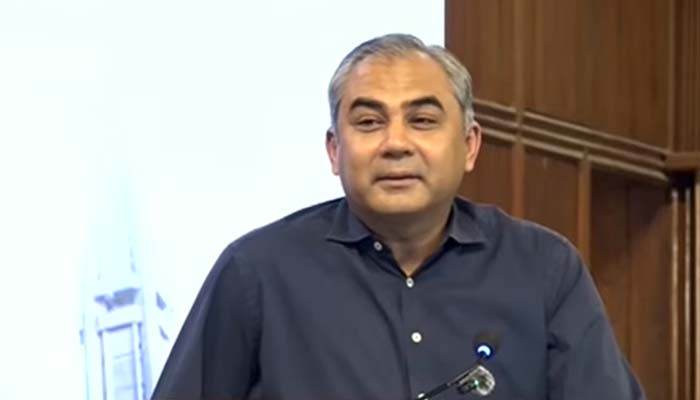
ISLAMABAD: Pakistan’s interior minister has called on the country’s political parties to reach a consensus on carving out new administrative units, telling a major economic gathering in Islamabad that the system under which the country is currently governed has “collapsed” and cannot deliver the reforms the country desperately needs.
Addressing the Pakistan Economic Summit 2026 on Thursday, Mohsin Naqvi said there was “only one solution” to improving the country’s fortunes, and it lay in taking the question of new provinces directly to the public rather than leaving it to political point-scoring.
“Whether you agree or not, the system we have been living under has collapsed,” he told delegates at the outset of his speech. There would be no change in the country’s fortunes, he warned, if that same system was allowed to persist.
The minister’s remarks reignited a debate that has simmered for years in Pakistani politics. Various parties have long pushed for the creation of new provinces or administrative units, arguing that smaller, more localised structures would bring government closer to ordinary citizens and speed up development. The idea remains deeply contentious, however, given that any change to the country’s four-province structure would require a constitutional amendment and a level of political agreement that has so far proved elusive.
The Muttahida Qaumi Movement-Pakistan, a coalition partner of the ruling Pakistan Muslim League-Nawaz, has repeatedly called for Karachi to be carved out of Sindh and made a province in its own right. The Pakistan Peoples Party, which governs Sindh and also sits in the federal coalition alongside MQM-P, has firmly resisted the proposal. Separately, both the PPP and the Pakistan Tehreek-e-Insaf have for years pushed for a South Punjab province, a demand that has yet to gain the traction needed to become reality.
Naqvi did not explicitly endorse either proposal on Thursday, using the terms “administrative units” and “provinces” interchangeably throughout his address and stopping short of saying precisely what form devolution should take. It was also unclear whether he was setting out a personal position or hinting at wider thinking inside a government in which he is widely seen as a figure close to the military establishment.
“All political parties should sit together in a single room, whether for a day, a month or a year,” he told the summit. “They will have to settle every issue of their country, including new units and provinces. Unless they do so, unless they sit together and change this, this country will remain in the same condition, regardless of how many seminars and functions you hold.”
Ordinary citizens, he said, simply wanted to be able to afford life’s necessities and to deal with a government that was actually within reach. Many, he added, still had to travel long distances merely to access a court or a government office, a state of affairs he said reflected the failure to bring public services closer to where people actually lived.
“A common man needs his basic facility,” he said. “He needs an interaction with his government, which we are not able to give.”
To make his case for greater decentralisation, Naqvi pointed to India, which he said had grown from 14 states at independence to 29 today, as well as Indonesia, which he said had similarly expanded its administrative structure over time.
Turning to the state of the public finances, Naqvi painted a bleak picture of a federal government trapped in a cycle of borrowing. “The condition of this federal government is such that we make our budgets in the negative, and we discuss how much debt we have to incur this year,” he said, adding that ministers were resigned to taking on further debt rather than correcting the underlying problems. Pakistan’s diplomatic successes, he suggested, amounted to little more than “firefighting” so long as the basics of governance went unaddressed.
Describing himself as democracy’s “biggest supporter”, Naqvi acknowledged that multiple models of democratic governance existed but insisted the country had to keep moving forward regardless. He was similarly blunt on the subject of youth employment, dismissing government schemes offering stipends and tablets to young people as no substitute for genuine opportunity.
“They are not asking for a tablet, or two to four thousand rupees a month,” he said. “They only ask for one thing — that we should get jobs on merit, and job opportunities.” Young people, he added, wanted a “corrected system”, not handouts, and warned that if the country’s “cockroaches” — a term that has entered the political lexicon following recent Gen Z-led protests in India — were to unite, they could “turn everything upside down”.
The minister also had pointed words for the business figures in the room, telling chambers of commerce and industry associations gathered at the summit that he regarded them as the people who effectively ran and financed the political system. “One gives funding of Rs500 million before elections, or the other gives Rs100 million or Rs50 million,” he said, adding that those present bore responsibility for the state Pakistan found itself in after seven decades of systems that had failed to deliver.
Speaking to reporters informally later in the day, Naqvi widened his critique to the military leadership, saying the efforts of the Chief of Army Staff and Chief of Defence Forces, Field Marshal Syed Asim Munir, would count for little unless politicians did their part to fix the system. “Unless politicians fix the country’s system, the Field Marshal’s hard work will be of no benefit,” he said, adding that Munir had repeatedly stressed he would not allow democracy to be derailed.
“The country’s political parties will have to come together to improve the system,” Naqvi told journalists. “Not only the PML-N and the PPP, but the PTI should also join efforts to improve the system.”
The minister used the same exchange with reporters to dampen speculation over his own political future, confirming he would remain interior minister rather than move to the foreign affairs portfolio, as had been rumoured. He also said the current government intended to serve out its full constitutional term and ruled out any shift to a presidential system, while declining to comment substantively on the legal cases facing former prime minister Imran Khan beyond saying the courts would decide them.
Copyright © 2021 Independent Pakistan | All rights reserved