By Staff Reporter
ISLAMABAD: Pakistan’s military has accused India’s National Security Adviser Ajit Doval of masterminding a sprawling terrorist network aimed at destabilising Pakistan, intensifying the long-standing rivalry between the two nuclear-armed neighbours.
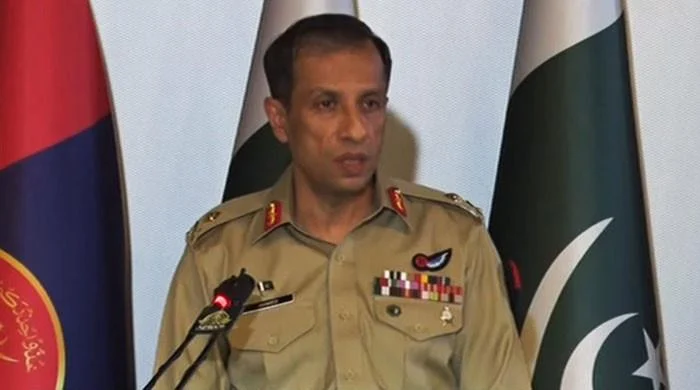
In an interview with Al Jazeera on Wednesday, Lt. Gen. Ahmed Sharif Chaudhry, director general of Pakistan’s Inter-Services Public Relations, alleged that India, under Doval’s leadership, is funding and arming militant groups to undermine Pakistan’s stability. The military spokesperson’s remarks come against the backdrop of simmering tensions, reignited by a recent clash between the two nations following India’s assertions that Pakistan was behind a deadly attack in occupied Kashmir’s Pahalgam, claims Islamabad has dismissed as baseless.
Chaudhry did not mince words, branding Doval, a former intelligence chief known for his tough stance against Pakistan, as the “evil chief architect of India’s terror enterprise.” He accused India of orchestrating a deliberate campaign to keep Pakistan mired in chaos. “The strategy of India is to keep Pakistan embroiled in this menace of terrorism, so that its true power … potential is not realized,” he said. “The power differential between the two countries keeps increasing, so that India can act as a regional hegemon, a bully and can dictate its own terms.”
The military said India, under Doval’s stewardship, provides funding, planning, intelligence, and technical support to terrorist outfits within Pakistan, specifically naming groups like Fitna-al-Khawarij and Fitna-al-Hindustan. Last July, Pakistan’s government designated the banned Tehreek-i-Taliban Pakistan (TTP) as Fitna-al-Khawarij, mandating the use of “khariji” (outcast) to describe its members. In May, it labeled terrorist organizations in Balochistan as Fitna-al-Hindustan, a term meant to underscore India’s alleged role in stoking instability—a narrative that may also serve to rally domestic support.
“Do you think it’s happening on its own?” Chaudhry asked. “This terror enterprise cannot be sustained without the sponsorship of India. Who is the chief architect? Mr. Ajit Doval.”
He went further, claiming that India’s support for terrorism extends beyond Pakistan’s borders, encompassing transnational killings and a pattern of interference dating back decades. Among the historical examples he cited was India’s backing of the Mukti Bahini in 1971, which contributed to the secession of East Pakistan and the birth of Bangladesh. “Indians have acknowledged it, PM [Narendra] Modi went on record not only acknowledging but boasting about it,” Chaudhry said.
To bolster his accusations, Chaudhry pointed to what he described as concrete evidence. He referenced the case of Kulbhushan Jadhav, an Indian Navy officer captured in Pakistan in 2016 and convicted of espionage and terrorism, as proof of New Delhi’s meddling. He also mentioned confessions from captured terrorist commanders who, he said, admitted to receiving support from India during public press conferences.
The general accused India’s spy agency, the Research and Analysis Wing (RAW), of running sophisticated operations, including a terror cell led by a serving Indian military intelligence officer identified as Major Sandeep. This cell, Chaudhry said, was responsible for planting improvised explosive devices (IEDs) across Pakistan. “These are the faces of the other accomplices,” he said, alluding to a non-commissioned officer and other soldiers involved. “These are the audios that’ve all been made public already, where the instructions are being passed, where the money is being exchanged, where the targeting is being done.”
Chaudhry said Pakistan is a responsible actor in stark contrast to India, which he called “a reckless and irresponsible state.” He argued that India’s internal struggles with terrorism stem from its own policies, particularly the “continuous oppression” of minorities, Muslims, Sikhs, Christians, and lower castes. “Rather than addressing these grave injustices, inequalities, and doing soul searching, it is very quick to put all the blame on Pakistan,” he added.
This “senseless blame game,” he warned, is pushing the region to the brink. “It is bringing the thresholds between India and Pakistan to dangerously low levels, to such levels that where one incident of terrorism or an act of violence can be turned into an act of war,” the general said. “This foolhardy, this hubristic political mindset of India is putting the destiny of 1.6 billion people of this region at risk.”
The stakes, he emphasized, are uniquely high given the nuclear capabilities of both nations. “We are an established and declared nuclear power, and the world has no experience of going to or even attempting to go into a misadventure against an established nuclear power,” Chaudhry said. “If such a misadventure is taken or attempted, then it will lead to horrific consequences which the world may not be able to endure.”
Addressing concerns about Pakistan’s own nuclear arsenal, Chaudhry sought to reassure the international community. “No one can dare target Pakistan’s nuclear assets,” he said, stressing that they are “under strong institutional control and meet all international safety standards.”
Copyright © 2021 Independent Pakistan | All rights reserved