By Staff Reporter
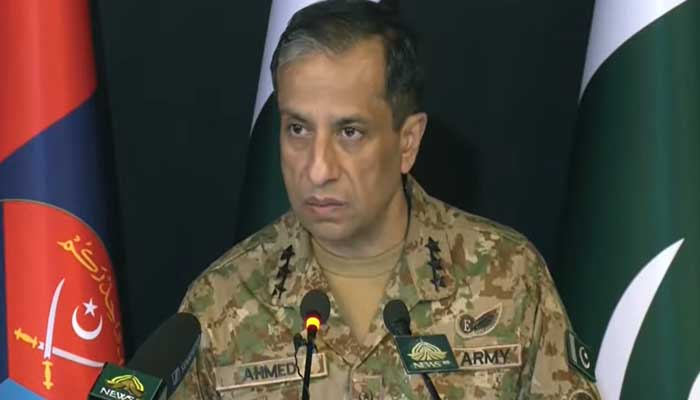
ISLAMABAD: Pakistan’s top military spokesman has hailed the performance of Chinese-made weapon systems during a brief but intense conflict with India in May, marking a rare public endorsement amid ongoing tensions between the nuclear-armed neighbors.
In an interview with Bloomberg published Monday, Lt. Gen. Ahmed Sharif Chaudhry, director general of the Inter-Services Public Relations, said the systems had “demonstrated exceptionally well” in the four-day clash, which involved airstrikes and saw Pakistan claim to have shot down multiple Indian aircraft. “Of course lately, recent Chinese platforms, they’ve demonstrated exceptionally well,” Chaudhry said. “We are open to all sorts of technology.”
The conflict, sparked by an attack in occupied Kashmir that New Delhi blamed on Pakistan without providing evidence, escalated into tit-for-tat strikes on each other’s airbases. Islamabad strongly denied responsibility for the initial attack and called for a neutral investigation. It took US intervention on May 10 to broker a ceasefire. During the fighting, Pakistan deployed Chinese J-10C fighter jets for the first time in combat, according to Deputy Prime Minister Ishaq Dar.
A Guardian report at the time noted that this would mark the debut of the planes — and the PL-15 missiles they carried — in live combat anywhere in the world. “The conflict marked the largest battlefield deployment of Chinese weaponry in recent history, with the J-10C as well as the PL-15 air-to-air missile seeing live documented fighting for the first time,” Bloomberg reported.
China initially expressed ignorance about the jets’ use, with officials saying in May that they were “not familiar with the matter.” But in July, the Chinese air chief commended the Pakistan Air Force’s “exemplary performance” in the conflict. Islamabad credited the J-10Cs with downing several Indian planes, including French-made Rafales.
Chaudhry said in the interview that Pakistan had recently updated its tally of Indian aircraft shot down to seven, up from a previous count of six. The new figure matches one cited last week by former US president Donald Trump, who told an audience in Virginia that “they just shot down seven planes” during the war, without specifying which side. Trump also described confronting both nations amid the active conflict that saw “seven aircraft shot down.”
Chaudhry refuted Indian claims that Pakistan had lost planes in the fighting. “Pakistan has never tried to play with figures and facts,” he said. “Pakistan didn’t lose any planes.” India’s highest-ranking general has acknowledged that its forces suffered losses in the air but denied losing six aircraft.
The systems’ performance has drawn intense scrutiny since the clash, which represented Pakistan’s first major use of modern Chinese-made platforms. In August, Pakistan announced the addition of the Z-10ME attack helicopter to its arsenal, a model similar to those China uses along its border with India.
Last month, President Asif Ali Zardari traveled to the Chinese city of Chengdu, where he visited the defence company that manufactures the J-10 fighter jet. The endorsement comes as tensions simmer. After Indian political and military leaders made aggressive statements last week, repeating terrorism allegations that Pakistan has repeatedly refuted, the Pakistani military warned on Saturday that any future conflict could lead to “cataclysmic devastation.”
A day later, Defence Minister Khawaja Asif said India had faced a “decisive defeat with a score of 6-0” in the May escalation, and “if they try again [to go to fight], God willing, the score will be much better than the last time.”
During the May escalation, shares of Chinese defence-manufacturing companies rallied as the tensions boosted the outlook for mainland exporters.
Chaudhry declined to say whether Pakistan would continue favoring Chinese arms, noting that the country procures equipment from both China and Western nations. “Our development strategy has always been to induct the most effective, efficient as well as economic platforms and technology,” he said. He emphasized that Pakistan is not engaged in a military catch-up or arms race with India, pointing to its smaller defence budget — “a fraction” of its neighbor’s. “We don’t have the luxury of unlimited money at our disposal,” Chaudhry said.
According to the Stockholm International Peace Research Institute, Pakistan allocated $10.2 billion to defence spending last year, compared with $86.1 billion for India.
Copyright © 2021 Independent Pakistan | All rights reserved