By Staff Reporter
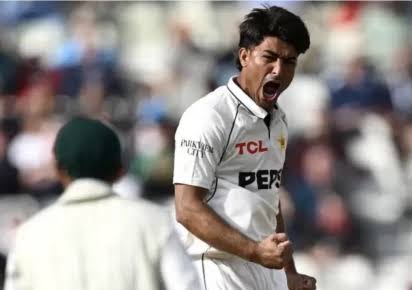
KARACHI: Pakistan’s cricketers left England on Saturday with the emphatic misery of a 3-0 series whitewash and, almost despite themselves, one image that will outlast the scoreline: a 21-year-old fast bowler from Mardan, on Test debut, launching nine sixes into the Edgbaston evening as his side’s innings defeat turned, however briefly, into hope.
That the contrast needed pointing out at all says everything about where Pakistan cricket now stands. Razaullah Khan’s innings of 81 from 63 balls — an unbroken half-century stand that turned an eight-wicket defeat into a fourth-innings target for England — was the single passage of play from three Tests that Pakistan’s supporters will choose to remember. Everything around it told a story of an institution in freefall.
England won by eight wickets on the fourth morning at Edgbaston, chasing just 130 after Ben Duckett and Emilio Gay were both out in the first over, before Joe Root and Jordan Cox settled the match with unbeaten half-centuries. Root passed 1,000 Test runs at the ground on his way to an unbeaten 62; Cox finished on 59, his third half-century of the series. Mohammad Abbas, so nearly the hero of Pakistan’s second innings with the bat, took both openers’ wickets inside the first over and finished as the only visiting bowler to take a wicket in the match. It completed a first home whitewash for England against Pakistan, following an innings victory at Headingley and a 194-run win at Lord’s.
The scoreline was only the surface of the story. By the time the teams reached Birmingham for the final Test, Pakistan had already sacked their head coach, Sarfaraz Ahmed, and bowling coach, Umar Gul, and removed seven players from the squad — a decision the Pakistan Cricket Board chairman, Mohsin Naqvi, defended in blunt terms. “We are not left with any option if a player is not performing but to look for his replacement,” he said, rejecting the idea that Pakistan cricket was in terminal decline as “unfair” and accusing critics of using the crisis to target him personally. The white-ball coach, Mike Hesson, was drafted in for the dead rubber; nothing changed on the field. Separately, two of the discarded players, Mohammad Rizwan and Imam-ul-Haq, were placed under investigation by Pakistan’s cybercrime authorities over allegations that team information had been leaked — an inquiry that hung over the closing days of the tour without being resolved before the players returned home.
A pattern, not an aberration
None of this was without precedent, which is itself the point. Pakistan have used three Test captains and six head coaches in three years; the PCB has had five chairmen in the same period, a churn that predates Naqvi’s own tenure, which began in February 2024 when he succeeded Zaka Ashraf, who had himself held the post for barely seven months. Sacking and suspending players after heavy defeats has long accompanied that turnover at the top: after Pakistan’s 3-0 whitewash in Australia in 2010, the board banned the captain, Mohammad Yousuf, and the senior batter Younis Khan indefinitely, and disciplined five further players, Shahid Afridi among them.
Wasim Akram, the former captain and one of the country’s greatest fast bowlers, said the collapse had been building for years. “It’s a disappointing state, but I could see this coming for the last five years, and you can’t blame one particular person and one factor because there are many,” he said. Afridi, watching seven of his former teammates drop inside a series, called the treatment of the squad indefensible. “You don’t disrespect players like this, and your system is not strong,” he said. “These are gloomy times in Pakistan cricket.”
Mushtaq Ahmed, part of the 1992 World Cup-winning side, located the failure further back, in a domestic system he said had stopped producing players ready for Test cricket. “We had a great number of match-winners and a strong legacy, and that is why we produced results in the past,” he said. “Now the decline is steep and will take time to fix.” Akram went further, arguing the imbalance was specific to the red-ball game. “We need to realise that we lack talent in red-ball cricket. White-ball teams are okay,” he said. “It’s easy to blame the PCB chairman, but when we were sleeping and not addressing the overall flaws, then such a fall happens.”
The numbers behind the mood
The scale of the batting failure was stark even by Pakistan’s recent standards: the top order managed to pass 200 in only one of their six innings across the series; that solitary total built on Edgbaston’s second innings, in which Shan Masood made 95, Babar Azam 76 and the opener Azan Awais also contributed, before the ninth-wicket stand between Razaullah and Abbas, worth 121, turned 318 for eight into 449 all out and a target of 130. Abbas’s share of that stand, an unbeaten 42 that eclipsed his previous Test best of 29, was itself a measure of how far down the order Pakistan’s resistance had to come from.
Pakistan had gone into the tour already struggling in the World Test Championship, sitting eighth of nine in the 2025-27 cycle after an uneven run that included victories and heavy defeats against West Indies and a 2-0 series loss in Bangladesh. A third defeat in England, their 16th in 21 Tests, will push that position further back still; in the previous WTC cycle, Pakistan finished ninth and last of the nine competing sides.
The white-ball formats offer little comfort. Pakistan’s defence of hosting rights for the Champions Trophy last year, the tournament that marked the country’s return to staging global events after 29 years, ended in a first-round exit. Their T20 record has followed the same trajectory: no semi-final appearance at the 2026 World Cup, and a group-stage exit two years earlier that included defeat by an untested United States side.
Mohammad Afzal, a banker whose four sons once played together at a local academy, said the effect on grassroots interest was already visible. “We all have lost interest as our team is not doing well,” he said. “Cricket is fast losing ground in Pakistan and we need strong measures to revive the glory.”
Razaullah’s innings will not by itself change any of that. What it demonstrated — pace that touched beyond 90mph, a debut spell that had Root lbw, a batting cameo built on nerve rather than technique — was talent, not a solution to the structural problems that both Akram and Mushtaq Ahmed described. The tension is one Pakistan cricket has lived with before: individual brilliance emerging from a system that keeps failing to produce it consistently, while administrators cycle through jobs faster than any coaching or selection philosophy can take hold.
Naqvi’s position, that difficult personnel decisions are simply what results demand, sits uneasily against a board that has changed leadership five times in five years and dismissed six head coaches in three. Whether the PCB uses this series as the moment to break that cycle, or simply as the latest occasion for it, will do more to determine Pakistan’s next Test campaign than anything produced by one debutant in a losing cause at Edgbaston.
Copyright © 2021 Independent Pakistan | All rights reserved