By Staff Reporter
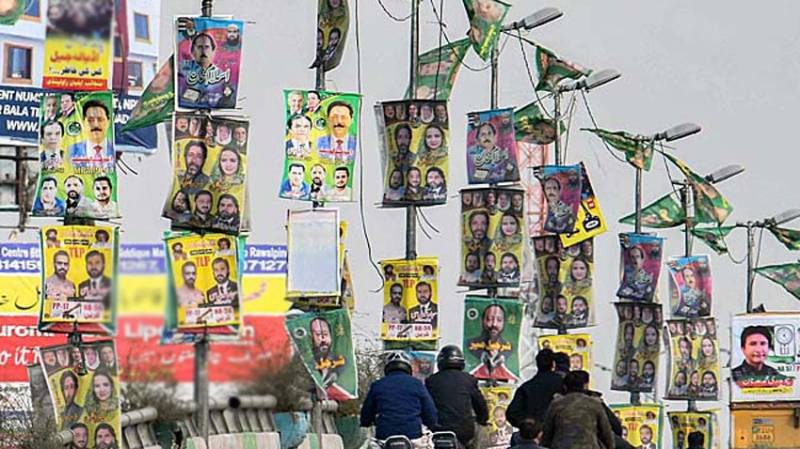
ISLAMABAD: Pakistan’s election campaign entered its final hours on Tuesday, as candidates and parties scrambled to woo voters ahead of a pivotal vote that could alter its political landscape amid heightened security and a looming threat of violence.
The election rules prohibit any political rally or public gathering 48 hours before polls, allowing the voters to reflect on their choices before casting their ballots. Candidates can only use private meetings and personal contacts to woo the voters.
The elections are set to be held on February 8 and polling will start at 8:00 am and will continue non-stop until 5:00 pm. After the election, the new parliament will choose the country’s next prime minister. If no party wins an outright majority, then the one with the biggest share of assembly seats can form a coalition government.
The caretaker government, which took over in August after the previous parliament completed its five-year term, said elaborate security measures have been taken, including the deployment of regular army troops, to maintain peace.
Gohar Ejaz, the caretaker interior minister, told reporters in Islamabad that around 650,000 security personnel, including army and paramilitary forces, had been deployed across the country to safeguard the voters and the polling stations.
“Over 137,000 security personnel from paramilitary and army units will be deployed along with 511,000 police personnel performing duties during the elections,” Ejaz said.
The Election Commission of Pakistan (ECP), which had delivered more than 260 million ballot papers across the country despite time constraints and weather-related challenges, has set up more than 90,000 polling stations for the nearly 128 million registered voters, who will elect 266 members of the National Assembly, the lower house of parliament, and 593 members of the four provincial assemblies.
Out of the total polling stations, more than 45,000 have been declared sensitive or highly sensitive, meaning they are prone to violence or disruption.
Ejaz said around eight security personnel on average would be deployed at each polling station.
“We have a three-tier security system: firstly, the police, behind them, the civil armed forces, and behind them, the armed forces.”
“For restive areas, a special aerial Quick Reaction Force (QRF) has also been established so that if God forbid, any incident occurs at any polling station, our aerial QRF force, comprising our commandos, will be ready to respond promptly.”
The elections are expected to be the most competitive and consequential in Pakistan’s history, as three major parties vie for power in the nuclear-armed nation of 230 million people. Many observers also fear that the polls will be marred by rigging, intimidation and violence, amid a crackdown on the opposition and a heightened security presence.
The incumbent Pakistan Muslim League-Nawaz (PML-N), led by former prime Minister Nawaz Sharif and his brother Shehbaz Sharif, is facing a stiff challenge from the Pakistan Peoples Party (PPP), headed by Bilawal Bhutto Zardari, the son of slain former Prime Minister Benazir Bhutto, and the Pakistan Tehreek-e-Insaf (PTI), led by former prime minister Imran Khan, who is currently in jail on corruption charges.
But several smaller parties with sizeable vote banks, including the Muttahida Qaumi Movement-Pakistan, the Jamiat Ulema-e-Islam Fazl, the Awami National Party, the Pakistan Muslim League Quaid-e-Azam, the Balochistan National Party, are also poised to make gains and play a role in case no major winner emerges.
The stakes are high for Pakistan, which is facing a host of challenges, including a struggling economy, a resurgent Taliban, and strained relationships with all its neighbors, except China.
Many experts agree that in Pakistan’s political landscape today. Sharif, a three-time former prime minister, is widely seen as the front-runner for Pakistan’s top job, after returning from exile and clearing his name of past charges.
Sharif, who was ousted in 2017 over corruption allegations and banned for life from holding public office, came back to Pakistan last October, avoiding prison sentences that were soon overturned.
His main rival, Khan, was removed from power in April 2022 by a vote of no confidence and is now in jail, barred from running in the election. Khan still has a loyal base of supporters, but many observers believe that his dramatic downfall and Sharif’s smooth comeback have predetermined the outcome of the vote.
The arrest of Khan in May 2023 sparked violent protests that rivaled the chaos that followed the killing of Benazir Bhutto, a former prime minister, in 2007. His followers accused the military, which has a strong grip on the country, of orchestrating his removal and attacked army installations and property.
The authorities cracked down on Khan’s party, arresting hundreds of activists, banning its name and symbol, and introducing military courts for civilians. The repression seemed to dampen some of the dissent.
A year ago, Khan was a free man, campaigning for a comeback, while Sharif was in London, apparently sidelined. But the situation has reversed. Khan is behind bars, while Sharif’s return and exoneration — along with a late-starting but well-funded campaign — have made him the favorite of the security establishment.
Pakistan has a history of flawed elections, marred by ballot-rigging, intimidation and fraud. The switch in fortunes of Sharif and Khan reflects the ruthless nature of the country’s power politics.
Candidates from Khan’s party have been forced to run as independents, facing harassment and threats from the authorities. Sharif’s party, on the other hand, has enjoyed a relatively smooth campaign, with the backing of the establishment, especially in the crucial province of Punjab.
But analysts are skeptical that the establishment will tolerate a strong and independent civilian government, especially one led by Sharif, who has clashed with the army in the past. Some observers suspect that the establishment may try to create a hung parliament, where no party has a clear majority, and then arrange a coalition government that suits its interests.
Copyright © 2021 Independent Pakistan | All rights reserved