Confident that the initiative will not break the budget, Finance Minister Ishaq Dar hopes it will enhance the industries’ competitive edge in export markets.
By Muhammad Ali
ISLAMABAD: Finance Minister Ishaq Dar Thursday succeeded in averting a major crisis when he reached a deal with the country’s export-oriented industries for provision of electricity at a subsidised PKR 19.99 per kilowatt hour.
The beneficiaries of the largesse, to the tune of PKR 100 billion per year, are the five export-oriented, zero-rated sectors – textiles and jute, leather, carpet, surgical, and sports goods. Around 65 percent of Pakistan’s exports come from these five sectors.
Led by the textiles sector, these are the country’s major earners of the export dollar as well as major job creators. The decision came after the textiles sector representatives held a detailed meeting with Finance Minister Ishaq Dar.
The compromise deal came a day after the textile sector gave a call for closing down production activities countrywide. Such a move could potentially cut Pakistan’s exports by approximately $5 billion and trigger a shockwave of unemployment.
The package is aimed at enhancing the competitiveness of the export-oriented industries vis-a-vis some regional players who are beating Pakistani exports owing to their low production costs. The hope is that cheaper energy will help them enhance their exports.
Interestingly, a concessionary tariff package was approved in July 2022 to supply electricity at a rate of 9 cents per kWh to existing connections of these five sectors till end-June 2023. However, the government again decided to discontinue the tariff from Oct 1, 2022, hardly three months after its inception.
Dar’s rationale
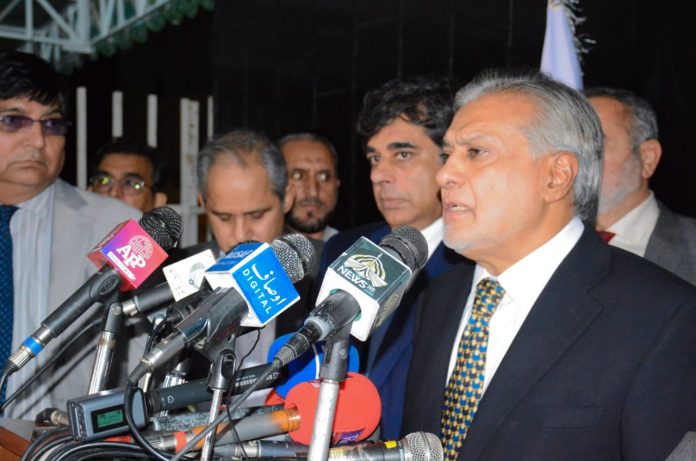
Announcing the decision in a media talk, the Finance Minister termed the demand for energy subsidies “just” and promised that the government would bear the difference between the new fixed price and the actual per unit production cost.
He said, “I expect the industries to now increase Pakistan’s exports.” The package will cost the exchequer somewhere between PKR 90-100 billion annually.
To a question, Dar said that Pakistan did not need to seek permission of the International Monetary Fund (IMF) for the initiative, as the government had the budgetary space required to facilitate the sector.
“I don’t need to take [the IMF] into confidence”, said the Finance Minister. “[W]hen I know what I am doing then it is my responsibility to create [the fiscal] space for it and I have done so”. He insisted that the development will have no impact on the primary and budget deficit, and that “everything will be taken care of”.
An IMF delegation is due to visit Pakistan on Oct 25, the Finance Minister said. “I will explain it myself. I believe in prudent decisions and we have a source of funds available for the package.”
Regarding dollar-rupee parity, Dar said, “I want to clarify that I can genuinely prove that (the dollar’s) actual value is below PKR 200.” He added that the market was now headed in the right direction, and that it was a necessary correction.
Since Dar’s return to the Ministry just over a week ago, the rupee appreciation has shaved around PKR 2.6 trillion off the country’s public debt and liabilities.
Criticism
The export-oriented sectors including textile have drawn broad criticism over getting subsidised gas and electricity at the same time.
The textile sector had captive power plants to meet their electricity needs in case they did not have electricity from the national grid. These textile units had been receiving electricity and gas at discounted rates at the same time.
The previous government had linked the provision of gas to the textile units with the performance audit of captive power plants. But the textile industry had obtained stay orders from the court to stop the government from conducting an audit of the captive power plants.
There have been allegations of misuse of the subsidy on gas to the captive power plants as those textile units also received subsidised gas and were selling their products in the local market.
Under the previous government, the Finance Ministry had also pointed out that textile exports increased due to the rupee devaluation and there was no increase in quantity. Due to this, the government decided to probe the matter.
Copyright © 2021 Independent Pakistan | All rights reserved