By Staff Reporter
ISLAMABAD: Prime Minister Shehbaz Sharif urged some of the world’s biggest financial firms to invest more in Pakistan on Tuesday, taking his case for the government’s economic overhaul to a day of meetings in London that began with the opening of trading at the London Stock Exchange.
He met executives from JPMorgan Chase & Co., BlackRock Inc., Citigroup Inc., Barclays Plc and Rothschild & Co, his office said. None of the firms was reported to have announced a financing commitment or a new mandate.
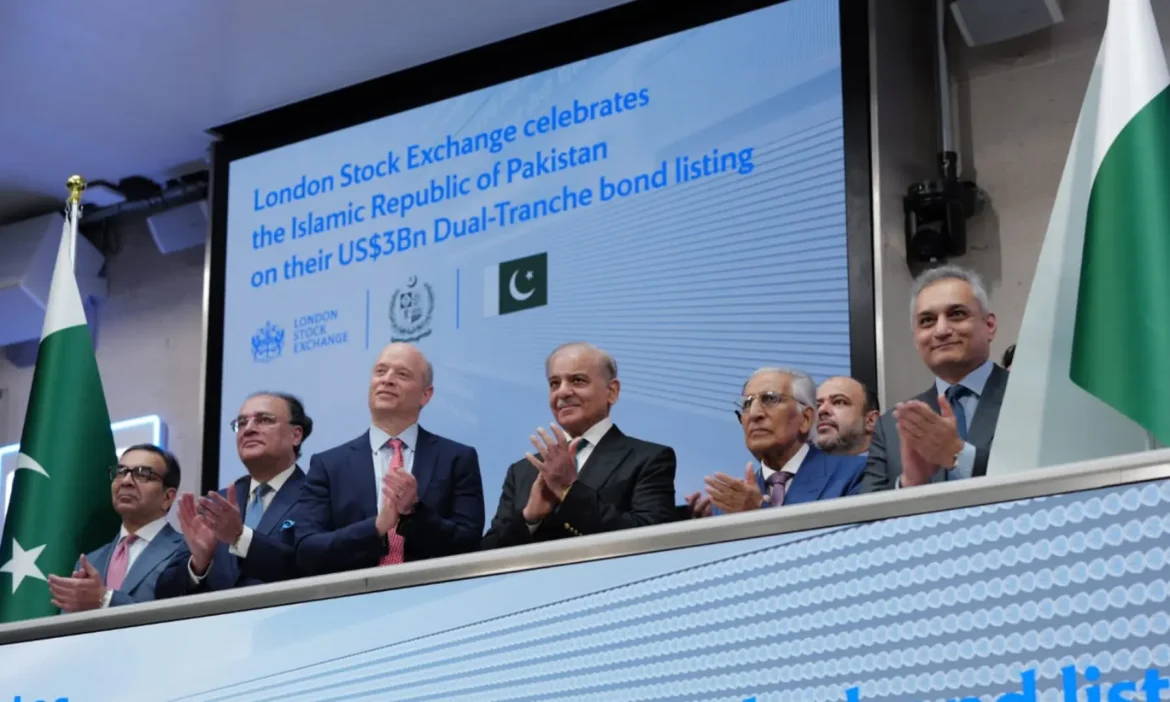
Sharif became the first Pakistani prime minister to open a trading session at the exchange, according to his office. At the ceremony at the bourse’s Paternoster Square headquarters, he formally marked Pakistan’s $3 billion dual-tranche sovereign Eurobond, sold earlier this month. London Stock Exchange Group Chief Executive Officer David Schwimmer welcomed him. Finance Minister Muhammad Aurangzeb, High Commissioner Tipu Usman and members of the Pakistani delegation attended.
The bond, the country’s largest single international issuance, comprised $1.75 billion of 5½-year notes at a 7.5% coupon and $1.25 billion of 10-year notes at 7.9%. Orders reached almost twice the amount sold, and Citi was among five joint bookrunners.
“Pakistan in recent years has worked very hard to strengthen its economy,” Sharif told the audience, calling the improved macroeconomic indicators “promising.” He credited Aurangzeb’s team for the bond sale, which he said reflected “our hard work.”
Sharif also said Pakistan would have “taken off like other emerging economies” had the Middle East conflict not erupted. He pointed to Islamabad’s role as a mediator in the war between the U.S. and Iran and said the Gulf crisis was pushing investors to reassess where they put their money. Pakistan, he said, could offer “safer markets” that are “highly profitable, mutually beneficial, safe and secure.” He asked Schwimmer for advice on engaging global financial markets beyond sovereign debt.
JPMorgan
Sharif met a JPMorgan delegation led by Matthieu Wiltz, co-CEO for Europe, the Middle East and Africa, and discussed capital markets, trade finance and investment banking. The prime minister’s office said the delegation “reaffirmed its interest in sovereign debt capital markets and corporate banking opportunities.” It did not announce a role for the bank in any future bond sale.
Access to those markets matters for Pakistan as it seeks external financing. It returned to the dollar bond market in April after a four-year gap, raising $750 million, before September’s larger deal. The government has discussed capital-market financing with JPMorgan before, including at an April meeting. Aurangzeb also addressed a JPMorgan-hosted investor conference in London earlier this month.
Sharif asked BlackRock to raise allocations to Pakistani equities and fixed income within its frontier-markets strategy. The delegation included Gordon Fraser and Sam Vecht, co-heads of emerging markets and frontiers, and portfolio manager Emily Fletcher. Both sides stressed the importance of consistent policy in building investor confidence, the prime minister’s office said.
He urged Citi, represented by Chief Client Officer David Livingstone, to expand its corporate and institutional banking services. He praised the lender’s long presence in Pakistan. At Barclays, he briefed Mohammad Kamal Syed, head of Private Bank and Wealth Management UK, on the government’s stabilization measures and encouraged the bank to look at opportunities in the financial sector.
Sharif also met Lord Mark Sedwill, chair of geostrategic advisory at Rothschild, and Majid Ishaq, head of UK investment banking, to discuss Pakistan’s “geo-economic priorities” and possible advisory work on capital markets and investment strategy. Aurangzeb and Muhammad Ali, adviser on privatization and head of the Privatisation Commission, joined the meetings.
The prime minister’s office said the executives expressed confidence in Pakistan’s reform momentum, and described the meetings as a sign of “growing traction” for the program among global institutions.
S&P Global Ratings raised Pakistan to B from B- in July, citing stronger institutional stability and progress on IMF-backed reforms. Moody’s Ratings followed in August with an upgrade to B3 from Caa1. Both grades remain well below investment grade.
Copyright © 2021 Independent Pakistan | All rights reserved