By Staff Reporter
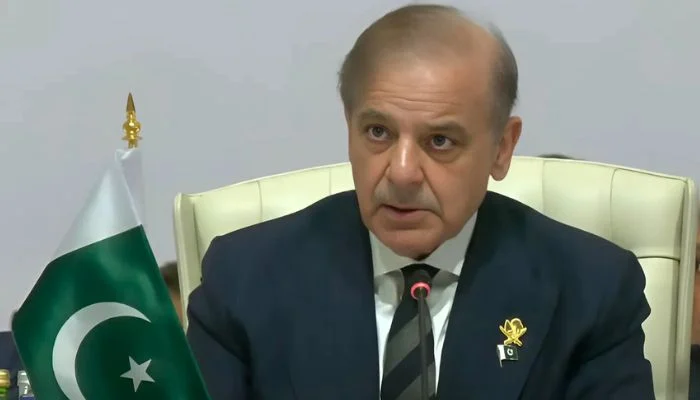
ISLAMABAD: Prime Minister Shehbaz Sharif called on Monday for an Arab-Islamic task force to combat Israeli “aggression and expansionism,” as leaders from more than 50 nations convened under the Organization of Islamic Cooperation to craft a unified response to Israel’s airstrike on Qatar last week, an attack that killed five Hamas peace negotiators and a Qatari security officer and threatened fragile cease-fire talks in Gaza.
The emergency summit, drawing representatives from the 57-member OIC, is weighing a draft resolution co-sponsored by Pakistan that demands accountability for Israel, including suspension of its UN membership and invocation of Chapter 7 of the UN Charter for an immediate Gaza cease-fire.
Sharif framed the Sept. 9 attack on Doha as a deliberate blow to peace efforts, carried out by an “aggressor who violates international law seriously.” “This is a flagrant violation of the sovereignty of Qatar and we express our solidarity with our brothers: the Qataris,” Sharif said. “The Israeli attack on Qatar is not apart from the other attacks, it is hegemonic ambition on part of Israel to control the whole region and the role of mediators is always considered to be sacred and they are the hope of peace.”
Sharif linked the incident to Israel’s broader campaign in Gaza, where he said the world was “watching a massacre” and “women and children … were suffering disaster” as the enclave lay reduced to “rubble and ruin” by a “genocidal campaign.”
He urged “urgent steps to put an end to the war crimes in Gaza and to establish a task force to take effective steps to stop Israeli expansion plans.”
The prime minister demanded Israel’s UN membership be suspended and called for “other effective steps” against Tel Aviv, including stronger measures from Arab and Islamic countries. He pressed the UN Security Council to enforce under Chapter 7 an “immediate and unconditional ceasefire, the release of hostages, and the exchange of Palestinian prisoners, along with guaranteed humanitarian access.”
“Above all, a just and lasting two-state solution must be achieved with the creation of an independent Palestinian state on pre-1967 borders with Al-Quds as its capital,” Sharif added.
The gathering affirmed “the common ideas and acts of the participants to condemn the Israeli attacks,” Sharif said, portraying them not as isolated but as part of a “wider hegemonic agenda.” He questioned Israel’s commitment to talks, noting that “even in wartime, the role of peace mediators is always inviolable and sacrosanct — they are the messengers of fragile hope.”
Sharif praised Qatar’s “sincere and tireless diplomatic efforts” under its emir to “bridge divides and promote regional as well as global peace,” even as the Gulf state mediated Gaza negotiations.
On the summit’s margins, Sharif held several bilateral meetings, including a “warm and cordial” session with Saudi Crown Prince and Prime Minister Mohammed bin Salman. Joined by Deputy Prime Minister and Foreign Minister Ishaq Dar and Army Chief of Staff Field Marshal Syed Asim Munir, Sharif condemned the strike as a “deliberate attempt by Israel to derail the Middle East peace efforts.”
He expressed “deep appreciation” for the crown prince’s “bold and sagacious leadership in unifying the Ummah at this critical time” and pledged Pakistan’s full diplomatic support — especially at the UN Security Council, where Islamabad holds a non-permanent seat — and in forums like the OIC. “The convening of the Emergency Arab-Islamic Summit in Doha had sent out an important message that Muslims around the world spoke with one voice against Israel’s unlawful and reckless aggression, that threatened regional peace and security,” Sharif said.
Reiterating the “historic, deep-rooted fraternal bonds” between Pakistan and Saudi Arabia, Sharif thanked Riyadh for its “steadfast support … through thick and thin.” The crown prince looked forward to Sharif’s state visit to Riyadh later this week for “a comprehensive exchange of views on bilateral as well as regional and global issues” and commended Pakistan’s “active diplomatic efforts … to express solidarity with Qatar.”
Dar, already in Doha, helped shape Sunday’s draft resolution at a foreign ministers’ session. Dar met on Monday with Turkish Foreign Minister Hakan Fidan, where they “strongly condemned Israel’s unprovoked and unjustified strikes on Qatar and other nations in the region,” a Foreign Office post on X said. The pair “reaffirmed unwavering support for the Palestinian cause, underlined the importance of the OIC and the Arab League in mobilising collective action of the Muslim Ummah, and welcomed the convening of the Arab-Islamic Summit.”
On Sunday, Dar conferred with OIC Secretary General Hissein Brahim Taha, Egypt’s Badr Abdelatty, Iran’s Abbas Araghchi, Malaysia’s Dato’ Seri Mohamad Hasan, Bangladesh’s Md Touhid Hossain and Uzbekistan’s Bakhtiyor Saidov.
At the ministerial meeting, Dar demanded “urgent steps against Israel to safeguard the global order,” noting that the “frequency of meetings to discuss Israel’s activities in the region underlines how Israel has become a persistent irritant and a danger to world peace and security.” He added: “Pakistan condemns, in the strongest possible terms, the illegal and unprovoked Israeli aggression against the brotherly State of Qatar.”
Dar’s proposed actions mirrored Sharif’s: accountability for Israel’s “war crimes and crimes against humanity” to prevent it from “attacking Islamic countries and killing people with impunity”; an “Arab-Islamic task force to monitor the Israeli designs in the region and adopt effective deterrent and offensive measures in a synchronised manner to ward off Israeli expansionist designs”; pursuit of “the suspension of Israel’s membership in the United Nations” as a “clear message on seriousness by the ummah”; and “additional punitive measures against Israel … to reinforce accountability and deter further violations of international law.”
The summit underscores rare unity among US-aligned Gulf states, exacerbating strains between Israel and the United Arab Emirates, which normalized ties in 2020. Analysts see it as a stark warning to Tel Aviv; diplomats suggest leaders may advance Palestinian statehood bids at the UN General Assembly in New York.
The widely condemned strike disrupted Qatar’s mediation role. The UN Human Rights Council, meanwhile, scheduled an urgent on Tuesday debate on “the recent military aggression carried out by the State of Israel against the State of Qatar on 9 September 2025.”
In Washington, President Donald Trump, who dined Friday in New York with Qatari Prime Minister Sheikh Mohammed bin Abdulrahman al-Thani, struck a cautious note: “Qatar has been a very great ally. Israel and everyone else, we have to be careful. When we attack people, we have to be careful.” Trump had called himself “very unhappy” about the strike, but Secretary of State Marco Rubio said Sunday it would “not … change the nature of our relationship with the Israelis.” Rubio met Israeli Prime Minister Benjamin Netanyahu Monday to gauge fallout on Gaza truce prospects.
Copyright © 2021 Independent Pakistan | All rights reserved