By Staff Reporter
ISLAMABAD: Pakistan’s first astronaut has entered China’s Tiangong space station as its first foreign visitor, a flight Prime Minister Shehbaz Sharif has called “living proof of the ironclad friendship” between Islamabad and Beijing.
Wing Commander Muhammad Zeeshan Ali, a 40-year-old fighter pilot, floated into the station on Wednesday afternoon after the Shenzhou-24 spacecraft lifted off from the Jiuquan Satellite Launch Center in north-western China at 8.18am Beijing time. The capsule docked three hours and 38 minutes later. He flew with the Chinese astronauts Tang Hongbo and Wu Yi.
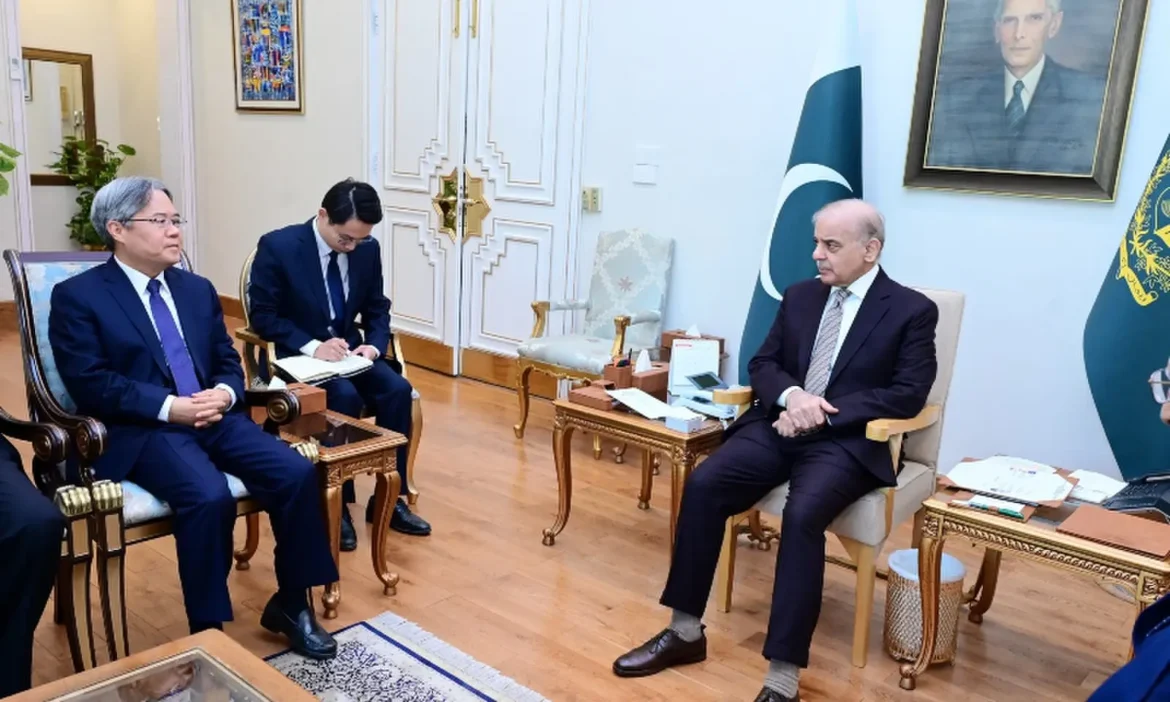
Sharif made his remarks on Thursday during a meeting at the Prime Minister House with the Chinese ambassador, Jiang Zaidong, according to a statement from the Prime Minister’s Office.
The prime minister told the envoy that the flight was “not merely the journey of an individual astronaut, but that of 240 million Pakistanis”, the statement said, embodying the aspirations of the country’s youth and scientific community. Cooperation between the two countries, he added, had “truly reached the stars”.
He said the achievement would inspire young Pakistanis to “aim for the moon and beyond”. He thanked the Chinese institutions that trained Pakistan’s astronauts, and praised Pakistan’s space agency, Suparco, its universities, scientists and armed forces. He also paid tribute to what the statement described as the “dynamic leadership and sagacious vision” of President Xi Jinping, under which China has opened its space programme to friendly countries.
Sharif asked the ambassador to pass his greetings to Xi and Premier Li Qiang, and handed over congratulatory letters addressed to both. The two sides also reviewed relations, including events marking the 75th anniversary of diplomatic ties this year. Pakistan, the prime minister said, remained “unwavering” in its commitment to work with China on the peaceful exploration of outer space.
For China, the mission is the first time it has hosted a foreign astronaut on Tiangong, a station it built and operates. Ali, who is serving as a payload specialist, the crew member responsible for scientific work, is expected to stay about a week.
His stay is much shorter than that of his Chinese crewmates. Tang and Wu will remain aboard for the full six-month term, while Ali returns early in the Shenzhou-23 capsule with two of its crew, Zhang Zhiyuan and Lai Ka-ying. Shenzhou-23’s commander, Zhu Yangzhu, will stay on for a full year, China’s first year-long stay in orbit, to study how the human body copes ahead of planned Moon missions.
The partnership began with satellites. China launched Pakistan’s first in 1990, and the two countries began exploring a crewed mission in 2019, according to Suparco. They reached a final agreement in 2025 to select and train Pakistani astronauts.
“This mission actually, we can also say in one way that it is an outcome of the long-term relationship and cooperation between Pakistan and China,” Ayesha Jagirani, who oversees international research partnerships at Suparco, told Arab News.
Pakistan invited nominations from across the country and screened candidates for physical and mental fitness, academic qualifications and the ability to carry out scientific work in orbit.
Chinese evaluators chose Ali and a fellow Pakistani pilot, Khurram Daud, for final training. The two were selected in April and spent months at China’s astronaut training centre, using a replica of the station to practise emergency procedures and rehearse experiments. Daud trained as Ali’s backup.
Pakistani universities and research institutions submitted about 300 proposals for the flight, and four experiments were chosen. One will test whether microalgae grown in orbit could eventually supply nutrients and oxygen on longer missions.
The other three will stay outside the station for about a year, long after Ali has come home. One will examine how quinoa seeds withstand exposure to space. The others will test composite materials, including one designed to repair itself when damaged.
Tiangong circles the Earth about 16 times a day at an altitude of roughly 400 kilometres (250 miles). Despite the rapid succession of sunrises and sunsets, the crew keeps to a fixed timetable, with the lights adjusted to mimic day and night, and dinner at 6pm. These arrangements will be made so that the astronauts will have an experience of normal daytime and nighttime.
Ali’s menu includes food from home. Halal meals can be reheated aboard, and about 200 dishes are available. “For the Pakistani astronauts, the normal food like biryani, nihari, chicken kormawill be available on board. Chinese state media reported that the welcome aboard was less formal. Lai, the Hong Kong astronaut, offered the new arrivals small cakes baked in the station’s space oven, saying she had baked them to welcome the crew.
Copyright © 2021 Independent Pakistan | All rights reserved