By Staff Reporter
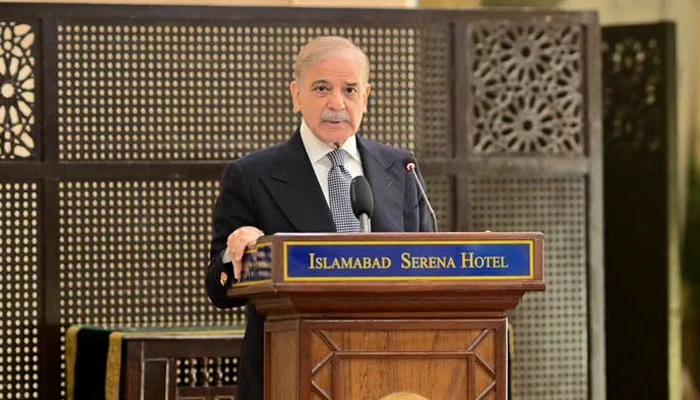
ISLAMABAD: Prime Minister Shehbaz Sharif credited the country’s economic stabilization to a productive partnership between the military and political leadership, telling American business executives in Islamabad that such cooperation had never existed in the nation’s history.
Sharif spoke on Thursday at a ceremony organized by the American Business Council of Pakistan. “I can tell you without any fear of contradiction that this and other humble achievements couldn’t have been possible without this great team and great teamwork,” he said. “When was the last time you had struck a very productive partnership between military and political hierarchy? Never in the history of Pakistan.”
He said he wished such a partnership had existed earlier, arguing that Pakistan “would have completely transformed long ago.” Sharif said he would not take credit himself and pointed instead to his team and the “other partners in this field,” a reference to Field Marshal Asim Munir, the chief of defense forces and army chief, and his staff.
The army has long held outsized influence over Pakistani politics, and its chief is widely regarded as the country’s most powerful figure, which makes the prime minister’s public acknowledgment unusually direct. A civil-military investment body created in 2023 has been a central part of the government’s push for foreign funding.
Sharif recalled that the country faced a serious threat of default in 2023 and cited statistics to show macroeconomic stability since. “Despite the Gulf crisis, which has jolted even the most powerful economies around the globe, Pakistan is still passing through a period of stability,” he said, while conceding that the situation is “very fragile” on energy.
Pakistan imports more than 90% of its energy needs, Sharif said, yet the country saw no panic or long queues at fuel stations. He pointed to the Prime Minister’s Fuel Relief Scheme. “In fact, to the contrary, we have been able to carve out a subsidy programme to shelter the most vulnerable segments of our society,” he said. “It all came through hard work, untiring efforts, and pain borne by the common man of this country.”
The war launched by the US and Israel against Iran in late February has pushed up fuel costs. Petrol was priced at 377.71 rupees a liter in late October. The relief scheme, announced in September, takes 100 rupees a liter off petrol for motorcycles, rickshaws and cars of up to 800cc. A federal minister has said about 24 million people benefit from it.
The central bank has responded to the price pressure. The State Bank of Pakistan raised its policy rate by 50 basis points to 12% on Oct. 26, its first increase since a 100-basis-point hike in April, citing energy costs linked to the Iran war. Its foreign-exchange reserves stood at $21.4 billion in September. Inflation eased to about 10.3% in September and to 9.61% in October, still above the central bank’s 5%-7% medium-term target.
Pakistan is also waiting on its International Monetary Fund program. The lender reached a staff-level agreement on Oct. 8 that would release about $1 billion under its Extended Fund Facility and about $210 million under its Resilience and Sustainability Facility, subject to Executive Board approval. The IMF estimated growth of 3.6% in the fiscal year that ended in June, with momentum fading as energy prices rose and supplies were disrupted. Gulf News reported that the fund has asked Islamabad to end fuel subsidies.
On the war, Sharif said Pakistan was “working tirelessly” to restore peace and was talking to Tehran and Washington with the support of friendly countries. “Difficult as it is, I have no doubts in my mind that we will be able to arrest this situation,” he said. “If peace is restored in the region, we are about to take off to an altitude never seen before.”
Pakistan hosted the first round of direct US-Iran talks in April, and the two sides signed an interim deal in June while accusing each other of prolonging the standoff over the Strait of Hormuz. Foreign Minister Ishaq Dar said Monday that Pakistan was awaiting a US response to Iran’s latest proposals, which he described as based on the June deal, and that Islamabad had not given up hope. Qatar is also acting as an intermediary.
Sharif told the audience he was there to listen to business leaders and to set up a mechanism for addressing their “genuine grievances.” He said the government was committed to removing bottlenecks facing investors. “Transparency is the primary requirement of such a system,” he said. “We are trying our best to be as transparent as we possible.”
The council is a local affiliate of the US Chamber of Commerce and has more than 60 American member companies. Its president, Adnan Asad, said members were satisfied with steps taken in recent years to stabilize the business environment. Sharif called the members “great ambassadors for Pakistan.”
He said the last budget included tax breaks worth 400 billion rupees even though the country is in an IMF program. The relief went to exporters, manufacturers, the corporate sector and salaried workers, he said, to act as “a stimulus to promote and strengthen our economy.”
“Of course, you cannot solve this problem of seven decades overnight,” Sharif said. He added that Pakistan has mineral deposits worth “trillions of dollars” and that work on the sector has been under way for two to three years. “We have together taken the first step; God willing, we’ll keep marching in the right direction.”
The prime minister also took aim at the auto industry, saying carmakers had received subsidies for years with little to show for it. “And yet they do not want to face competition,” he said. “This is the time for electric vehicles.” He asked whether it was in the national interest to back the industry or policies that would cut dependence on imported energy and help control climate disasters.
Sharif approved a draft five-year auto policy in September that keeps protection for existing assemblers of conventional vehicles for four more years while offering tax incentives on new-energy vehicles. A separate policy for 2025-30 aims for 30% of new vehicle sales to be electric by 2030.
Sharif said the government had taken “difficult decisions, exercised physical discipline and embarked upon a programme of structural reforms.” He said the goal now was to lock in those gains. “Our task now is to consolidate these gains and put Pakistan firmly on the path of sustained export-led growth,” he said. “It has to be export-led growth.”
Copyright © 2021 Independent Pakistan | All rights reserved