By Staff Reporter
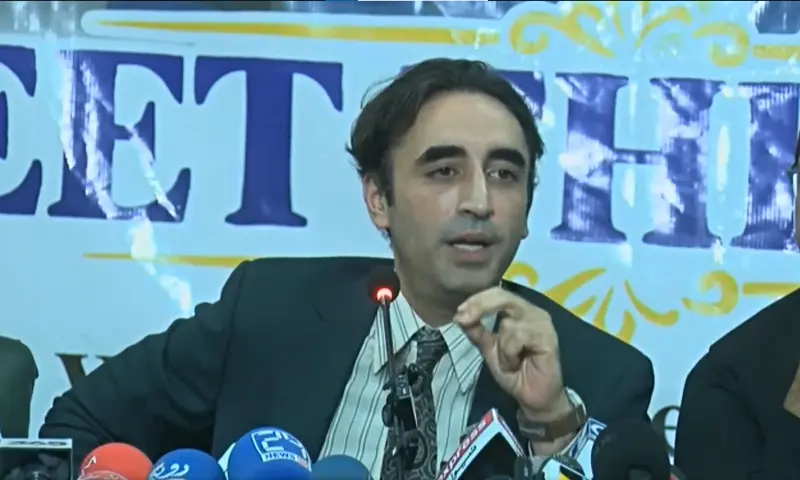
MULTAN: Bilawal Bhutto-Zardari, chairman of the Pakistan Peoples Party and a key ally of the governing coalition, has declared that the party of the jailed Imran Khan is a “political reality” and that no “reset” of Pakistan’s political system can work until its trust in that system is restored.
Speaking at the Multan Press Club on Thursday, the son of President Asif Ali Zardari said the reset now being debated in Islamabad must be democratic and political, and carried out in Parliament rather than outside it. He is touring Punjab and has already stopped in Multan, Dera Ghazi Khan and Muzaffargarh.
“Khan sahib is a convict, he is in jail, but PTI is a political reality,” Bhutto-Zardari said. “Until PTI’s trust is restored in this system […] and they are able to play their role in the Parliament, the reset that is being discussed cannot take place in that manner.”
Asked about his earlier description of Khan as a “political prisoner”, he said he had made the “controversial” remark in a polarised climate in which neither Khan’s supporters nor his detractors could be talked out of their views. It was, he said, an observation about Pakistan’s political history, in which elected prime ministers often end up in jail or reach power after imprisonment, and not a verdict on Khan himself.
“Whatever opinion you may hold about Khan sahib, even if you think he is not a political prisoner, there is no denying the fact that PTI is a political reality,” he said. Even if Khan were considered a “convicted felon or terrorist or whatever”, he added, prisoners in a respectable society were entitled to their rights. Khan had “tried to deny my family those rights”, Bhutto-Zardari said, but he had no wish to repeat the “same mistakes” out of vengeance.
The remarks continue a row that has strained relations between the PPP and its senior partner, the Pakistan Muslim League-Nawaz (PML-N). The “reset” debate began in July, when Interior Minister Mohsin Naqvi said the system of governance had “collapsed” and called for new administrative units. In a speech at the Karachi Press Club on 17 November, Bhutto-Zardari countered that the system had not collapsed but had been “made to collapse”. On Monday he called for restoring the supremacy of Parliament and public trust in the judiciary and the electoral system.
In Multan Bhutto-Zardari said the distrust ran both ways. The government, he argued, must take confidence-building measures to persuade the opposition that Parliament, the Election Commission, the courts and the accountability system could be trusted again. The government in turn distrusted the opposition.
“If we truly want this system to serve the public… then we will have to take steps as soon as possible so we can establish unity, political stability, and restore trust in all institutions,” he said. A political reset, he explained, meant bringing the ruling party, its allies and the opposition into the conversation. “If we want to make the Parliament functional, then all decisions have to be made in the Parliament alone,” he said, warning that decisions taken “outside the Parliament” would leave the system unable to meet its challenges.
Bhutto-Zardari faulted the debate in Parliament, the cabinet, seminars and television studios for ignoring the problems of ordinary people. “People are distressed about managing two square meals. They’re worried whether they should educate their children or arrange medicines for their elders,” he said. “Whether it’s a cultivator or a farmer, they are not getting the price for their crops. Labourers and hard workers are not being rewarded for their efforts.”
He described “restlessness and distress” among young people, who struggle to find work and, when they do, spend their wages on getting to and from the job. According to local media reports, he called the economic situation a “catastrophe” unlike anything he had seen in his lifetime and warned that regional tensions could make it worse.
Addressing journalists, he said he wanted to restore the “power” press clubs once held. “With your voice, your columns, you used to make and topple governments,” he said. “I don’t want to topple any government, nor do I want to form another one. But I believe your role is to hold up a mirror to those sitting in power.” Media given space only to repeat what those in power told each other would never bring the public’s hardships to the fore, he added.
Bhutto-Zardari used the occasion to revisit his party’s own record. “I am not backing away, I am not claiming that I am, you know, an angel and everyone else is dirty. I admit [we played a] role in this,” he said, insisting that the PPP never meant to weaken the press. But whatever its intentions over the Prevention of Electronic Crimes Act (Peca), he said, the country had reached a point where press freedom was “nonexistent”.
Local media reports said he also turned on the opposition, urging it to end its boycott of parliamentary committees and to join the electoral reform committee, which he called central to any reset. On the 27th Amendment, he said his earlier remarks had been taken out of context. He did not want it reversed, he said, but wanted the lawyers and judges uneasy about the new judicial set-up to be brought into discussions.
The PPP voted for the Peca amendments, which the National Assembly rushed through in January last year over protests, as PTI lawmakers and journalists walked out of the chamber.
Copyright © 2021 Independent Pakistan | All rights reserved