By Staff Reporter
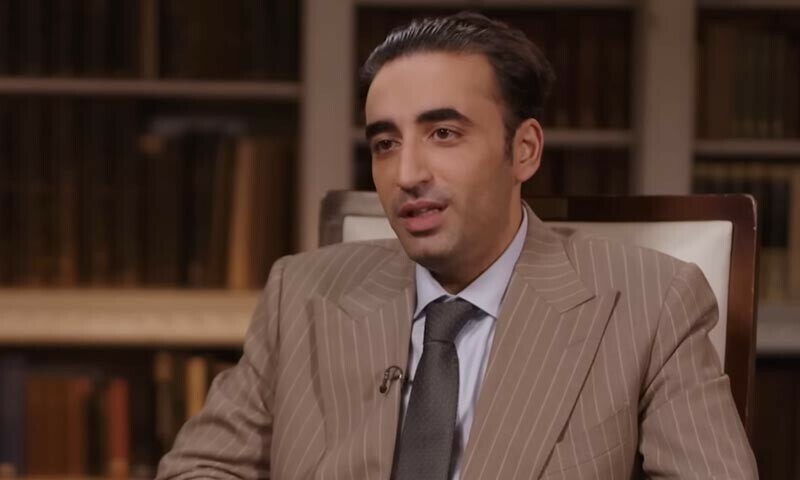
ISLAMABAD: Pakistan Peoples Party chairman Bilawal Bhutto-Zardari has called for the contentious question of creating new provinces to be settled through debate in Parliament, rather than in the public statements and forums that have inflamed tensions between his party and the Pakistan Muslim League-Nawaz-led government’s most senior security official over the past six weeks.
Speaking to reporters in London on Wednesday, where he is accompanying his father, President Asif Ali Zardari, on an overseas visit, Bilawal was pressed on repeated calls by Interior Minister Mohsin Naqvi for the creation of additional administrative units, a proposal that has provoked fury in Sindh and reopened one of Pakistan’s most sensitive constitutional debates.
Asked pointedly whose interests Naqvi was speaking for, Bilawal was careful not to dismiss the interior minister’s right to hold his own view, even as he made clear he disagreed with the venue in which that view was being aired.
“Mohsin Naqvi sahib must be speaking his own language, and I speak my language,” Bilawal told reporters. “It is his right to express his opinion.”
But the PPP chairman insisted that a matter of such constitutional weight belonged in the National Assembly, not on the sidelines of economic conferences. He noted that Naqvi was rarely seen in the chamber where the issue ought properly to be resolved.
“So instead of speaking at business forums, Mohsin Naqvi should visit Parliament,” Bilawal said, in a pointed reference to the interior minister’s original remarks at the Pakistan Economic Summit in July, when he first floated the idea of redrawing the country’s administrative map.
Bilawal went further, throwing down a direct challenge to the government. “I am ready to debate this with any representative of the federal government or a federal minister,” he said, adding that Parliament was the only forum in which the country’s long-standing governance failures could be honestly confronted.
“The real issues resulting in the system’s collapse and their solutions should be discussed in Parliament by the people’s elected representatives,” he said, arguing that the structural problems now being cited to justify new provinces were not new but had existed for years without being properly addressed by any government.
A dispute six weeks in the making
The row started on July 30, when Naqvi used an address to the Pakistan Economic Summit to call for a sweeping overhaul of the country’s governance structure, arguing that new provinces were needed to improve service delivery, strengthen the justice system and create opportunities for a young and rapidly growing population. The remarks landed as a political bombshell, not least because they were seen in Sindh as a direct threat to the province’s territorial integrity.
Sindh Chief Minister Murad Ali Shah rejected the minister’s diagnosis outright, dismissing suggestions that the governance system had “collapsed” as outdated thinking, and warning bluntly that no bloodshed would be tolerated over any attempt to redraw the province’s boundaries.
Rather than retreat, Naqvi has doubled down in the weeks since. On September 5, he declared he would continue pressing for new provinces regardless of whether he remained in government, arguing the decision should ultimately rest with the public rather than politicians. He said voters should first be presented with the “pros and cons” of new administrative units before being asked to decide.
Addressing a National Policy Dialogue on devolution at the University of Management and Technology in Lahore, Naqvi insisted his proposed “reset” was not about toppling a government or a political party, but about a fundamental restructuring of a system he argued could no longer cope with the country’s needs. He went as far as calling for Islamabad itself to be granted provincial status, noting that residents of the federal capital receive no share under the National Finance Commission award.
Sindh Assembly draws a line
The dispute reached a formal head on September 3, when the Sindh Assembly unanimously passed a resolution rejecting any move to divide the province or alter its territorial limits, describing Sindh as a “historic, civilisational and constitutional entity” and declaring that “Sindh is one and shall remain one.” Chief Minister Shah followed up with an unambiguous declaration that there would be “no compromise on Sindh’s geographical unity.”
On Tuesday, the Sindh Assembly Secretariat formally notified the principal secretaries to the president and prime minister, as well as the Senate and National Assembly, of the resolution’s passage — a procedural step underlining the seriousness with which the provincial government is treating the challenge.
President Zardari’s meeting with Naqvi in London, held during the same trip on which Bilawal made his remarks, has done little to defuse the row. Two days after the Sindh Assembly’s resolution, Naqvi used his Lahore address to restate his position rather than soften it, telling the gathering that new administrative units “will eventually have to be created” given Pakistan’s expanding population and evolving needs.
The escalation has pushed the PPP’s Sindh leadership into open confrontation with the federal coalition of which it is nominally a part. At a meeting chaired by provincial president Nisar Ahmed Khuhro, party leaders accused federal ministers of interfering in matters that are constitutionally the province’s own, and warned Prime Minister Shehbaz Sharif that continued remarks from his ministers could lead the PPP to conclude the government was engaged in a “conspiracy against Sindh’s unity, provincial autonomy and the 18th Amendment.”
Wider political fault lines
The interior minister’s proposal has scrambled traditional political alignments. The Muttahida Qaumi Movement-Pakistan, which sits inside the federal coalition but forms the opposition in Sindh, broke with the PPP in August by backing the creation of new provinces and calling for a national dialogue, citing population growth, weak governance and the concentration of political power. The party has separately renewed its long-standing demand that Karachi be carved out as a province in its own right, separate from Sindh.
The PPP, for its part, insists that administrative reform and provincial division are entirely separate questions. Sindh minister Nasir Hussain Shah said the provincial government remained open to discussing improvements to governance and greater devolution of power, but rejected any attempt to tie those discussions to the creation of a new province. Notably, while the PPP has resisted division of Sindh, it has for years supported carving a South Punjab province out of Punjab, a position shared by the opposition Pakistan Tehreek-e-Insaf.
PTI chairman Barrister Gohar Ali Khan waded into the debate on September 7, warning that dividing Sindh or any other province without the consent of its people and elected representatives would weaken the federation, and calling instead for a commission and extensive deliberation before the matter is taken to Parliament.
Government figures have offered a more cautious line than Naqvi. Defence Minister Khawaja Asif acknowledged Sindh’s right to take its own position but said any final decision would have to be built on consensus, while separately floating Islamabad as a possible starting point for administrative restructuring. Prime Minister’s adviser Rana Sanaullah said the question should be resolved at the appropriate forums through agreement among political parties, rather than through unilateral declarations.
A constitutional grey area
Naqvi’s insistence that the matter should ultimately be decided by “the people” has opened up a fresh legal debate over whether a referendum could be used to test public opinion on new provinces. Article 48(6) of the Constitution allows a matter of national importance to be referred to a referendum, but only after approval by a joint sitting of Parliament — and even then, a referendum result would not itself create a new province. Any actual change to provincial boundaries would still have to pass through the full constitutional amendment process, requiring approval from the relevant provincial assembly as well as Parliament.
Copyright © 2021 Independent Pakistan | All rights reserved