By Staff Reporter
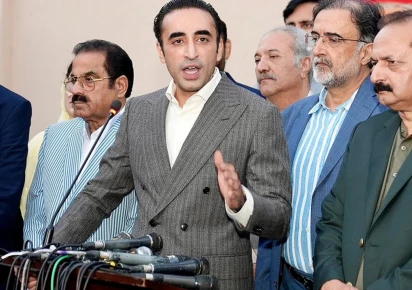
ISLAMABAD: The chairman of Pakistan’s People’s Party, Bilawal Bhutto-Zardari, said his party stood ready to form a government in Azad Jammu and Kashmir, vowing to end the political turmoil that has gripped the region and reaffirming the party’s historic commitment to the Kashmiri cause.
The statement came as the party’s representation in the 53-seat Azad Jammu and Kashmir Legislative Assembly surged to 27, bolstered by the defection of 10 lawmakers, all originally elected on tickets from Imran Khan’s Pakistan Tehreek-e-Insaf in the July 2021 elections, who joined a forward bloc aligned with the People’s Party on Sunday.
With this new majority, the party is moving swiftly to table a no-confidence motion against Prime Minister Chaudhry Anwar-ul-Haq, whose coalition government, once backed by the People’s Party and the Pakistan Muslim League-Nawaz, now teeters on the brink of collapse. “We are in a position to form a government in Kashmir, being a majority,” Bhutto-Zardari told reporters. “Whatever the issues are, PPP has a reputation for finding political solutions.”
The maneuver reflects a broader realignment in Pakistani politics, where alliances forged and frayed under Khan’s turbulent tenure are being recast amid economic woes and regional unrest. A joint no-confidence resolution, signed by lawmakers from both the People’s Party and the Muslim League-N, has already been finalised. On Thursday, after days of consultations, President Asif Ali Zardari, Bhutto-Zardari’s father, and Prime Minister Shehbaz Sharif gave their endorsement to the plan.
Officials close to the party indicated that the nominee for the premiership would likely be revealed in a day or so, following a meeting of the People’s Party’s Azad Jammu and Kashmir parliamentary board, chaired by Bhutto-Zardari himself.
For Bhutto-Zardari, 37, the scion of a dynasty that has defined Pakistani progressivism for half a century, the stakes extend far beyond parliamentary arithmetic. “PPP’s foundation was laid down in the name of the Kashmir cause,” he said, invoking the sacrifices of three generations of party leaders who have championed the issue on national and international stages. “I promise the people of Kashmir that I will not disappoint you.”
He framed the current crisis as a direct inheritance from Khan’s government, which he accused of rigging the 2021 elections with the complicity of the powerful military establishment. “We all know what the conditions were in the last elections — it was Khan sahib’s government, and we know the role the establishment had at the time,” Bhutto-Zardari said. “PPP won the election, but overnight their victory was taken away; the same script was applied in Kashmir and Gilgit-Baltistan as well.”
That alleged subversion, he argued, had fostered a “non-political behaviour and mindset” that created a dangerous vacuum. “As a result of which, the people are being harmed,” he said, warning that the instability could “pose a threat” to the Kashmiri cause on the world stage. Only the People’s Party, he insisted, was equipped to represent the region’s interests both at home and abroad: “PPP remained committed to resolving the political turmoil in Azad Jammu and Kashmir, reflecting on the party’s ‘reputation for finding solutions.’”
The coming months until fresh elections, he acknowledged, would serve as a “test” for the party, a proving ground to deliver on its pledges and restore faith in democratic processes. The push gained public momentum earlier this week. On Monday, Qamar Zaman Kaira, a senior People’s Party leader, flanked by Planning Minister Ahsan Iqbal and Rana Sanaullah, an adviser to Sharif on political affairs, laid out the rationale at a news conference. “It has been decided that the current AJK government, which we both parties were part of, has become a basis of creating a crisis instead of solving problems,” Kaira said. “Now there is a consensus of opinion that a no-confidence motion will be brought against it, on which the PPP and PML-N will be together.”
Anwar-ul-Haq, 68, a veteran politician whose tenure has been marred by protests over electricity tariffs, wheat prices and administrative lapses, initially appeared poised to resign. But sources close to him said he had resolved to fight on. “Though the option of resigning before a vote on no-confidence will be open,” one associate noted, “PM Haq was ready to face the vote.”
Azad Jammu and Kashmir, a picturesque Himalayan territory of some four million people that Pakistan administers as a semi-autonomous region, remains a flashpoint in the decades-old dispute with India over the broader Kashmir. New Delhi controls the more populous southern half, and both nuclear-armed neighbours claim the entire territory. Political instability here has long reverberated in Islamabad, where leaders fear it could embolden separatist sentiments or invite Indian propaganda.
Copyright © 2021 Independent Pakistan | All rights reserved