By Staff Reporter
ISLAMABAD: Catastrophic flash flooding unleashed by heavy monsoon rains and cloudbursts has killed at least 240 people and left communities shattered in Pakistan’s northern regions, officials said on Saturday, as authorities scramble to rescue stranded residents and brace for more intermittent downpours until August 21.
With dozens injured and entire villages wiped out, rescue teams are racing against time to reach isolated areas amid fears that the death toll will climb further. The calamity, part of a broader wave of havoc wreaked by monsoon rains since late June, has triggered deadly floods, landslides, and displacement across the country, hitting hardest in vulnerable, poorly drained, or densely populated areas of Khyber Pakhtunkhwa (KP) and the northern territories.
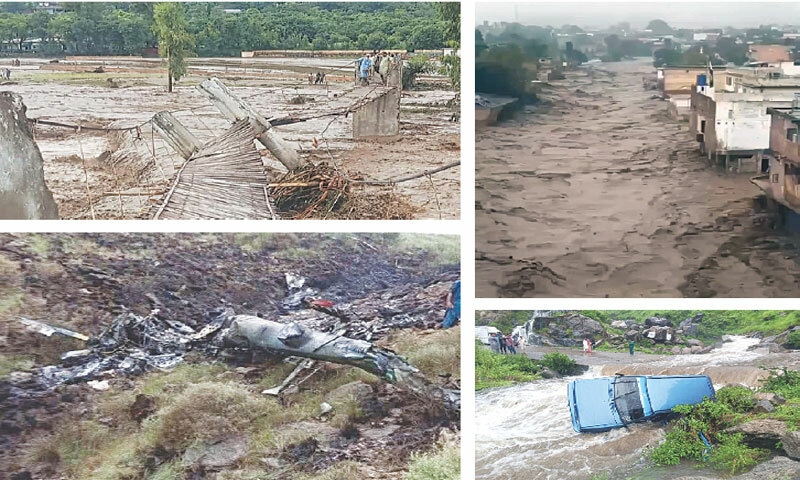
KP bore the brunt of the devastation, with at least 213 deaths reported in Buner district alone, according to rescue officials. Several others remain missing in Buner, a figure officials said would only become clear once floodwaters recede. Across the province, over 200 lives were lost, while 12 perished in Gilgit-Baltistan (GB) and 19 in Azad Jammu and Kashmir (AJK).
“Helicopters are being used to carry out rescue operations in remote and inaccessible regions. Floodwaters had completely submerged Pir Baba Bazaar and the adjoining neighbourhood,” Buner Deputy Commissioner Kashif Qayum Khan described the scene.
The floods swept away homes, vehicles, and livelihoods, while damaged mobile phone towers severed communications, leaving affected regions cut off from aid and information.
An emergency has been declared across the district, with relief efforts ongoing. The destruction in KP extended far beyond Buner. Bajaur, in the same Malakand Division, saw 21 killed, including eight children, and eight injured in flash floods. Lightning strikes claimed the lives of 15 men in Battagram, while Mansehra reported 14 deaths and two injuries due to floods. In Swat, flash floods and thunder strikes took 11 lives, with 49 homes destroyed there alone. A roof collapse in Lower Dir left five men dead and three wounded, and a similar incident in Shangla killed two men and injured as many.
“All departments and institutions are engaged in rescue operations, which are being monitored from a control room set up at CM House in Peshawar,” KP Chief Minister Ali Amin Gandapur, in a video statement, said. “The province, especially in the Malakand and Hazara regions, has been hit by terrible floods due to cloudbursts and rain… As a result, many lives have been lost due to various accidents.”
In a tragic blow to relief efforts, a KP government helicopter carrying supplies to Bajaur’s Salarzai area crashed in bad weather over Mohmand district, killing all five on board. “Two helicopters of the provincial government were working to rescue people, but one of these helicopters met with a tragic accident due to bad weather. Five crew members were martyred,” Gandapur said. The helicopter, an MI-17 dispatched with supplies to Bajaur, lost contact before being confirmed crashed, killing two pilots and three crew. “The provincial government has called for a day of mourning tomorrow, and flags will be flown at half-mast. Rescue teams have been dispatched to the crash site, and the martyrs will be buried with full honours.”
Despite the loss, another provincial MI-17 helicopter reached Buner to evacuate people to safe areas. Gandapur said district administrations and all provincial departments are actively engaged, “ensuring all measures to protect the lives and property of the people.” “The administration of the affected districts, as well as others, has also been put on high alert, and safety measures are being taken,” he added. “Heavy machinery has been deployed in the affected areas for rescue operations and to clear blocked roads.” Provincial lawmakers are on the ground, coordinating with local officials.
The KP Health Department has declared a health emergency in Buner, Swat, Mansehra, Abbottabad, Bajaur, and Mohmand, along with establishing flood control rooms and disease data-sharing centres in hospitals across the province. The move aims “to prevent [the] outbreak of communicable diseases and effectively monitor risks to the health of the affected population,” the notification stated, putting all healthcare staff on high alert and cancelling their leaves to ensure adequate staffing for victims. A second notification to all KP hospitals ordered flood control rooms “in order to ensure the availability of medicines and the functioning of medical equipment.” “In light of the anticipated rise in fatalities and injuries, as well as the increasing cases of both communicable and non-communicable diseases, you are requested to nominate a focal person from your district who will be responsible for providing daily updates to the health directorate.”
Muhammad Sohail, media coordinator for Rescue 1122, said more than 157 bodies have been recovered so far, while over 100 people, including women and children, have been rescued and moved to safe locations. “The situation is at its worst and rescue operations are continuing in the affected areas, as authorities work to reach stranded residents and provide relief,” he said.
KP Governor Faisal Karim Kundi affirmed the need for an emergency declaration when asked, though an official notification is yet to be issued. Prime Minister Shehbaz Sharif responded swiftly, directing the NDMA to launch comprehensive relief operations in KP and AJK, prioritizing the urgent delivery of tents, medicines, and food supplies. In an emergency meeting in Islamabad, NDMA Chairman Lieutenant General Inam Haider Malik briefed Sharif on the scale of destruction and ongoing efforts.
Sharif ordered relief goods dispatched by truck on a priority basis and stressed close coordination with KP’s government to mobilise all resources. He also called for stranded individuals and tourists to be relocated to safe areas immediately. In phone calls with KP Governor Kundi and Chief Minister Gandapur, Sharif expressed profound sorrow over the loss of lives. “In this hour of hardship, our heartfelt sympathies are with the affected people,” he said, assuring that the federal government is dispatching essential supplies and will fully support the provincial administration.
The Pakistan Army is spearheading relief efforts in Swat and Bajaur, relocating residents to safety and airlifting people in Bajaur via helicopter. Food and medical supplies are also being delivered by air to cut-off areas.
In Gilgit-Baltistan, flash floods ravaged crops, orchards, homes, bridges, and water channels, particularly in Ghizer’s Yasin Thoi, where houses, schools, water tanks, and farmland were damaged. A landslide on the Baltistan Highway killed a man from Lahore traveling from Skardu to Gilgit, raising GB’s death toll to 12, according to the government spokesperson.
Landslides disrupted the Baltistan and Sadpara roads, while Thor in Diamer and Astore valley reported severe damage to agricultural land and roads. The Karakoram Highway remains blocked, severing links between Gilgit and Rawalpindi, though it and Babusar Road are restored within GB. Rescue and relief operations continue despite challenging weather, with low-lying areas evacuated as rain is expected to persist. Several valleys in Diamer and Skardu are cut off after the Sadpara Dam’s water channel was destroyed, shutting down power stations. “This is a testing time for Gilgit-Baltistan. The government is mobilising all available resources to assist the affected communities.” GB spokesperson Faizullah Faraq said.
In Azad Jammu and Kashmir’s Neelum Valley, floodwaters destroyed six suspension bridges, while a cloudburst in Muzaffarabad claimed eight lives, including six from one family. Landslides have blocked sections of the Kohala and Neelum highways, stranding tourists at Ratti Gali base camp after roads were washed away. The AJK government closed schools on August 15 and 16 due to ongoing rains and landslide risks.
Pakistan’s monsoon season, which brings about three-quarters of South Asia’s annual rainfall, is critical for agriculture but often deadly. Landslides and flash floods are common from June to late September. Syed Muhammad Tayyab Shah, an NDMA representative, said this year’s monsoon started earlier and is expected to last longer. “The next 15 days… the intensity of the monsoon will further exacerbate,” he warned. Climate change is intensifying extreme weather worldwide, with Pakistan among the most vulnerable nations. This summer’s “unusual” rains have already claimed over 500 lives, including 159 children. In July, Punjab saw 73% more rainfall than the previous year, with more deaths than the entire prior monsoon.
Pakistan, contributing less than one percent of global greenhouse gas emissions, is highly vulnerable to climate change. Floods in 2022 killed over 1,700 and caused $30 billion in damages. Scientists say rising temperatures are intensifying South Asia’s monsoon, increasing risks of flash floods and landslides in mountainous regions like KP and Gilgit-Baltistan.
Copyright © 2021 Independent Pakistan | All rights reserved