By Staff Reporter
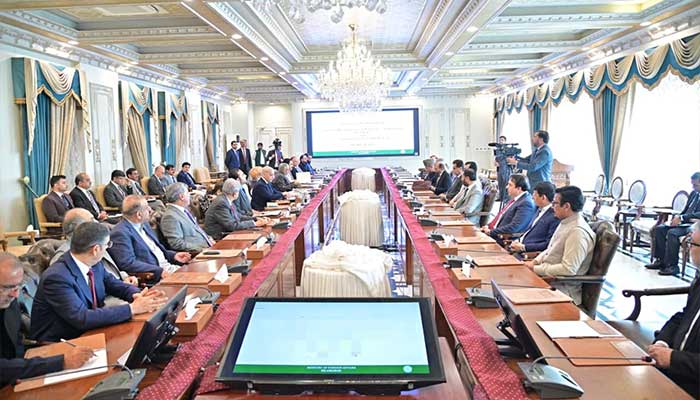
ISLAMABAD: Prime Minister Shehbaz Sharif convened an in-camera briefing for parliamentary party leaders on Wednesday to address the rapidly deteriorating security situation across Pakistan’s western frontiers and the wider Middle East, where US and Israeli attacks have killed Iran’s supreme leader Ayatollah Ali Khamenei and triggered wider instability.
The closed-door session at the prime minister’s office came as Pakistani forces press ahead with Operation Ghazab lil-Haq, a military campaign launched on 27 February against Afghan Taliban elements and associated militants accused of orchestrating cross-border attacks. At the same time, Islamabad is closely monitoring the fallout from the strikes on Iran, which Pakistani officials have condemned, and the subsequent attacks across the Gulf region.
A statement from the prime minister’s office said participants were briefed on the Pakistan-Afghanistan situation, developments concerning Iran, the conflict in the Middle East and the Gulf, and Pakistan’s diplomatic engagements. Sharif, who chaired the meeting, informed those present about his recent contacts with Middle Eastern leaders and the country’s efforts to promote de-escalation. “Participants emphasised the need for national unity, consensus and cohesion in the current circumstances,” the statement said.
Parliamentary leaders from the ruling coalition and several opposition parties expressed appreciation for Pakistan’s diplomatic push for regional peace and urged that those efforts be intensified. They also offered suggestions on the way forward and reaffirmed a collective resolve to eliminate terrorism from Pakistani soil.
The gathering was attended by deputy prime minister and foreign minister Ishaq Dar, National Assembly speaker Ayaz Sadiq, deputy speaker Ghulam Mustafa Shah, Pakistan Peoples Party chairman Bilawal Bhutto Zardari, Jamiat Ulema-e-Islam-Fazl chief Maulana Fazlur Rehman, and federal ministers including Ahsan Iqbal, Azam Nazeer Tarar and Attaullah Tarar. Representatives of other parliamentary groups, including the Muttahida Qaumi Movement, were also present. Notably absent were leaders from the main opposition Pakistan Tehreek-e-Insaf (PTI), which boycotted the session.
In the National Assembly later on Wednesday, minister for parliamentary affairs Tariq Fazal Chaudhry expressed regret at the decision and called on the opposition to set aside political differences on matters of national interest. “This was a matter of Pakistan’s security and of evolving a rational policy to move forward while safeguarding the country’s interests under the prevailing circumstances,” Chaudhry told the house. He noted that Dar and foreign secretary Amna Baloch had provided a detailed briefing, and said input from attending leaders – including Bhutto Zardari and Maulana Rehman – would be incorporated into future policy.
Chaudhry reiterated Pakistan’s position as a peace-loving nation that seeks neither to enter the conflict nor to take sides. “We neither want to jump into the war nor will we take sides,” he said. “Our efforts are directed at bringing the conflict to an end and de-escalating heightened tension in the region.” He added that Pakistan had strongly condemned the US-Israeli strikes on Iran, a “brotherly country”, and the assassination of Ayatollah Khamenei, while expressing concern over subsequent attacks on Gulf states.
The briefing also covered the security situation along the Afghan border, where Islamabad accuses the Taliban authorities in Kabul of harbouring militants, including the Tehreek-e-Taliban Pakistan (TTP), who have carried out attacks inside Pakistan. Chaudhry said foreign minister Dar had visited Afghanistan three times since the Taliban’s return to power, without success, and that talks in Doha had included an offer of Rs10bn to help resettle TTP fighters away from the border – an offer that was refused.
Since 2022, more than 8,000 Pakistani civilians, security personnel and law enforcement officers have been killed in terrorist incidents linked to Afghan soil. Operation Ghazab lil-Haq – whose name translates roughly as “wrath for justice” – was launched in response to what officials described as unprovoked cross-border aggression and will continue until infiltration is halted and Pakistan’s border is secured.
Law minister Azam Nazeer Tarar told reporters that a proposal had been floated during the briefing to convene a joint sitting of parliament so that all lawmakers, including those who missed Wednesday’s session, could be briefed jointly by Sharif and Dar on Afghanistan and the Middle East.
In the National Assembly, several lawmakers offered their own views. MQM parliamentary leader Dr Farooq Sattar suggested that Sharif and army chief Field Marshal Syed Asim Munir should engage directly with US leadership, while cautioning that a “well-planned conspiracy” appeared to be dragging Muslim countries into conflict. JUI-F’s Naeema Kishwar urged the government to pursue a wise and peaceful approach.
The session underscored the domestic political pressures facing Sharif’s coalition government as it attempts to navigate two simultaneous crises. On one side lies the risk of wider regional war following the killing of Iran’s supreme leader; on the other, a grinding military campaign against militants operating from Afghan territory that threatens to further strain an already fragile economy. Pakistan has long positioned itself as a responsible actor seeking de-escalation. Officials insist that while the country will defend its borders robustly, its overriding goal remains peace – both in the Gulf and along the Durand Line.
Copyright © 2021 Independent Pakistan | All rights reserved