By Staff Reporter
LAHORE: The powerful Sharif family convened a private meeting on Sunday to strategise over the escalating political tensions with the opposition Pakistan Tehreek-i-Insaf party and potential shifts in the Punjab government, as leaders across the political spectrum rallied to support the armed forces against what they described as a concerted effort to undermine state institutions.
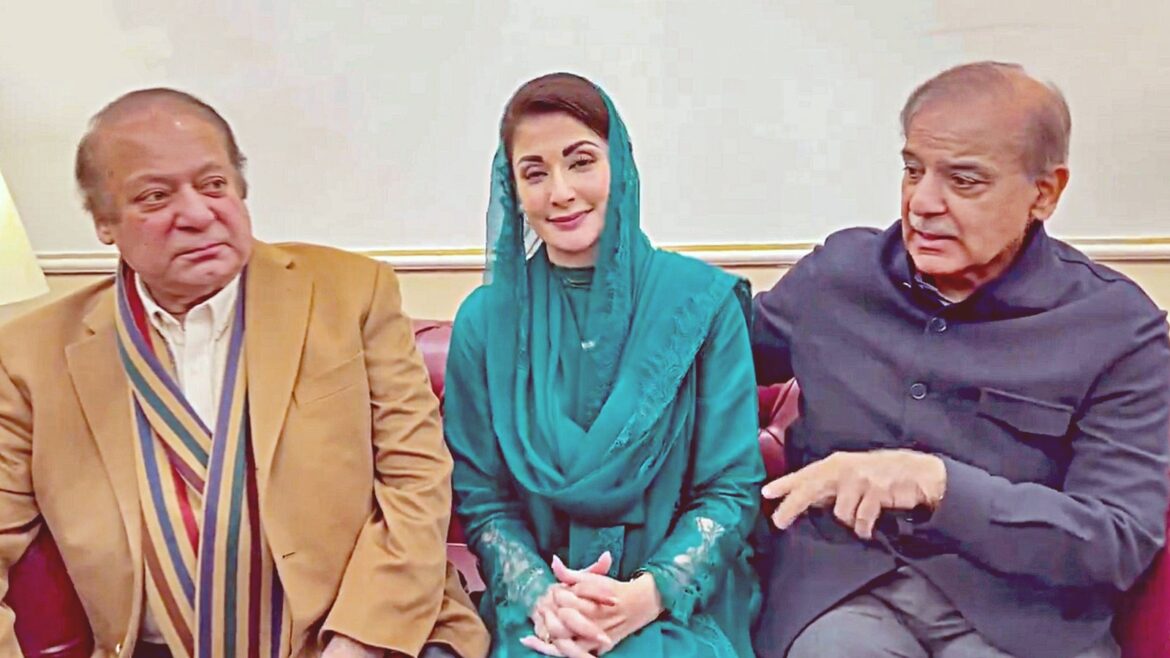
The gathering at the family’s Jati Umra residence, which lasted more than two hours, brought together Prime Minister Shehbaz Sharif, Punjab Chief Minister Maryam Nawaz and Pakistan Muslim League-Nawaz President Nawaz Sharif, according to sources close to the ruling family, as reported by the Dawn newspaper on Monday. The discussion focused on the current political landscape, particularly the future trajectory of the PTI and its jailed founder, Imran Khan.
Participants reviewed the PTI’s potential strategies in the coming days and explored how the federal and Punjab governments could mount an effective response. The conversation delved into Khan’s influence within his party, weighing whether PTI leaders would continue to heed guidance from the incarcerated former prime minister or begin to distance themselves amid the military establishment’s sharpest rebuke yet against him.
The Sharifs also examined the establishment’s views on various political and economic initiatives pursued by the PML-N governments. Maryam Nawaz briefed her father and uncle on a recent performance audit of the Punjab cabinet, pointing out key deficiencies identified in the review. She expressed her intent to reshuffle the cabinet and bring in new ministers to enhance the government’s performance, the newspaper reported.
The meeting unfolded against a backdrop of intensifying criticism from coalition partners and other political figures, who on Sunday accused the PTI of orchestrating a campaign to discredit the military and foster instability. This followed a PTI statement on Saturday denouncing a military press briefing as “inappropriate and unfortunate.” In that briefing, the military’s spokesperson Lt. Gen. Ahmed Sharif Chaudhry, had labelled Khan a “narcissist” and a “mentally ill person” whose anti-army rhetoric was veering into “security threat” territory.
Ahsan Iqbal, a PML-N leader and the planning minister, took to the social media platform X to condemn Khan’s rhetoric as “a deeply irresponsible and dangerous trend that seeks to undermine Pakistan’s state institutions, weaken national cohesion, and erode public trust in the armed forces who defend our borders with courage and sacrifice.” “Political differences are part of any democracy — but when politics crosses the line into anti-state narrative building, deliberate misinformation, and attacks on the integrity of Pakistan’s Armed Forces and its leadership, it threatens the stability, security, and unity of the country,” Iqbal wrote. He added that no leader had the right to “weaponise divisive rhetoric for personal gain at the cost of Pakistan’s national security.”
Khalid Maqbool Siddiqui, convener of the Muttahida Qaumi Movement-Pakistan, drew parallels to his own party’s past during a press conference in Karachi, flanked by senior leaders including Mustafa Kamal, Farooq Sattar, Anis Qaimkhani and Aminul Haque. He urged the PTI to prioritise the state over its founder, recalling how the MQM-P had once severed ties with its own leader for the nation’s sake. “We never claimed that our leader was bigger than Pakistan. We detached ourselves from him for the sake of the state. If PTI believes its leader is greater than the country, then it must make a choice,” Siddiqui said. He warned that Pakistan was at “one of the most critical crossroads in its history” and could not tolerate prolonged instability, citing ongoing political turbulence and evident foreign interference.
Siddiqui said Pakistan had already “defeated India decisively this year” and would now defeat “its proxies as well.” Kamal, the federal health minister and a senior MQM-P deputy convener, accused the PTI and its leadership of “actively maligning Pakistan’s military and its commanders internationally.” “These attitudes are shameful,” he said. “Thank them that the army is only holding press conferences to expose your actions. Karachi’s missing persons’ families knocked on every door in search of justice. You are still fortunate that dialogue is ongoing.”
Sarfraz Bugti, the Balochistan chief minister and a leader of the Pakistan Peoples Party, echoed these sentiments at a press conference in Islamabad, charging Khan with “spreading propaganda against the army and maligning them in line with the agenda of hostile agencies.” With two provinces grappling with serious insurgencies, he said, “the nation needed to stand with its security forces more than ever before.” “In this situation, the nation has to choose, and the nation has chosen to stand with its forces,” Bugti asserted, emphasising the need to “abandon the narrative which was weakening the state.”
Defence Minister Khawaja Asif, of the PML-N, posted on X that it was “justified to call any individual ‘delusional’ or ‘mentally ill’ if they target the state in pursuit of political interests.” “Behind the response given in the DG ISPR’s press conference lies the incessant hate-mongering rhetoric of that person and his followers, for which there is no parallel in Pakistan’s history,” Asif wrote. He condemned the PTI’s efforts to “create divisions between the armed forces and their leadership” and asserted that “no effort contrary to the country’s dignity, sovereignty, and national security” would be tolerated. “The criminal sitting in Adiala cannot be permitted under any circumstances to toy with the country’s stability.”
In Rawalpindi, Railways Minister Hanif Abbasi lambasted Khan at another press conference, claiming that earlier allegations of the PTI receiving funding from India and Israel had been validated. “I had said that the PTI was receiving Indian and Israeli money. This was proven. I took the foreign funding case to the Supreme Court,” he said. “Had the decision been made then and had he (Imran Khan) been disqualified, then there would not be anarchy or terrorism.”
The PTI responded in a statement to Abbasi’s remarks, asserting that “it would be difficult for individuals like Abbasi to understand that Imran always stood firm for his country, its institutions, and the people of Pakistan at every forum.”
The exchanges highlight deepening rifts in Pakistan’s fractious political arena, where Khan’s imprisonment since last year has not diminished his party’s confrontational stance against the military and the ruling coalition.
Copyright © 2021 Independent Pakistan | All rights reserved