By Staff Reporter
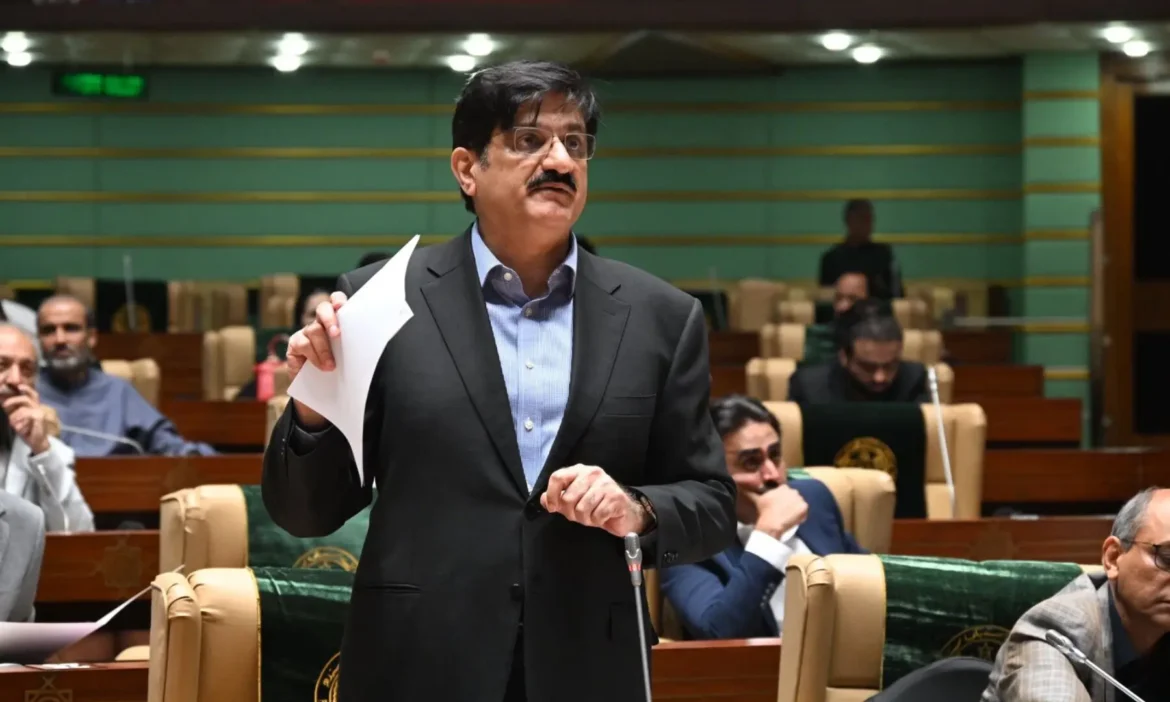
KARACHI: The provincial assembly in Sindh on Saturday overwhelmingly approved a resolution declaring Karachi an “inseparable part” of the province, a pointed rebuke to opposition demands that the sprawling metropolis be placed under direct federal oversight.
The measure, introduced by Chief Minister Syed Murad Ali Shah and backed by a majority vote, condemned “any conspiracy aimed at the division of Sindh or the creation of a separate province comprising Karachi.” It asserted that “Karachi is, and shall forever remain, an integral and inseparable part of Sindh,” urging political leaders to steer clear of rhetoric that could erode provincial harmony or national unity.
The vote deepened a rift between Shah’s ruling Pakistan Peoples Party (PPP) and the Muttahida Qaumi Movement-Pakistan (MQM-P), which has repeatedly pressed the central government to intervene in Karachi’s governance, including proposals to designate it a “federal territory.” MQM-P lawmakers voted against the resolution, arguing during floor speeches that it ran afoul of Pakistan’s Constitution.
The showdown follows weeks of acrimony between the two parties, ignited by a deadly fire at the Gul Plaza shopping center that killed several people and exposed longstanding grievances over urban management. MQM-P leaders, including Federal Health Minister Mustafa Kamal, have accused the provincial government of chronic neglect in Karachi, a city of more than 23 million that serves as Pakistan’s economic hub but grapples with crumbling infrastructure, water shortages and crime.
In a sharp exchange on the assembly floor, Shah dismissed the MQM-P’s constitutional objections, daring critics to pinpoint any unlawful provision in the text. He recalled a similar resolution passed unanimously in 2019 — with MQM-P support at the time — that also opposed carving up Sindh. “The members of MQM cannot play on both sides of the fence,” Shah said. The chief minister also brushed off complaints about indirect references to the provincial governor, clarifying that the resolution itself named no one. “If a member takes the governor’s name, you may expunge it from the proceedings; it has nothing to do with the resolution,” he told lawmakers, though he acknowledged a related meeting had occurred at the Governor’s House.
Shah’s address struck a defiant tone, invoking historical precedents and national slogans to frame the debate as a defence of Pakistan’s federal structure. He condemned statements floating the idea of a separate province for Karachi, calling them the work of “enemies” seeking to fracture the country. “Whoever believes in Pakistan will support this resolution,” he said, echoing the PPP’s longstanding mantra of “Pakistan Khappay” — a Sindhi phrase meaning “Pakistan is needed” popularised by the President Asif Ali Zardari.
The resolution itself delved into Sindh’s storied past, noting that the province was the first to endorse the creation of Pakistan in a 1947 assembly vote and has long championed federalism and democracy. It cited Article 239 of the 1973 Constitution, which requires a two-thirds majority in the relevant provincial assembly for any boundary changes, underscoring that no such alterations could proceed without broad consent. “Sindh has collectively contributed to building Karachi into the economic engine of Pakistan,” the text stated, tracing the city’s roots to its ancient name, Kolachi, and its growth as a port nurtured by the province’s people from coastal Ketibundar to the northern hills of Karoonjhar.
It warned that detaching Karachi would betray historical bonds, democratic principles and the “federal compact,” potentially unraveling national cohesion. The document evoked Sindh’s resistance to the 1955 One Unit scheme — a centralized administrative overhaul under military rule that erased provincial identities — and celebrated its restoration in 1970 as proof of the people’s resolve. It portrayed Sindh as one of the world’s oldest civilizations, its language and culture enduring through centuries of upheaval.
Support for the resolution crossed party lines, with Jamaat-i-Islami lawmaker Muhammad Farooq and Pakistan Tehreek-e-Insaf members Shabbir Qureshi and Sajjad Soomro voting in favor. Shah, wrapping up his remarks, declared that “even the thought, dream or idea of breaking Sindh will never succeed.”
The vote comes at a time of heightened political maneuvering in Pakistan, where provincial autonomy often clashes with federal ambitions, especially in resource-rich urban centers like Karachi. Analysts say the resolution could further strain relations between the PPP-led Sindh government and the MQM-P, a key ally in the national coalition, as both sides jockey for influence in the city.
Shah’s administration has faced criticism for uneven development, with Karachi’s residents — a diverse mix of ethnic groups including Muhajirs, Sindhis and Pashtuns — often caught in the crossfire of partisan blame games. Yet the chief minister insisted the measure was not aimed at any specific party but served as a bulwark against division. “The unity, territorial integrity, and historic identity of Sindh are sacred trusts inherited from our forefathers,” the resolution affirmed, pledging to defend them through “constitutional, democratic, and political means.”
Copyright © 2021 Independent Pakistan | All rights reserved