By Staff Reporter
KARACHI: The southern Sindh province braced for a potential “super flood” on Tuesday as surging waters from the swollen Indus River threatened to inundate towns, farmland and infrastructure, compounding a monsoon crisis that has already claimed 60 lives and displaced millions in the neighboring agricultural heartland of Punjab.
Authorities in Sindh ramped up emergency preparations as floodwaters from Punjab’s eastern rivers — the Chenab, Ravi and Sutlej — merged into the Indus, Pakistan’s longest river, after weeks of heavy rains and releases from dams in India. Indian officials routinely release water to manage reservoir levels during intense monsoon periods, but the downstream flows have overwhelmed Pakistan’s flood defences, prompting warnings of severe urban flooding in major Sindh cities through Sept. 10.
Sindh Irrigation Minister Jam Khan Shoro, after inspecting flood defenses on Monday, said the province had “made preparations for a super flood” and was reinforcing weak embankments. He described the Kashmore-Kandhkot embankment, near the Punjab border in northern Sindh, as “strong” and not at risk.
“The water will reach Guddu Barrage by tomorrow,” Shoro said, noting that some flows had already been diverted to the sea.
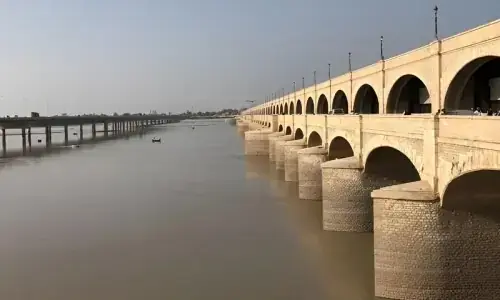
The Sindh government released updated data on water flows at key barrages as part of its monitoring efforts. According to the Provincial Rain and Flood Emergency Monitoring Cell, inflow and outflow at Trimmu stood at 339,292 cusecs, while at Panjnad both were recorded at 396,836 cusecs. Guddu Barrage saw an inflow of 443,494 cusecs against an outflow of 434,294 cusecs, Sukkur Barrage registered 385,299 cusecs inflow and 371,859 cusecs outflow, and Kotri Barrage recorded 252,145 cusecs inflow and 251,745 cusecs outflow.
Pakistan Peoples Party chairman Bilawal Bhutto Zardari visited Guddu Barrage on Tuesday to review flood preparations. Chief Minister Murad Ali Shah and Shoro briefed him on the situation, including vulnerabilities along the Indus dykes. Shoro highlighted how the Qadirpur Gas Field, built inside the riverbed, has narrowed the channel between the Tori embankment in Kandhkot and Ghotki district to four miles. “In this pocket Indus River faces clogging,” he said.
The Provincial Disaster Management Authority issued separate warnings of flash floods in central Sindh districts like Dadu, Jamshoro and Kambar Shahdadkot, attributing exceptionally high flows in the Sutlej River at Ganda Singh Wala, near the Indian border, to upstream reservoir releases.
Since Aug. 28, floods have displaced 143,789 people in Sindh, according to the monitoring cell. The province has established 528 relief camps and 159 medical camps, treating about 50,394 patients. Additionally, 111 livestock camps have been set up, with 1,526 animals evacuated in the past 12 hours. Overall, since late August, Sindh has evacuated 390,466 livestock and treated or vaccinated 985,557 animals, including 10,732 in the last 24 hours.
Nationwide, the death toll from rains and floods since the monsoon began on June 26 has climbed to 922, the National Disaster Management Authority reported.
Punjab, Pakistan’s most populous province and breadbasket, has suffered the heaviest blow from the late-August rains. Relief Commissioner Nabeel Javed said in a Tuesday statement that flooding in the Ravi, Sutlej and Chenab rivers had affected 4.2 million people across more than 4,300 villages.
“A total of 2.163 million people have been shifted to safer places,” he said, adding that 417 relief camps, 498 medical camps and 431 veterinary camps were operating in the affected districts. Around 1.579 million animals had been evacuated.
Copyright © 2021 Independent Pakistan | All rights reserved