By Staff Reporter
ISLAMABAD: Pakistan’s flood crisis shifted downstream into Sindh province on Monday, with officials warning that more than 1.6 million people could be affected this week as surging waters from the Indus River and its tributaries threaten southern towns and farmland before draining into the Arabian Sea.
The deluge, fueled by weeks of heavy monsoon rains and controlled releases from dams in neighboring India, has already devastated Punjab, the country’s agricultural powerhouse, killing 60 people there, displacing millions and destroying vast swaths of cropland. Now, as the floodwaters converge on the Indus basin, Sindh authorities are bracing for a potential super flood, with preparations underway to evacuate vulnerable populations and divert excess water seaward.
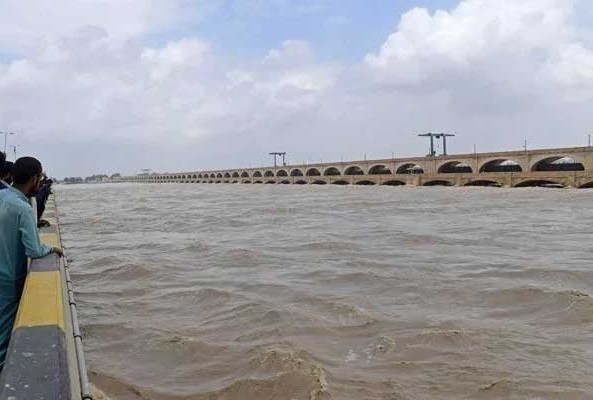
Sindh Irrigation Minister Jam Khan Shoro told journalists that a flow of 800,000 cusecs of water was moving toward Guddu Barrage from Chachran, but he assured that all preparations to deal with a possible super flood had been completed. Around 200,000 people in the katcha areas could be affected, he said, while 70 relief camps and 40 boats had been arranged for the operation. He added that 30 schools and one health centre between Guddu and Sukkur had already been impacted.
In Sindh, emergency announcements urge residents in riverine “katcha” areas to evacuate, with provincial ministers overseeing operations on both banks of the Indus. Over 300,000 people already displaced in the province and another 100,000 evacuated in early September.
Shoro emphasized that the first priority was to shift women and children to safe locations, while water released from Sukkur Barrage was being diverted toward Kotri and onward to the sea. “InshaAllah, the flood surge will safely pass into the sea.”
The minister clarified there was no option of breaching embankments in Sindh, adding that canal flows had not been stopped, and standard operating procedures were being followed to open gates when water levels rose.
“The protection of people’s lives and property is the Sindh government’s top priority, and the provincial government stands with the people at all times,” Sindh information minister Sharjeel Inam Memon said in a statement.
He said 133,887 people and 380,363 animals had already been shifted to safe locations, while the most dangerous flood situation was at Panjnad, where the Chenab and Sutlej rivers meet, and at Trimmu, a key headworks on the Chenab in central Punjab.
Officials reported on Monday that the crisis, which has claimed over 900 lives since June, has inflicted an estimated $1.4 billion in economic damage, equivalent to 0.33% of the country’s GDP, with agriculture bearing the brunt as rice crops in Punjab face up to 12% losses.
In Punjab, which has shouldered the bulk of the disaster since late August, officials reported widespread destruction. Speaking to reporters on Monday, Punjab’s information minister Azma Bokhari said the province had shifted 2.147 million people and 1.55 million animals to safer places, with more than 4.2 million people in total affected since the latest spell of monsoon rains and flooding began in late August.
“Overall, 4,335 areas have been affected [by floods] and from this, you can estimate its severity,” she said. The province’s farmland had been hit hard, with about 1.84 million acres under cultivation destroyed, including rice, sugarcane, cotton and vegetables.
PPP Chairman Bilawal Bhutto-Zardari has called on the government to declare an agricultural emergency in the wake of devastating floods in the country.
Addressing flood victims in Muzaffargarh, Bhutto-Zardari noted that farmers have been the hardest hit during floods and urged the government to support them and utilise all available resources to “make up for the damages sustained during floods”. “Declaring an emergency at this time would save the country from significant economic damage”.
He also called on the government to waive the electricity bills of the flood victims.
Bhutto-Zardari has appealed to Prime Minister Shehbaz Sharif to rebuild houses destroyed or damaged due to floods in south Punjab. “The immediate help we’re asking for on an emergency basis right now from the federal government, and I’ve talked to the prime minister himself, we request the premier to immediately provide financial aid to those areas which have been affected by the floods through the Benazir Income Support Programme.”
Meanwhile, rescue operations continued in Multan, a major city in southern Punjab near the confluence of the Chenab and Sutlej rivers, which lies directly in the path of floodwaters heading toward Sindh. In Multan alone, more than 10,800 people have been rescued so far, including 2,343 in the past 24 hours, while the district administration has already carried out advance evacuation of 350,000 people and 300,000 animals, according to Rescue Punjab spokesperson Farooq Ahmed.
Officials said residents of Muzaffargarh, a district squeezed between the Indus and Chenab rivers, and Alipur Jatoi, a tehsil of Muzaffargarh lying on the Indus floodplain, had also been urged to evacuate from high-risk riverbank communities before the surge moves downstream. The water levels remained extremely high in the province’s three eastern rivers — the Chenab, Ravi and Sutlej — though flows at some key points were beginning to ease.
On the Chenab River, levels were steady at more than 530,000 cusecs at Trimmu Headworks, a major control structure in central Punjab where the river’s surge is being monitored closely. Flows at Qadirabad and Khanki headworks upstream had started to fall, indicating that the flood peak may already have passed in those areas, though water at Head Muhammad Wala near Multan was still rising.
On the Ravi River, which runs through Lahore before joining the Chenab, flows were falling at Shahdara and Ravi Syphon but were rising further downstream at Balloki, suggesting the flood wave was moving south. On the Sutlej River, very high flows continued at Ganda Singh Wala, Sulemanki and Islam headworks, while at Panjnad, where the Sutlej meets the Chenab before joining the Indus, levels stood at over 520,000 cusecs. Officials warned that Panjnad’s capacity had been reduced due to a backwater effect from the Indus, adding to flood risks in southern Punjab.
The Indus itself was recorded at over 411,000 cusecs at Guddu Barrage in Sindh, with gauges upstream showing water still rising, underscoring the threat now shifting downstream into Sindh province. The Pakistan Meteorological Department forecast further urban and coastal flooding through Sept. 10 as the monsoon’s 10th spell continues.
Copyright © 2021 Independent Pakistan | All rights reserved