By Staff Reporter
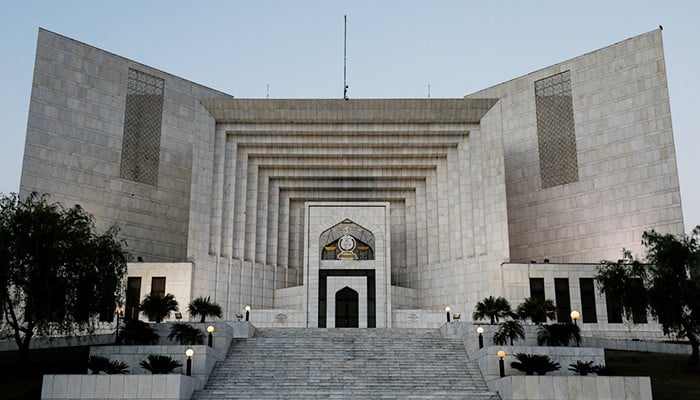
ISLAMABAD: Pakistan’s Supreme Court on Wednesday upheld a law that gives a panel of three senior judges the authority to regulate the court’s own affairs, including how cases are assigned and which judges hear them.
The law, passed in April, also gives a right to appeal against Supreme Court judgments, a provision that was partly upheld by the court.
The law was challenged by several petitioners, including former judges, lawyers and civil society activists, who argued that it violated the Constitution and undermined the independence and prerogatives of the chief justice.
The full court, headed by Chief Justice Qazi Faez Isa, announced the short order from Courtroom No.1 and dismissed all the petitions that challenged the validity of the law.
The court, however, ruled by a 10-to-5 majority that the law was constitutional and dismissed the petitions.
It said a detailed judgment would be issued later.
Previously, these powers were exercised by the chief justice alone, who could also form benches of any number of judges to hear cases.
The law was passed by the coalition government of Prime Minister Shehbaz Sharif, who had often faced judicial scrutiny and criticism from the then chief justice Umar Ata Bandial.
The law proposes that a three-member committee, comprising the chief justice and two senior-most judges of the Supreme Court, would decide on matters such as taking up legal issues directly, commonly known as suo moto action, hearing appeals and entrusting cases to other judges.
Bandial, who retired last month, had struck down the law as unconstitutional shortly after it was passed.
The law also allows for appeals against any decisions taken by the Supreme Court under Article 184(3) of the Constitution, which grants the court the power to take suo motu notice of matters involving fundamental rights.
But the court ruled that this provision will not apply to cases that have already been decided by the court under Article 184(3), effectively ruling out any possibility of reopening some of the most consequential verdicts in the country’s history, such as those that disqualified former prime minister Nawaz Sharif from holding public office and struck down several amendments to the anti-corruption law.
The court order, divided into three parts, was issued by different majorities of 10 to five, nine to six and eight to seven respectively.
The judges who dissented from the majority opinion were Justice Ijazul Ahsan, Justice Munib Akhtar, Justice Sayyed Mazahar Ali Akbar Naqvi, Justice Ayesha A. Malik and Justice Shahid Waheed.
The second part of the decision, which explained that the right of appeal would only apply to future cases, also saw Justice Yahya Afridi dissenting along with were Justice Ijazul Ahsan, Justice Munib Akhtar, Justice Sayyed Mazahar Ali Akbar Naqvi, Justice Ayesha A. Malik and Justice Shahid Waheed.
The third part of the decision, which declared Section 5(2) of the law as ultra vires for granting the right of appeal retrospectively, was opposed by Chief Justice Isa and six other judges: Justice Sardar Tariq Masood, Justice Syed Mansoor Ali Shah, Justice Amin-ud-Din Khan, Justice Jamal Khan Mandokhail, Justice Athar Minallah and Justice Musarrat Hilali.
The judgment came after a lengthy hearing that spanned over two months and witnessed heated arguments from both sides. The petitioners contended that the law was an encroachment on the judicial power and violated the basic structure of the Constitution.
The ruling on Wednesday was the first major test for the new chief justice Qazi Faez Isa, who is widely regarded as an independent-minded judge who has been critical of the role of the military in politics.
Isa himself was the target of an unsuccessful attempt by former prime minister Imran Khan to remove him from office on charges of financial impropriety in 2018. The charges were dismissed by the Supreme Court in 2019 for lack of evidence.
Copyright © 2021 Independent Pakistan | All rights reserved