

By Staff Reporter
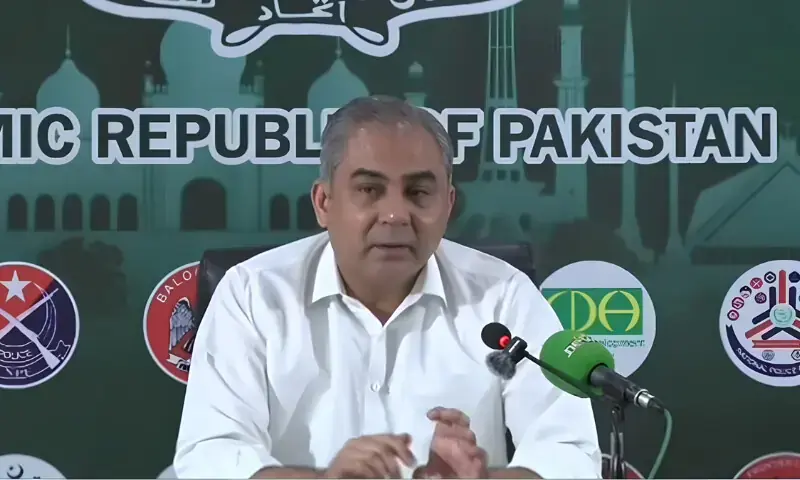
ISLAMABAD: Interior Minister Mohsin Naqvi on Sunday accused Khyber Pakhtunkhwa (KP) chief minister of “sabotaging” negotiations, after two days of talks failed to stop a march on the capital by supporters of the jailed former prime minister Imran Khan.
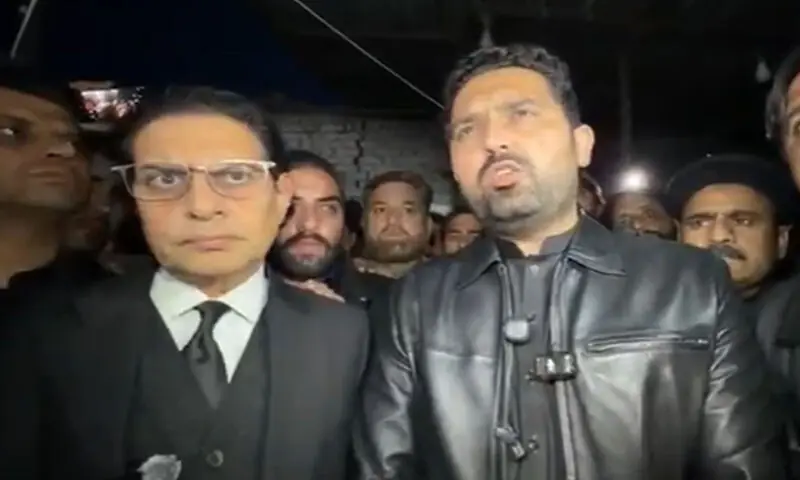
Speaking at a press conference in Islamabad, hours after the second round of negotiations ended without result, Naqvi placed the blame on one man, KP Chief Minister Sohail Afridi.
“Their team was reasonable,” Naqvi said of the opposition negotiators. “There is only one person responsible for the entire collapse, and that is the KP chief minister.”
He said Afridi would be responsible “if there is any loss of life” and warned that anyone backing him would be committing contempt of court. “We will take legal action against them to every possible extent,” he said.
Afridi, who governs the province in the north-west bordering Afghanistan, reached Lakki Marwat by helicopter on Sunday to lead the march, which is meant to demand Khan’s release. The march is due to leave from Gandi Chowk on the Indus Highway.
The march was first announced for 27 September. Afridi postponed it to 4 October, saying the delay was part of the party’s “political strategy” and that talks with the government would continue.
Two days of talks
The negotiations were chaired by National Assembly Speaker Ayaz Sadiq. An initial round on Friday, in which the two sides set out their positions, ended without agreement. A second session began at Parliament House after 4pm on Saturday and ran into the early hours of Sunday.
Naqvi said there were to be two agreements: a “main agreement” covering political matters with the opposition, and a separate document on counterterrorism. The two sides, he said, had agreed “100 percent on political things”, so that the KP government could join the centre on security.
He said that on Saturday he had asked Afridi to bring his provincial government on board, and that the meeting was postponed until Sunday to allow this. According to Naqvi, the opposition team then spent four hours with Afridi, who gave them a mandate to finalise whatever they agreed with him.
But the minister said that after the draft was sent to the chief minister at around 9pm, requests for changes followed, and by midnight or 12.30am he returned “an entirely new draft”. It altered, Naqvi said, matters that had already been settled.
“If we had known that no one in this committee was authorised to give a commitment on behalf of the KP government, or that the KP government would veto all these things, we would not have held the negotiations in this form in the first place,” he said.
In a pointed reference to Afridi, the minister said that placing “immature and inexperienced people in positions of authority had consequences for the country”. He said an “immature boy” in such a post “will call himself a representative of the people” but would make decisions as he had seen “yesterday”.
Counterterrorism commitments
Naqvi said on X that the PTI had agreed to a written agreement and an implementation plan within 72 hours, and that the KP government then withdrew. The commitments he listed were:
- Reconsidering the Police Act 2026 to shield security matters from political interference
- Preventing terrorists from operating freely or finding safe havens in the province
- Unequivocally condemning the banned Tehreek-i-Taliban Pakistan and other militant groups
- Supporting national policy on Afghan refugees, including repatriation and the dismantling of camps in KP
- No contact with the interim Afghan government
- Substantial funding for counterterrorism operations and the police
- Full provincial ownership of counterterrorism measures and stronger cooperation with the armed forces
- Decisions on counterterrorism in the former tribal areas and merged districts
- Implementation of the National Action Plan
“Last night, during the final phase of negotiations, the KP government backed out of these commitments,” he said. “Security must not be politicised while the province is at war.”
He also criticised the provincial government’s conduct. “It is not appropriate that there is a war going on in one province and the ministers there are giving statements against the army, are not coming to funerals, and at the local level, somewhere or the other, terrorists are also being given support,” he said. “If there is a military operation, would you tell the army which gun to use or which drone to use? This happens nowhere in the world.”
Naqvi said there had been no government request for the march to be postponed, and that PTI was free to protest but would not be allowed to “create a disturbance”. He said an Islamabad High Court order of 14 September had found that no political party had a “lawful right to occupy public roads, highways, interchanges, toll plazas and buildings in Islamabad”.
“Whether they are workers or politicians, whether they are protesting within KP or outside KP, we will pursue them one by one,” he said. “This time, we want to ensure that this repeated episode of creating a disturbance in Islamabad comes to an end.”
Opposition account
The opposition tells a different story. PTI said the talks ended in deadlock at around 2.30am over three “fundamental red lines”.
The first was a meeting with Khan, because, PTI said, only he had the authority to call off the march. When the government refused, the opposition proposed that Abbas meet him instead. “But the government did not agree to that either.”
The second was Khan’s health. The opposition’s minimum demand was that his personal doctors be involved in his treatment “so that doubts regarding his health could be dispelled”.
The third was security policy in KP. The opposition wanted no unilateral decisions, and consultation with all parliamentary parties before the federal and provincial governments agreed a joint course of action. PTI alleged the government instead wanted decisions within 72 hours.
PTI leader Salman Akram Raja said the party’s team had held that counterterrorism action in KP should rest on an agreement between the federal and provincial governments and have the “buy-in” of parties in the provincial assembly. He said it should also respect the recommendations of a jirga of political and tribal elders held in the assembly, and should avoid civilian casualties and displacement. The government, he said, had insisted that the provincial government own all actions it launched unilaterally.
Sherry Rehman of coalition partner Pakistan Peoples Party said she had “never” seen “such a reckless squandering of an opening” to build confidence after years of political division. She said the KP government had refused to sign a counterterrorism draft agreed that afternoon, and had “began dictating terms after 8:30pm when all but final agreements had been signed”.
Afridi published a seven-point draft on X, saying none of the demands was “unconstitutional or illegal”. It called for:
- Regular meetings between the prime minister and opposition leaders in both houses
- A joint political negotiating committee
- Medical and legal rights for Mr Khan and his wife, Bushra Bibi, including access to their own doctors, family and lawyers
- Appeals by prisoners to be heard within 10 days
- The early release on humanitarian grounds of women held on political sentences, including Yasmin Rashid and Ms Bibi
- A federal-provincial meeting within 72 hours on a joint security strategy
The draft said PTI would call off the march on receiving written assurances from the federal government, and would otherwise reserve the right to “peaceful, democratic and lawful protest”.
KP Information Minister Shafiullah Jan accused the government of wanting “to end PTI” rather than terrorism. He said a shift in counterterrorism policy was necessary because “relying solely on the policy of guns and batons will not work”.
Route and warnings
According to the plan Afridi published, the march will pick up supporters in stages through Karak, Kohat, Peshawar and Charsadda, with everyone due to gather at Khairabad on 8 October. He has said the next phase will be announced there, without detailing the final leg to the capital.
Section 144, which restricts movement and gatherings, has been imposed in several KP districts, including Dera Ismail Khan, Tank, Hangu and parts of South Waziristan.
The federal government has been unyielding. Rana Sanaullah, an adviser to the prime minister, said the march “will not be allowed to enter the limits of Islamabad” and that any attempt at disorder would be stopped using the force of law. He also said the government had shown flexibility on meetings with Khan, and that the door to further negotiations could stay open if the provincial government cooperated on terrorism.
Federal ministers have also warned that governor’s rule or an emergency could be imposed in KP. Sanaullah has said both are “on the table”. PTI chairman Barrister Gohar has said the march should not be met with either, and PTI has warned of dire consequences.
The government also objected to the chief minister’s travel arrangements. Information Minister Attaullah Tarar said the use of a state helicopter for a political march breached the Islamabad High Court’s order barring government resources from being used for such events, and added: “Terrorism is spreading in the province and Nero is playing his flute.” KP Governor Faisal Karim Kundi made a similar charge.
PTI has staged repeated protests since Khan was ousted as prime minister in 2022, and several earlier marches on the capital ended in confrontation with police.