By Staff Reporter
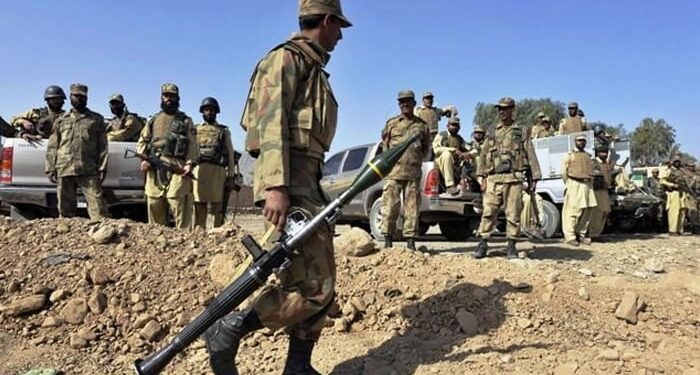
QUETTA: Security forces killed three militants, including a field commander, in a drone strike in Balochistan’s Mastung district, state media reported on Monday, the latest in a weeks-long escalation of military operations across the restive province.
Troops used a quadcopter to target a vehicle belonging to the “Fitna al-Hindustan”, according to the state-run Associated Press of Pakistan (APP) and Radio Pakistan, both of which cited unnamed security sources. The vehicle was destroyed in the strike.
The term “Fitna al-Hindustan” — which translates roughly as “the discord of India” — is adopted by Pakistani authorities to press the claim that India is directing and funding militancy in Balochistan.
Interior Minister Mohsin Naqvi commended the security forces involved, according to APP, “praising their efforts and professional capabilities in eliminating the three terrorists”. In a statement, Naqvi said the operation had foiled the militants’ objectives and reflected “the determination and preparedness of the forces in dealing with threats posed by terrorist groups”.
He said the armed forces “continue to play a key role in maintaining peace and protecting the country from terrorism”, describing their sacrifices as “vital in the ongoing fight against terrorist elements”. Operations would continue “until its eradication”, he added, with forces taking action “wherever necessary to ensure the safety and security of the country”.
Naqvi said the “nation stands firmly alongside the security forces”, and that their commitment “remains essential in achieving lasting peace and security”.
A province under mounting strain**
Monday’s strike is the latest in a sharp escalation of violence and military activity across Balochistan, Pakistan’s largest but most sparsely populated province, long gripped by a low-level separatist insurgency and, increasingly, by the resurgent Pakistani Taliban (TTP) along its northern edges.
Data from the Pakistan Institute for Conflict and Security Studies shows attacks in the province rose seven per cent last month, from 83 in July to 89 in August — a trend security officials have cited to justify the intensified operations.
The surge in violence culminated in a coordinated assault on the night of 31 August into 1 September, when TTP militants struck a customs facility on the N-50 highway in Pishin district. Pakistan’s military said its forces killed ten attackers in the ensuing exchange, though the fighting also claimed the lives of six security personnel, two of them officers.
On the same night, in a separate incident, eleven fighters allied with Fitna al-Hindustan were reported killed in Chagai district after allegedly setting up an illegal checkpoint on the N-40 Quetta–Taftan highway — a route security officials said was being used to extort passing traffic.
The following days brought further reported killings: twelve militants in Kalat on 2 September during what the military terms an “intelligence-based operation”, and eleven more in Kharan and Washuk, alongside the seizure of 2.9 tonnes of explosives.
By 4 September, the military’s Inter-Services Public Relations wing said a further 36 militants had been killed in “high-tempo” operations spanning Mastung, Quetta, Kalat and Sibi — a tally that, if accurate, would bring the reported death toll from state operations to more than 80 in under a fortnight. The same statement said security forces had thwarted a separate attack on a police station in Sibi’s Bhag area.
Copyright © 2021 Independent Pakistan | All rights reserved