By Staff Reporter
ISLAMABAD: Transsion Holdings Co., the Chinese owner of the Tecno and Infinix smartphone brands, has discussed moving beyond handset assembly in Pakistan toward component manufacturing and deeper local sourcing.
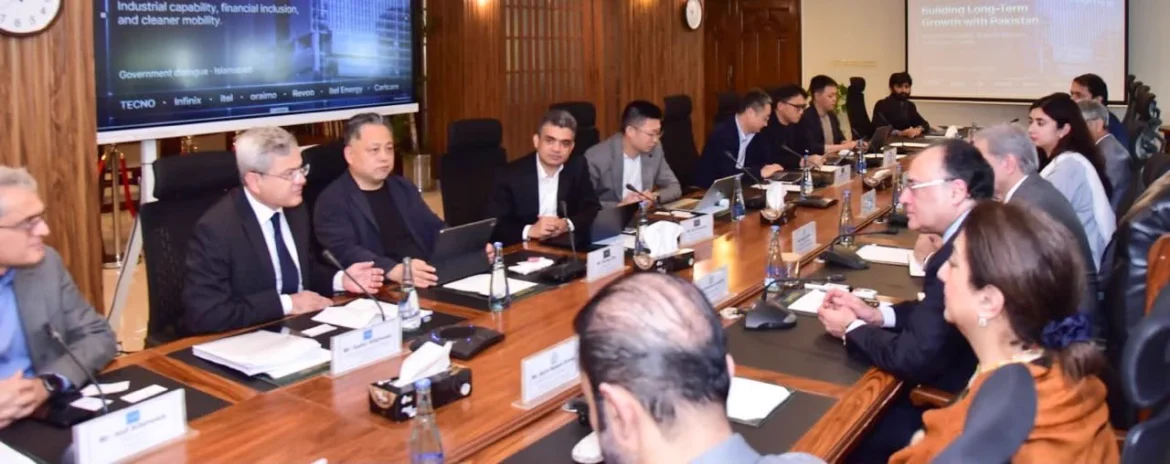
Finance Minister Muhammad Aurangzeb met Transsion founder and Chairman George Zhu and his delegation in Islamabad on Friday, the Finance Division said. The talks covered the company’s operations in Pakistan, its investment plans and ways to strengthen local manufacturing and exports. The statement didn’t give an investment figure or a timeline. Zhu is also known as Zhu Zhaojiang.
Transsion, a Shenzhen-based company with a market value in the billions of dollars, operates in Pakistan through Transsion Tecno Electronics, a China-Pakistan joint venture that runs a CPEC-based assembly unit. The company briefed the minister on its businesses in smartphones, electric bikes and energy storage, according to the statement.
The discussion centered on building supporting industries and local supply chains so that more of the value in each device stays in the country. Transsion pointed to the chance to expand into higher value-added work and component production, which the Finance Division said would create openings for Pakistani businesses and draw further investment. The two sides also discussed positioning Pakistan as a manufacturing and export hub.
Transsion called Pakistan a strategic market, citing its large domestic consumer base, its location and its business environment. The talks also covered using Pakistan’s manufacturing capacity to supply international markets.
Aurangzeb said sustained macroeconomic stability gives investors a base for long-term planning. He reaffirmed the government’s commitment to staying on its reform path and stressed export-oriented growth, greater value addition and closer integration with global supply chains as the route to better competitiveness. He urged Transsion to keep working with relevant government institutions on further investment, and both sides said they wanted closer cooperation.
Assembly boom, thin localisation
The conversation fits a policy push that Islamabad has been making for months. Pakistan now meets most of its handset demand through local assembly. Local plants turned out 20.08 million handsets in January-September, against 2.85 million imported commercially, with VGO TEL the largest producer ahead of Infinix and Itel. The regulator has issued 37 manufacturing licences since the previous policy took effect in 2020, and nearly every major brand except Apple is now assembled locally.
But assembly isn’t manufacturing. Under the 2020 policy, localisation stayed in single digits and mostly covered low-value inputs, and more than 90% of the parts in locally assembled phones were still imported, Profit reported. Imports of finished phones have also kept climbing. Mobile phone imports jumped 29% to $1.747 billion in the 11 months through May of fiscal 2026, according to Pakistan Bureau of Statistics data cited by Dawn. Local assembly slipped 7% to 11.17 million units in the first five months of the year from 12.05 million a year earlier.
The government’s answer is a Mobile and Electronic Devices Manufacturing Policy for 2026-33, drafted by the Engineering Development Board. It aims to raise domestic value addition from about 10% to 50% by 2033. It also sets a target of $2.5 billion in mobile and IT equipment exports by that year. Plans call for a levy of up to 5% on imported phones and electronic devices to help pay for localisation. By February the draft had gone to the prime minister for approval. The extent to which a company such as Transsion would build components in Pakistan, and which parts, remains to be seen. Industry participants have noted that high-value items such as displays need heavy capital spending and that the policy sets out few concrete incentives for them.
Transsion arrives at the table in a tougher position than a year ago. Its Hong Kong shares fell more than 7% in their October 15 debut, and the offering raised $394 million. Third-quarter revenue fell 27% as rising memory-chip costs hit demand, in its first report since the listing; Omdia counted 254.7 million smartphones shipped worldwide in the quarter, 20% fewer than a year earlier and the weakest third quarter since 2013. The first half had looked better, with revenue up 21.9% to 35.43 billion yuan and net profit up 46.2% after the company raised prices.
Pakistan, for its part, is pitching macroeconomic stability. Aurangzeb has been making that case to foreign investors under the IMF-backed program. He reviewed progress under the Extended Fund Facility and the Resilience and Sustainability Facility with Fund management in July. At an IMF meeting in Bangkok in October, he cited a fiscal deficit at a 22-year low and three straight years of primary surpluses.
Transsion has been courting Islamabad for some time. When Zhu met Prime Minister Shehbaz Sharif in Shenzhen in June 2024, he said the company’s Pakistani unit employed more than 5,000 people. He also signaled interest in e-bikes, modern agriculture and fintech. Sharif invited the company to produce locally and export.
Copyright © 2021 Independent Pakistan | All rights reserved