By Staff Reporter
ISLAMABAD: Security forces gunned down two terrorists accused of being backed by India after they stormed government offices in Balochistan’s Mastung district on Tuesday, an attack that left a 16-year-old boy dead and seven others injured.
The assault is the latest in a string of violent incidents that underscore the mounting security challenges in this resource-rich but impoverished province, where separatist militants have stepped up their campaign against the state.
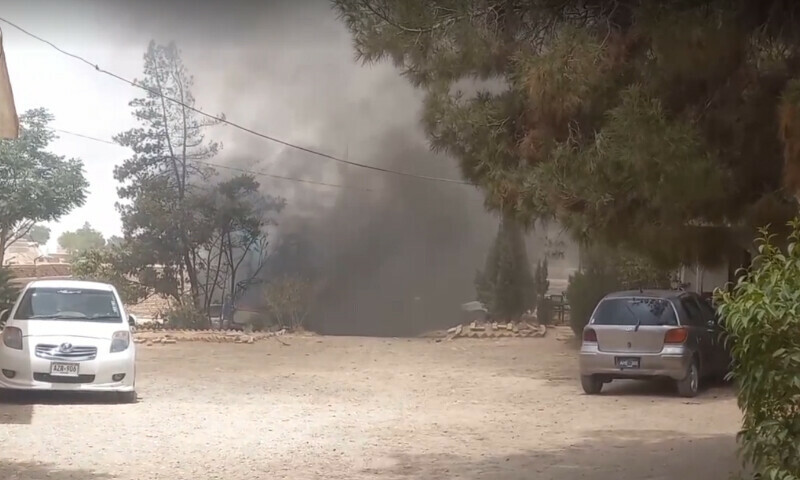
The attack unfolded around 11 a.m. in Mastung, a small town roughly 50 miles southeast of Quetta, when gunmen opened fire on a tehsil office, additional government buildings, and a nearby bank. “Heavy firing and blasts [were] heard in the small town,” Mastung Deputy Commissioner Athar Abbas Raja told Dawn newspaper. Amid the chaos, a teenager was fatally shot, and seven others sustained injuries from the terrorists’ barrage.
Security forces, including the Frontier Constabulary, Counter-Terrorism Department, and Levies, moved swiftly to seal off the area, sparking an “intense fire exchange” with the assailants. “Two terrorists were killed while another three were injured,” Balochistan government spokesperson Shahid Rind said in a statement. “The immediate response by the security forces was effective in preventing further loss of lives.”
Authorities have launched an “organised” clearance operation at the site, with search efforts underway to track down any facilitators who aided the attackers. “The operation to protect citizens and arrest terrorists was based on intelligence input,” Rind added, signaling a broader effort to dismantle the networks behind the violence.
The government pointed the finger at India, labeling the attackers as agents of “Fitna al Hindustan”, a phrase recently coined by the military to frame India’s alleged role in sponsoring terrorism as a destabilization tactic.
“Fitna al Hindustan attacked the tehsil office, government offices, and a bank,” Rind’s statement read, accusing New Delhi of fueling unrest in Balochistan.
The attack comes against the backdrop of a troubling uptick in terrorism in Balochistan, where the banned Balochistan Liberation Army (BLA) has emerged as a central player in 2024. Once engaged in a low-level insurgency, the BLA has escalated its operations, targeting government installations, security personnel, and civilians alike.
On May 21, a school bus bombing in Khuzdar claimed 10 lives, including eight children, a stark reminder of the group’s reach and ruthlessness. In April, a blast on Mastung’s Dasht Road killed three policemen and injured 16 others, while last month, security forces reported eliminating four Indian-sponsored terrorists in the Duki and Kachhi districts.
Balochistan’s unrest is deeply rooted in decades of grievances. The province, sprawling across Pakistan’s southwest and rich in natural gas and minerals, remains mired in poverty and underdevelopment, conditions that separatist groups like the BLA exploit to push their demands for autonomy or independence. Pakistan has long accused India of stoking these tensions, a charge that has heightened diplomatic friction between the two nations.
In the country’s northwest, unidentified gunmen ambushed and killed two traffic police officers in Lakki Marwat, a district in Khyber Pakhtunkhwa near the Afghanistan border. The officers were shot dead on Longkhel Road, near Gulbaz Dehqan village, while heading to their posts, according to an official statement.
“We share the grief of the bereaved families,” Khyber Pakhtunkhwa Chief Minister Ali Amin Gandapur said, vowing that “the families of the martyrs will not be left alone and will be fully supported.”
He ordered law enforcement to track down the perpetrators, though no group has yet claimed responsibility. Past attacks in the area have frequently been linked to the Tehreek-e-Taliban Pakistan (TTP), a militant faction that has regained momentum since ending a ceasefire with the government in November 2022.
Copyright © 2021 Independent Pakistan | All rights reserved