By Staff Reporter
KARACHI: The International Monetary Fund (IMF) and Pakistan agreed on Friday to a $3 billion, nine-month loan agreement to help the country cope with external shocks and policy missteps that have stalled economic growth and fueled inflation.
The Stand-By Arrangement (SBA), which expires in March 2024, builds on a previous $6.5 billion Extended Fund Facility (EFF) that ends today.
The much-awaited staff-level agreement for a new but crucial bailout could help stabilize the country’s flailing economy and lift it out of an impending debt default.
“I am pleased to announce that the IMF team has reached a staff-level agreement with the Pakistani authorities on a nine-month Stand-By Arrangement (SBA) in the amount of SDR 2,250 million (about $3 billion),” Nathan Porter, IMF Mission Chief for Pakistan, said. “This will support near-term policy efforts and replenish gross reserves, with the aim of bringing them to more comfortable levels.”
The new loan from the IMF is the country’s 22nd bailout from the lender since the 1950s. The IMF funds will help Pakistan service its $23 billion of external debt payments due in the fiscal year starting in July, which exceed its foreign-exchange reserves by more than six times.
The reserves have dwindled to $3.5 billion as of mid-June, down almost 60 percent from a year ago, forcing the country to curb imports.
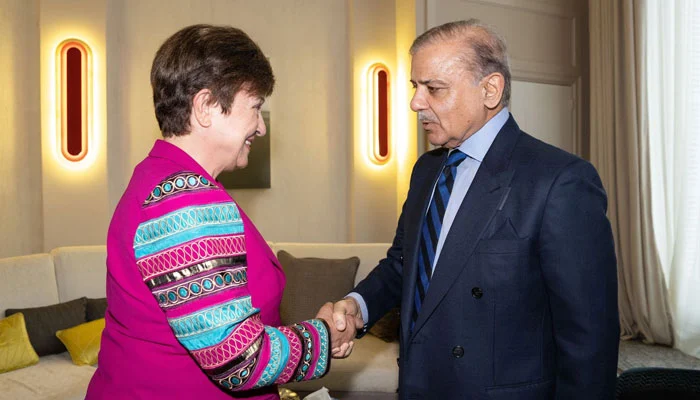
“This arrangement will help strengthen Pakistan’s foreign exchange reserves, enable Pakistan to achieve economic stability, and put the country on the path of sustainable economic growth,” Prime Minister Shehbaz Sharif said on Twitter.
Pakistan received the formal documents on the deal on Friday from the IMF, Finance Minister Ishaq Dar said, which he said he would “sign, seal, and return by tonight.”
The IMF funding will also unlock other bilateral and multilateral external financing and debt rollovers, particularly from friendly countries like Saudi Arabia and the UAE, which have already pledged around $3 billion.
“The new SBA would provide a policy anchor and a framework for financial support from multilateral and bilateral partners in the period ahead,” Porter added.
Meanwhile, Pakistan’s sovereign dollar bonds were trading higher after the deal, with the 2024 issue enjoying the biggest gains, up more than 16 cents at just above 71 cents in the dollar. Eurobonds worth $500 million maturing in September 2025 rose 13 cents to 55 cents. The gains were most pronounced in shorter-dated bonds.
The IMF statement said Pakistan has faced several challenges since completing the seventh and eighth reviews under the EFF in August 2022, including devastating floods, a spike in global commodity prices amid Russia’s war in Ukraine, and foreign exchange market constraints that have led to import shortages and reserve losses.
Porter said the authorities had taken measures to address these issues, such as tightening monetary policy, allowing greater exchange rate flexibility, and increasing electricity tariffs.
“Despite the authorities’ efforts to reduce imports and the trade deficit, reserves have declined to very low levels. Liquidity conditions in the power sector also remain acute,” he added.
“Given these challenges, the new arrangement would provide a policy anchor and a framework for financial support from multilateral and bilateral partners in the period ahead.”
However, Porter warned that more fiscal discipline was needed to avoid unbudgeted spending or tax exemptions that could derail the budget targets. “It will be important that the budget is executed as planned, and the authorities resist pressures for unbudgeted spending or tax exemptions in the period ahead,” he said.
Porter said the central bank had removed guidance on import prioritization and was committed to letting the market determine the exchange rate.
“Going forward, the central bank should remain proactive to reduce inflation, which particularly affects the most vulnerable, and maintain a foreign exchange framework free of restrictions on payments and transfers for current international transactions and multiple currency practices.”
He also said the authorities were seeking new financing and debt rollovers from multilateral institutions and bilateral partners to support their policy efforts and replenish reserves.
The IMF said the program also included ongoing efforts to improve the energy sector, state-owned enterprises, and public investment management. It said full and timely implementation of the program was critical for its success.
The IMF said the power sector also remains under stress, with mounting arrears and frequent blackouts.
Reforms in the energy sector, which has accumulated nearly Rs3.6 trillion in debt, have been a cornerstone of the discussions with the IMF.
The IMF would want steadfast policy implementation by Pakistan to overcome challenges, “particularly in the energy sector,” the statement said.
“The authorities’ program also includes ongoing efforts to strengthen the viability of the energy sector (including through a timely FY24 annual rebasing),” the IMF said, pressing Pakistan to increase electricity tariffs in the next fiscal year.
Analyst Mohammed Sohail of Topline Securities said the “new program is far better than our expectations,” adding that there were a lot of uncertainties about what would happen after a new government comes to power later in the year.
“This funding of $3 billion and for 9 months will definitely help restore some investor confidence.” Sohail said the new government, likely by November/December, will have some time to evaluate the economic situation and decide on the way forward on a “bigger IMF loan with or without debt restructuring/reprofiling.”
Copyright © 2021 Independent Pakistan | All rights reserved