By Staff Reporter
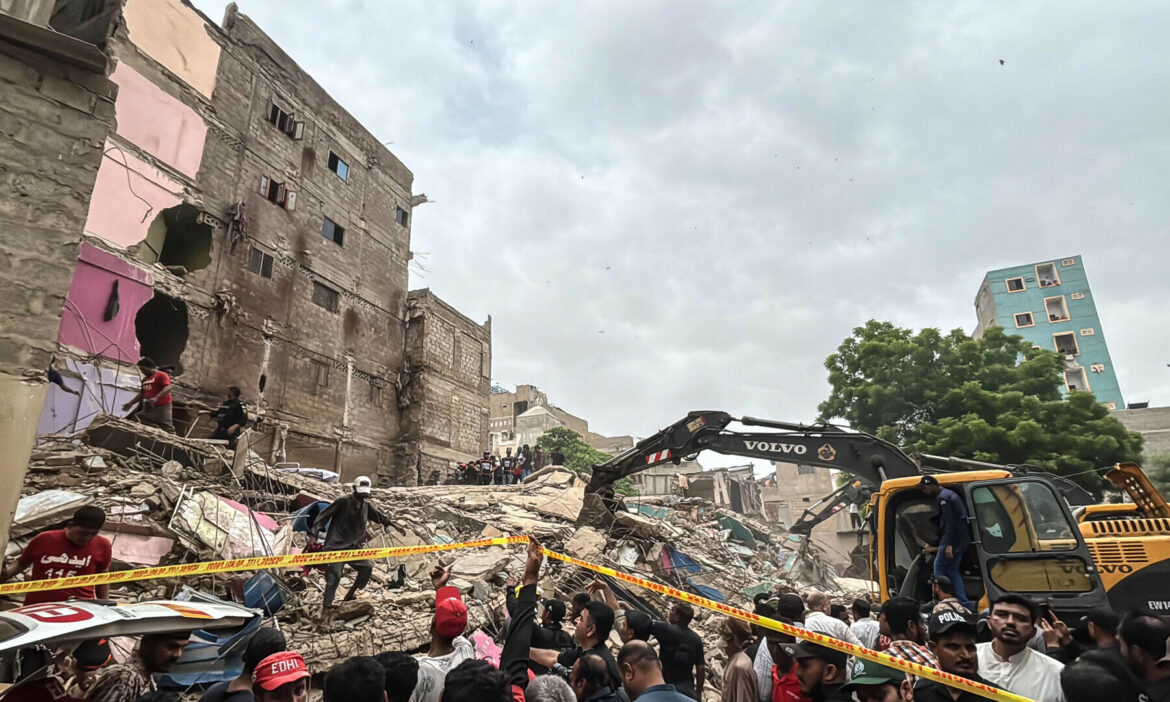
KARACHI: The air was thick with dust and desperation on Friday morning when a five-story residential building in Karachi’s crowded Lyari neighborhood crumbled years of unheeded warnings, killing at least 14 people and entombing dozens more in a pile of concrete and grief.
The disaster at Fotan Mansion, a decaying structure long flagged as a death trap, unfolded around 10:30 a.m. in the Baghdadi area, a warren of tightly packed homes.
“I suddenly woke up … it felt like there were tremors, like an earthquake,” said Salman Ahmed, jolted awake in a nearby building as the collapse unleashed a blinding swirl of smoke and debris. “We could hear voices from underneath, crying out.”
By nightfall, rescuers, local volunteers, Pakistan Rangers, and heavy machinery had pulled eight survivors from the wreckage and recovered 14 bodies: five women, eight men, and a seven-year-old boy. But their efforts were hampered by narrow alleys that heavy machinery struggled to navigate. Police also resorted to baton-charging residents to clear the way as distraught relatives gathered near the site, desperate for news of loved ones.
Nearby, two adjacent buildings, one two-story and one seven-story, were evacuated as a precaution. Authorities fear 25 to 30 others remain trapped as the painstaking search stretches into a second day.
For survivors, the toll is unbearable. Jumho Maheshwari, 70, lost his entire family, six people, when his first-floor apartment vanished beneath him while he was at work. “Nothing is left for me now,” he said, voice breaking. “All I can do is pray.”
Nearby, Maya Sham Jee clung to hope for her brother’s family, still buried. “The world has changed for us,” she said. “We are helpless and just looking at the rescue workers to bring our loved ones back safely.”
Shankar Kamho, 30, narrowly saved his wife and daughter after a frantic phone call about cracking walls. “She warned the neighbors,” he said. “One woman laughed it off ‘This building will stand for 10 more years.’ “Still, my wife took our daughter and left. Twenty minutes later, it was gone.”
Rescue crews worked under floodlights, cranes clawing at the rubble as anguished families watched. The Sindh Building Control Authority (SBCA) had red-flagged Fotan Mansion as dangerous since 2012, issuing eviction notices and loudspeaker warnings after recent rains weakened its frame.
“Before the recent rains, public announcements were also made in the area, but unfortunately, no one was willing to vacate,” SBCA spokesperson Shakeel Dogar said.
The agency even urged utility companies to cut services and enlisted local officials to enforce evacuation, to no avail. Residents, reluctant to leave without alternative housing, stayed put despite megaphone warnings as recently as June 29.
Karachi Mayor Murtaza Wahab, surveying the scene, blamed the victims. “This building was declared dangerous, and a couple of notices were issued to the occupants to vacate because of its structure,” he said. “But unfortunately, people chose to risk their lives, and they did not vacate.”
The collapse is the latest in a string of deadly structural failures haunting Pakistan’s largest city. The SBCA counts 588 buildings as hazardous, 107 in Lyari alone, worn down by neglect, monsoon battering, and lax oversight.
In 2020, collapses in Rizvia Society and Gulbahar claimed 43 lives. Last year, seven died in Malir and Korangi.
Karachi’s housing crisis is a slow-motion catastrophe. Rapid urbanization has packed 23 million people into a city where safe, affordable homes are scarce. Aging buildings like Fotan Mansion, described by authorities as “worn-out”, often illegally modified, teeter on the brink.
“The incident of the building collapse in Lyari is deeply tragic,” said Muhammad Hassan Bakhshi, a prominent builder and developer. “It is alarming that despite having a list of dangerous buildings, the SBCA did not take action to get them evacuated,” Bakhshi said. “This is a tragedy we saw coming.”
Wahab acknowledged the systemic challenge, noting 434 dangerous buildings in the Old City area alone. “We have two options: to convince people to move out or force them to evacuate,” he said. “This loss of lives today shows that when the state or the government tells you anything, you should follow it.” Yet coercion is a hard sell when relocation means upheaval or homelessness.
The mayor pledged that rescue efforts were the priority, with accountability to follow. “Once we’re done with the rescue aspect, we will focus on who was responsible for this negligence or omission.” The SBCA, though, suspended its director, deputy director, and building inspectors amid the fallout.
Copyright © 2021 Independent Pakistan | All rights reserved