By Staff Reporter
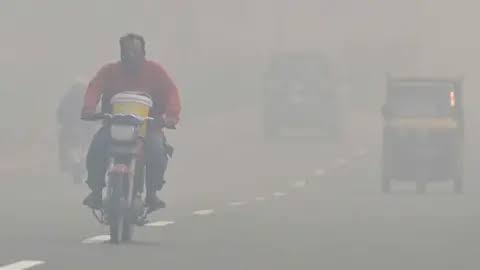
LAHORE: Lahore was ranked the most polluted major city in the world on Friday, with dense smog pushing air quality readings above 400 on one international tracker.
The Swiss monitoring platform IQAir put the Pakistani city’s air quality index (AQI) at about 344 at 8am, a hazardous reading. Other readings that morning were higher, at 410 and 424. Doctors urged residents to wear masks outdoors.
New Delhi was second in the rankings seen on Friday morning, with an AQI of between 203 and 244. Dakar in Senegal was third with a reading in the 180s to 190s. India’s Mumbai and Kolkata recorded 179 and 172, both classed as unhealthy. Lahore was the only Pakistani city among the 20 most polluted, and Karachi, with an AQI of 110, was the only other on the 21-city list.
In Lahore, IQAir said, the concentration of PM2.5 was between 45 and 57 times the World Health Organisation’s annual guideline, depending on the reading. “PM2.5 concentration is currently 45.2 times the World Health Organisation annual PM2.5 guideline value,” the platform said on its Lahore page.
PM2.5 refers to fine inhalable particles measuring 2.5 micrometres or less in diameter. IQAir says they pose the greatest health threat of all air pollutants. They are small enough to enter the bloodstream and even the brain, raising the risk of stroke, heart disease, lung cancer and chronic respiratory illness.
IQAir advised residents to avoid outdoor exercise, keep windows closed, wear a mask outside and use an air purifier indoors.
Pollution varied sharply across the city. Iqbal Town recorded the highest reading of 535, followed by Airwash on Bedian Road at 497, Kahna at 446 and Defence Phase 5 at 360. Model Town registered 350 and Barki Road 253. Samaa TV reported readings of 441 in Johar Town, 440 in Cantt, 420 on GT Road and 408 in Shadman, and said some areas had exceeded 800.
The Punjab government’s own monitoring platform recorded an AQI of 339 for Lahore at 11am on Thursday, based on data from 10 stations across the city. The gap between that figure and IQAir’s may reflect differences in monitoring stations, averaging periods and methodology, although both pointed to severe pollution in the provincial capital.
Maryam Nawaz, the Punjab chief minister, said on 2 October, the day Lahore last topped the IQAir list with a reading of 167, that smog had not been eliminated but had lessened over three years.
Smog season in Punjab is reported to run from 15 October to 15 January. The provincial authorities say that since 1 October they have shut down 20 stone-crushing machines, demolished 14 brick kilns, sealed 119 others, issued notices to 1,403 farmers over crop-residue burning and fined 11,953 vehicles a combined Rs35.9m. The environment department has also imposed a province-wide ban on burning waste in open spaces. On Thursday it extended anti-smog gun operations, first piloted in Lahore last year, to Gujranwala, with Sheikhupura, Faisalabad and Multan to follow.
Experts noted that air quality had deteriorated within days of a brief respite after rain, with official readings reaching highly unhealthy levels on Wednesday. They questioned whether the authorities were adequately prepared. Earlier this week, the EU’s Copernicus Atmosphere Monitoring Service ranked Lahore among cities with “extremely poor” ozone levels.
Lahore’s smog has worsened in recent winters. Readings exceeded 1,000 in November 2024. IQAir’s annual figures put the city’s average PM2.5 in 2025 at 88.9 micrograms per cubic metre, eighth highest in the world.
Cooler seasonal air traps pollutants near the ground, producing a mix of crop-residue smoke, traffic emissions, industrial fumes and construction dust. Delhi is frequently ranked among the world’s most polluted capitals, with authorities often blaming farmers burning stubble in neighbouring Punjab and Haryana.
Unicef warns that polluted air puts children at heightened risk of acute respiratory infections, and a 2023 study found that air pollution can cut life expectancy by more than five years in parts of South Asia. Across the region, smog routinely forces school closures, slows transport and strains health systems.
Copyright © 2021 Independent Pakistan | All rights reserved