By Staff Reporter
ISLAMABAD: Foreign ministers from Britain, France, Germany, Pakistan, Turkey, Saudi Arabia and Egypt met in Istanbul on Friday for the first time in this format, with Houthi missile strikes on Saudi Arabia and the threat to shipping in the Strait of Hormuz at the top of the agenda.
The gathering, hosted by the Turkish foreign minister, Hakan Fidan, brought together Ed Miliband, the Foreign Secretary, with Germany’s Johann Wadephul, France’s Jean-Noel Barrot, Egypt’s Badr Abdelatty, Saudi Arabia’s Faisal bin Farhan and Pakistan’s Ishaq Dar. Pakistan’s Foreign Office said Italy would also take part.
Miliband’s office said the British delegation would press for a diplomatic solution that restores full navigational rights in Hormuz, and would argue that Iranian tactics are being copied across the region, with attacks on Saudi Arabia adding pressure on Bab al-Mandeb and the Suez Canal. A Foreign Office statement said traffic through the strait remains sharply down on pre-war levels.
Defence Secretary Wes Streeting told MPs on Tuesday that RAF Typhoons will fly defensive missions over Saudi Arabia, calling the Houthi campaign an “outrageous” escalation. The jets are to protect Saudi cities and infrastructure and will not strike targets inside Yemen. Downing Street insisted the deployment did not mean Britain was being dragged into the conflict.
The format pairs two groups. The R4, which brings together Pakistan, Turkey, Saudi Arabia and Egypt, was formed in March and has concentrated on regional security and mediation between Washington and Tehran. The E3 of Britain, France and Germany was set up more than 20 years ago to coordinate diplomacy over Iran’s nuclear programme. Pakistan, Turkey and Saudi Arabia are also bound by the Makkah Joint Defence Agreement, signed in August, under which an attack on one is treated as an attack on all.
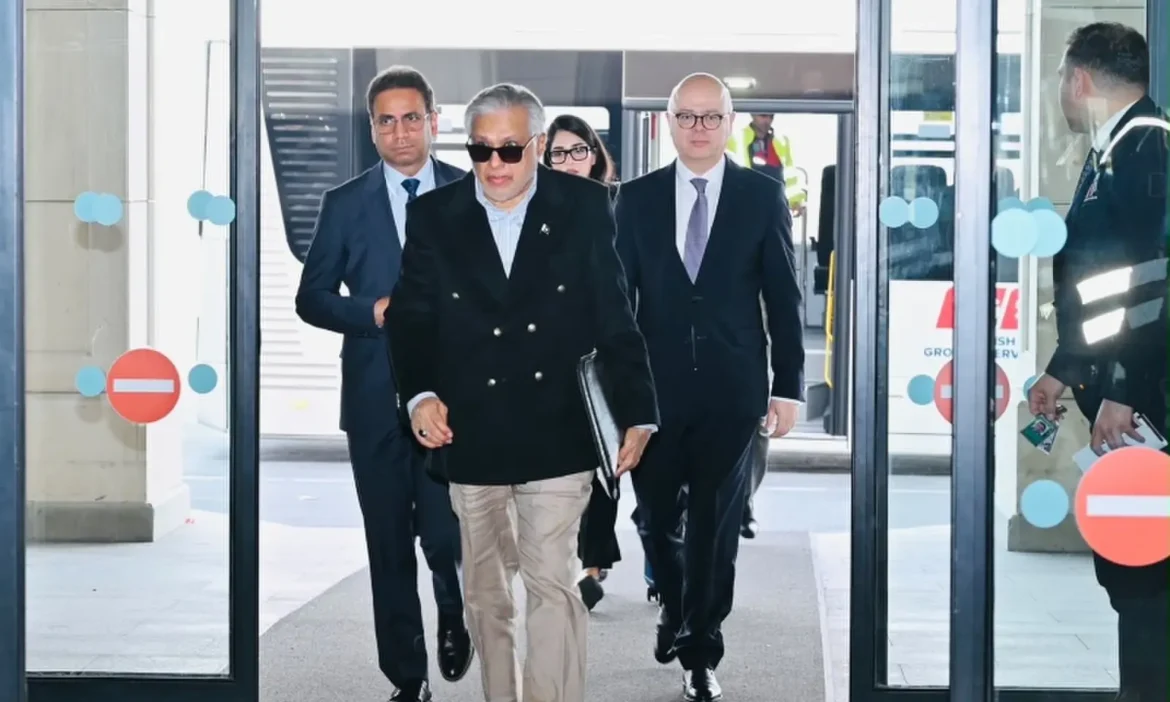
Dar, who is also Pakistan’s deputy prime minister, landed in Istanbul on Friday and was received by Cihad Erginay, a director general at the Turkish foreign ministry. He was also due to call on President Recep Tayyip Erdogan and hold bilateral meetings. Islamabad’s Foreign Office said Pakistan’s participation reflected its commitment to “constructive diplomacy” and the peaceful settlement of disputes.
Fidan told the meeting that “lasting solutions cannot be imposed from outside”. Turkish officials said he would call for greater international pressure on Israel over settlement expansion, stress permanent freedom of navigation through Hormuz and Bab al-Mandeb, and reaffirm Ankara’s backing for Saudi security under the Makkah pact. He was also expected to raise the risk of the Russia-Ukraine war spreading in the Black Sea.
The Houthi campaign against the kingdom has intensified sharply in recent weeks. On Wednesday, debris from an intercepted drone aimed at Aramco’s Shaybah oilfield killed two migrant workers, while an attack on King Fahd International Airport in Dammam killed two more people and injured eight. Riyadh’s King Khalid International Airport was shut on 10 October after repeated strikes, one of which killed 13 people and injured hundreds. Lufthansa and Air France have cancelled flights until mid-November.
Aramco has told staff to evacuate its headquarters in Dhahran, Reuters reported, a week after a missile caused a limited fire at the complex. Washington has ordered non-emergency government employees and their families to leave Saudi Arabia.
Fighting inside Yemen has escalated too. Yemen’s armed forces said on Thursday they had carried out 780 strikes on Houthi positions in 24 hours and “neutralised” more than 500 fighters, a claim that has not been independently verified. The offensive, Operation Dawn of Yemen, began on 5 October with air support from the Saudi-led coalition and aims to retake Houthi-held territory, including the capital, Sanaa.
Egypt’s president, Abdel Fattah al-Sisi, has asked parliament to authorise military support for Riyadh if requested, though he says it would be purely defensive and would not extend to attacking Yemen. Lawmakers have postponed the vote until next week.
In the Gulf, the US-Iran war that began on 28 February with joint American and Israeli strikes remains deadlocked. Iran’s Revolutionary Guard said on Thursday it had hit four vessels using a southern shipping route that Tehran rejects, and that three others struck mines. Brent crude rose above $112 a barrel, its highest level since May. Donald Trump accused Iran of inventing the incidents to push up oil prices before the US midterm elections.
The US reinstated its naval blockade of Iranian ports on 14 July, after the Islamabad Memorandum of Understanding collapsed over the wording of a clause on who controls transit through the strait.
Pakistan has been a central mediator since the conflict began. Iran’s foreign minister, Abbas Araghchi, said this week that Pakistan and Qatar were helping to facilitate indirect talks over a seven-day ceasefire proposal Tehran made in September, which Mr Trump rejected. Iranian media reported that a Qatari aircraft landed in Tehran shortly after a plane carrying Pakistan’s army chief, Field Marshal Asim Munir, left. Islamabad has also signed bilateral and trilateral defence pacts with Riyadh over the past year.
France’s foreign ministry said the meeting was meant to strengthen coordination between Europeans and Middle Eastern countries on crises “we did not choose”.
Copyright © 2021 Independent Pakistan | All rights reserved