By Staff Reporter
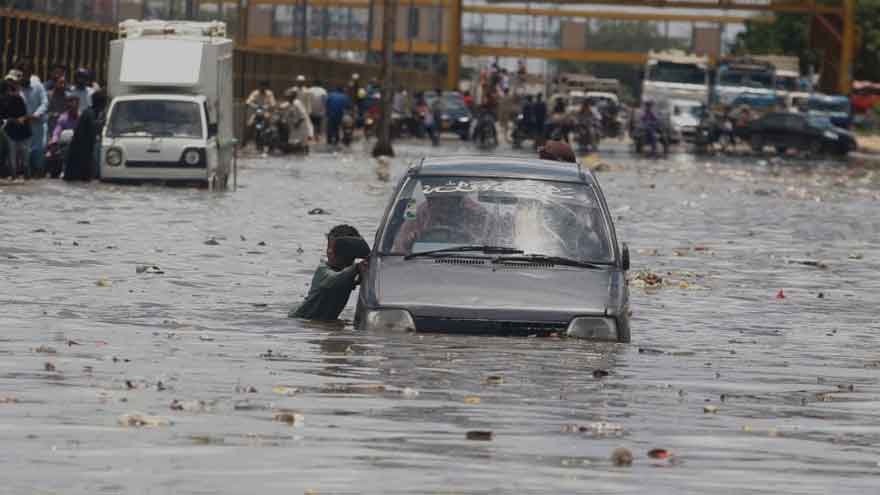
ISLAMABAD: A relentless wave of monsoon rains lashed Pakistan over the past 24 hours, claiming 14 lives and plunging cities into chaos as flash floods and collapsing structures wreaked havoc across the country.
The deluge, which has already killed 111 people since late June, has left streets submerged, power grids crippled, and families displaced, with authorities bracing for worse as forecasters predict another punishing storm system through Thursday.
The latest casualties span Punjab, Khyber Pakhtunkhwa, and Hyderabad, where heavy rains turned daily life into a desperate struggle for survival. In Punjab, five people perished in rain-related accidents, while six died in Khyber Pakhtunkhwa amid flash floods and collapsing homes. Hyderabad reported three deaths after a roof caved in at a timber market.
The National Disaster Management Authority (NDMA) said electrocution and flash floods remain the leading killers, a grim toll underscored by the deaths of 53 children among the 111 fatalities recorded since June 26.
In Khyber Pakhtunkhwa, the rugged northwest bore the brunt of nature’s fury. A woman in Bajaur died when her home’s boundary wall gave way, while two children in Khyber district were swept away by raging floodwaters. In Kohat, a man was crushed under the rubble of his collapsed roof, and in Malakand, two more children succumbed to injuries after a wall fell on them. The NDMA’s tally paints a stark picture of vulnerability in a region prone to such disasters.
Punjab, the country’s most populous province, saw its own share of heartbreak. In Okara, a lightning strike killed teenagers Anam and Asad, while 50-year-old Samina lost her life in a separate incident. In Manchinabad, a madrasa’s roof buckled under the rain, killing students Salam, 8, and Saifullah, 10, and injuring 12 others, including a teacher. Rescue teams rushed the wounded to Civil Hospital Manchinabad.
Near Kasur, in Haveli Nathu Wali, 42-year-old Omari Bibi died when a dilapidated room’s roof collapsed, leaving 45-year-old Iftikhar and 7-year-old Muneeb injured.
Hyderabad’s Timber Market turned deadly when a lumber warehouse roof gave way, killing laborer Nek Mohammad and injuring three others, who remain under treatment at Civil Hospital.
Across Punjab’s Muzaffargarh and Kot Addu, additional injuries piled up as walls and roofs crumbled under the relentless downpour.
The rains transformed urban centers into waterlogged nightmares. In Lahore, intermittent showers inundated low-lying areas like Canal Road, and Gulberg, tripping dozens of power feeders and plunging neighborhoods into darkness. Streets became impassable, stranding residents and paralyzing commerce.
Yet amid the misery, the rains offered a reprieve from stifling heat, with temperatures expected to hover around 33°C and cold winds sweeping through Faisalabad. Rainfall totals underscored the storm’s intensity: Okara logged 72 millimeters, Sahiwal 66, and Dera Ghazi Khan 51, with other cities like Mianwali, Bahawalpur, and Gujranwala drenched in the double digits.
In Dera Ghazi Khan and Kamalia, floodwaters swamped homes and streets, while Taunsa saw over 20 slums inundated as runoff from the Koh-e-Sulaiman mountains surged through. Families fled with what little they could salvage, their plight compounded by widespread power outages.
Hyderabad ground to a halt on Monday as 94 millimeters of rain, 56 on the airport side, turned roads into rivers. The storm, which began at 4 p.m. and tapered off by sunset, exposed gaping flaws in the city’s drainage and power systems. Over 200 feeders operated by the Hyderabad Electric Supply Company (HESCO) failed, stalling pumping stations and leaving water to pool.
In Punjab, PDMA Director General Irfan Ali Kathia reported a moderate flood in the Indus River at Taunsa, with a flow of 426,000 cusecs, while Dera Ghazi Khan’s Vidor Rudkohi swelled to high levels. Most other rivers, Chenab, Ravi, Jhelum, and Sutlej, held steady, but officials remained on edge as more rain loomed.
Balochistan’s Harnai, meanwhile, was severed from the mainland by flooded rivers and canals, with the PDMA urging citizens to call its 1129 helpline in emergencies.
Pakistan Meteorological Department (PMD) warned of worse to come, predicting a potent monsoon system merging with a westerly wave from Tuesday through Thursday. Khyber Pakhtunkhwa faces widespread thundershowers, with heavy to extreme falls expected in Peshawar, Mardan, Swat, and beyond. Urban flooding threatens low-lying areas, while rivers like the Chitral and Kabul could swell into torrents. Lahore, Sadiqabad, and Kot Addu brace for similar chaos.
The PDMA cautioned of flash floods in hilly regions like Galliyat and Malakand, urging travelers to steer clear of danger zones. Sindh and Balochistan could see “very heavy to extremely heavy” rains through Wednesday, with Punjab, Islamabad, and Kashmir also in the crosshairs. In Taunsa Sharif, rising Indus waters have already submerged bridges, isolating communities and fueling anger over scant relief efforts.
Copyright © 2021 Independent Pakistan | All rights reserved