By Staff Reporter
ISLAMABAD: A bipartisan group of US lawmakers is pressing the Trump administration to consider sanctions against countries, including Pakistan, that suppress religious freedom and violate fundamental rights.
The push came during a congressional hearing focused on Pakistan’s political climate, where lawmakers and witnesses alike painted a troubling picture of democratic backsliding, minority persecution, and electoral manipulation.
“One of the biggest disappointments, regardless of who is in the White House or at the State Department, is the absence of sanctions,” said Republican Congressman Christopher H. Smith, co-chair of the Tom Lantos Human Rights Commission (TLHRC), which convened the hearing. Smith, a veteran lawmaker known for his advocacy on global human rights, underscored the rarity of such measures, noting that the only individual ever sanctioned under US religious freedom laws was Indian Prime Minister Narendra Modi following the 2002 Gujarat riots.
“We are going to call on the Irfa office to consider imposing [sanctions], especially in light of the terrible acts committed against people of various faiths,” Smith said, referring to the International Religious Freedom Act (Irfa) office at the State Department. The Irfa authorizes the US government to designate and penalize countries that engage in or tolerate severe religious persecution.
Smith’s Democratic counterpart, Congressman James McGovern, echoed the urgency. “A vibrant Pakistani community in Massachusetts engages me all the time, and quite frankly, they are worried about the signals coming from our government right now,” McGovern said. “They need to know that people are watching. They need to know we don’t like what we are hearing.”
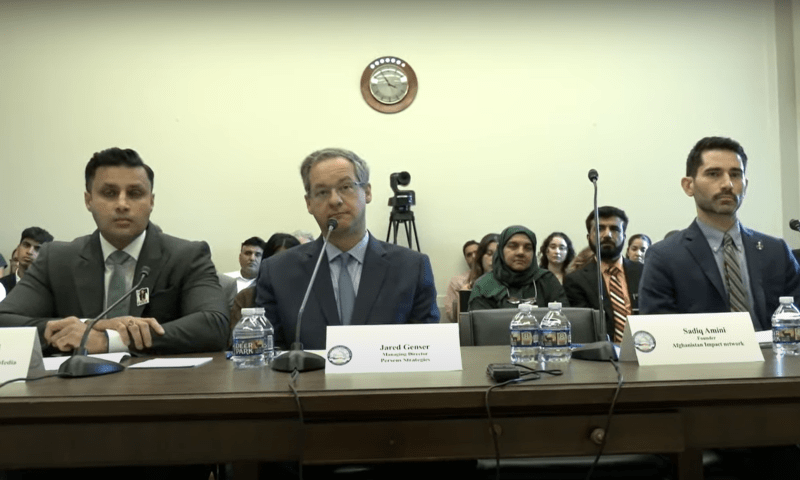
The TLHRC, established in 2008 and named after Holocaust survivor and former House Foreign Affairs Committee chair Tom Lantos, holds bipartisan hearings to shape US human rights policy. Tuesday’s session spotlighted longstanding concerns about Pakistan’s democratic trajectory, drawing testimony from a range of voices: Amnesty International’s Ben Linden, Pakistan Tehreek-e-Insaf (PTI) leader Zulfi Bukhari, Perseus Strategies’ Jared Genser, and Afghanistan Impact Network founder Sadiq Amini.
While the commission does not directly recommend sanctions, Smith’s pointed remarks, including his declaration, “That’s it. We’ve got 18 sanctions here, and we are going to impose them on you”, were seen as a signal that such measures may be considered if Pakistan’s human rights situation does not improve.
Ben Linden, Amnesty International’s advocacy director for Europe and Central Asia, opened his testimony with a focus on Balochistan, a province long plagued by unrest. “Dr. Mahrang and other Baloch detainees should be freed,” Linden urged, referring to the rights activist imprisoned for over three months on charges of “attacking” a hospital and “inciting violence.” He tied recent crackdowns on supporters of former prime minister Imran Khan’s Pakistan tahreek_e-Insaf party to a broader assault on civil liberties.
Linden also decried the persecution of religious minorities, particularly Ahmadis. “Vaguely worded blasphemy laws are being weaponized by majoritarian religious groups, while the accused have few means to defend themselves,” he said. In 2024, over 300 new blasphemy cases were registered—most against Muslims—with several accused individuals killed extrajudicially. “It’s a tragedy,” Linden added. He further condemned Pakistan’s blocking of US-based YouTube channels critical of the military, calling it “totally unacceptable.”
Zulfi Bukhari, a PTI leader and former aide to Khan, delivered a scathing account of alleged electoral manipulation in Pakistan’s February 8, 2024, general elections. “The rigging began long before election day itself,” Bukhari told the panel, outlining irregularities including the removal of PTI’s cricket bat symbol, candidate disqualifications, rally bans, and restrictions on party flags. He claimed PTI leaders were jailed, exiled, or forced into hiding, yet voters still turned out in droves.
Bukhari asserted that PTI-affiliated independents won 170 to 180 parliamentary seats, according to independent observers, but the results were altered within 72 hours. “There were constituencies where population figures were [inflated overnight] — in one case, a seat with 400 registered voters recorded 450,000 votes in the final Form-47,” he alleged. “Let me be very clear, Pakistan’s 2024 elections were neither free nor fair. They were engineered to silence the democratic voices of millions.”
He also highlighted nearly 200 “politically motivated” cases against Khan and his wife, Bushra Bibi, claiming that “fundamental rights had been suspended” and judicial independence undermined by “coercive” amendments.
Jared Genser, managing director of Perseus Strategies, argued for a balanced approach. “We don’t act that way with any regime. We have to engage,” Genser said. “The key is for President Trump and Secretary [of State] Marco Rubio to say very clearly: we want a strong relationship with Pakistan, but this is what needs to be done to get there. And that includes releasing [ex-prime minister] Imran Khan and other political prisoners.” He described Pakistan’s human rights situation as a “tragedy” but called its diaspora a “ray of hope.”
Sadiq Amini, founder of the Afghanistan Impact Network, accused Pakistan of “duplicity” in its US relations, alleging that Imran Khan misled Trump during his first term. “He convinced President Trump to pursue a peace deal with the Taliban, which only empowered them,” Amini said, linking the deal to the US withdrawal and the rise of a “gender apartheid regime” in Kabul.
He also criticized Pakistan’s detention and deportation of Afghan refugees as “shameful and inhumane,” urging a reassessment of Islamabad’s democratic commitment.
The hearing also addressed the harassment of Pakistani dissidents in the US, with speakers alleging that family members of critics were abducted in Pakistan within 48 hours of a June 14 protest outside the Pakistani Embassy in Washington. Democratic Representatives Jimmy Panetta, Suhas Subramanyam, and Greg Casar voiced support for protecting Pakistani Americans’ civil liberties. Earlier this year, Panetta and Republican Joe Wilson introduced a bipartisan bill calling for sanctions on Pakistani officials, while Wilson and August Pfluger urged Rubio to secure Khan’s release.
Smith warned that the US “cannot stand by” as military influence allegedly subverts civilian rule, a sentiment underscored by Bukhari’s claim that Trump’s recent meeting with Pakistan’s army chief, Field Marshal Asim Munir, reflected who “is calling the shots.”
The session comes amid mounting international concern. The Human Rights Commission of Pakistan recently warned of a “steadily shrinking space” for advocacy, while Civicus Monitor lists Pakistan as “repressed” for 2025. Freedom House’s latest report ranked Pakistan “partly free,” noting a three-point decline.
Copyright © 2021 Independent Pakistan | All rights reserved