By Staff Reporter
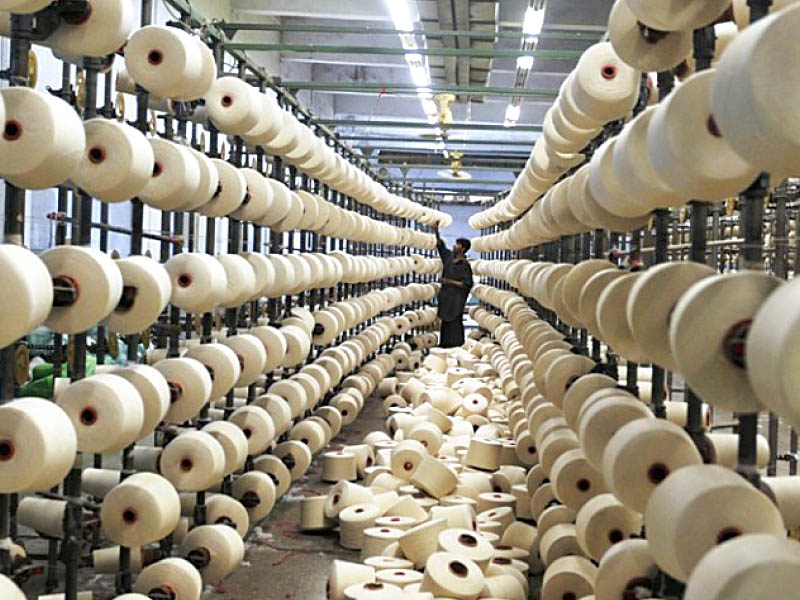
ISLAMABAD: Pakistan’s textile exports, the linchpin of the nation’s export economy, edged up by a modest 7.39% to $17.88 billion in fiscal year 2025, climbing from $16.65 billion the previous year, according to official figures released Friday by the Pakistan Bureau of Statistics.
While the uptick marks the second-strongest performance in five years, it falls far short of the blockbuster 25.5% surge in FY2022, when exports hit $19.33 billion.
Exporters and analysts point to persistent structural weaknesses, over-reliance on government subsidies, scant product innovation, and a lack of market diversification, as barriers to more robust growth.
The textile sector’s uneven performance underscores broader challenges for Pakistan’s economy, which leans heavily on this industry for foreign exchange.
Knitwear exports jumped 13.68% to $5.01 billion, readymade garments climbed 15.85% to $4.128 billion, and bedwear rose 11.1% to $3.11 billion, buoying the overall figures. Towel exports eked out a 2.6% gain to $1.08 billion. Yet, traditional categories stumbled: cotton cloth exports slid 3.05% to $1.81 billion, and cotton yarn cratered 28.76% to $680.7 million.
In June 2025 alone, textile group exports grew 7.59% to $1.52 billion, up from $1.41 billion a year earlier.
Pakistan’s wider export landscape revealed further strains. Food exports dipped 3.4% to $7.11 billion, dragged down by a 14.7% drop in rice shipments to $3.35 billion, a critical blow to foreign exchange earnings. Basmati rice fell 5.3% to $830 million, while other varieties slumped 17.4% to $2.5 billion. Meat exports declined 3.2% to $495 million, fruits dropped 10.3% to $308 million, and vegetables fell 14.5% to $367.6 million.
Bright spots included a 13.4% rise in fish and seafood exports to $465 million and a staggering 1,851% surge in sugar exports to $411.1 million, albeit from a low base.
Other sectors showed a patchwork of gains and losses. Sports goods exports slipped 2.74% to $385.5 million, with football shipments down 9.7% to $229.8 million. Surgical instruments inched up 1.6% to $451.7 million, while cement exports soared 23.7% to $329.8 million. Chemical and pharmaceutical exports rose 5.17% to $1.57 billion, propelled by a 17.2% increase in plastic products to $469.2 million and a 34% jump in pharmaceutical goods to $457.4 million.
On the import front, Pakistan’s bill offered a glimpse into evolving economic dynamics. Petroleum imports fell 5.76% to $15.93 billion, easing pressure on the current account. Within this category, LPG imports bucked the trend, rising 33.66% to $1.05 billion, while petroleum products dropped 10.3% to $5.96 billion, LNG declined 11.9% to $3.47 billion, and crude oil slipped 1.54% to $5.44 billion.
Machinery imports, however, surged 13.37% to $9.63 billion, signaling investment in industrial upgrades. Textile machinery imports soared 61.5% to $241.2 million, and power generation equipment rose 47.8% to $616.2 million. Construction and mining machinery jumped 46.8% to $138.3 million, electrical machinery grew 16.6% to $3.82 billion, and agricultural machinery increased 20% to $109.6 million. Telecom machinery imports, by contrast, fell 11.3% to $2.1 billion, with mobile phone imports down 21.3% to $1.49 billion.
A sharper concern emerged in the transport sector, where imports leapt 32.7% to $2.44 billion. The surge was driven by a 57.8% increase in complete knockdown/semi-knockdown (CKD/SKD) vehicle imports to $1.59 billion. Within this category, motorcar imports rose 41.5% to $1.103 billion, and buses, trucks, and heavy vehicles skyrocketed 132% to $442.3 million. Motorcycle imports climbed 22.1% to $48 million, while fully built-up motorcar imports hit $278.2 million. The spike, particularly in luxury vehicle imports, threatens to further strain Pakistan’s fragile foreign reserves.
Pakistan’s textile sector, despite its modest gains, remains tethered to old habits, subsidies and a narrow focus on Western markets, leaving it vulnerable to global shifts. The broader export slowdown, coupled with a rising import bill for vehicles and machinery, paints a complex picture for an economy grappling with limited reserves and mounting external pressures.
Copyright © 2021 Independent Pakistan | All rights reserved