By Staff Reporter
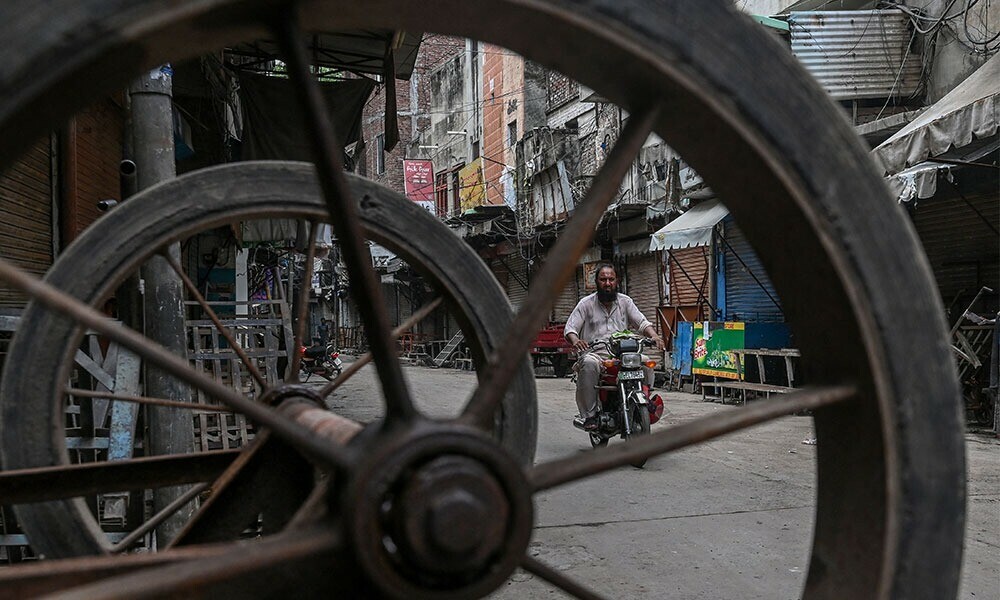
KARACHI: Businesses in Pakistan’s two largest cities, Karachi and Lahore, partially shuttered their doors on Saturday in a strike protesting new tax measures they say will cripple economic activity.
The strike, spearheaded by the Karachi Chamber of Commerce and Industry (KCCI), marks a growing rebellion against provisions in the Finance Act for fiscal year 2026 that traders and industrialists describe as “anti-business.”
The Finance Act, enacted earlier this year, has armed the Federal Board of Revenue (FBR) with sweeping new powers that have sparked outrage among merchants and industrialists. Sections 37A and 37B allow FBR officials to make arbitrary arrests, while Section 21(S) slaps steep penalties on cash transactions exceeding Rs200,000. The law also mandates digital invoicing under SRO 709 and introduces e-Bilty, an electronic waybill system, under Section 40(C).
Additional provisions allow the FBR to block high-value financial transactions by non-filers, such as vehicle and property purchases or investments in securities, and to seal unregistered business premises or confiscate goods
Businesses argue these rules will burden already-struggling enterprises and invite harassment by tax officials, particularly in Karachi, where inflation, declining purchasing power, and law-and-order challenges have battered commerce.
Traders argue these measures choke commerce and threaten an already fragile economy, demanding a return to the Final Tax Regime for exporters that was altered by the act.
Dozens of trade and market associations in both the cities, representing restaurants, motorcycle spare parts, iron and steel merchants, and packaging manufacturers, joined the shutdown, though participation was uneven in some areas. The call drew backing from industrial area associations, petroleum dealers, transporters, and chain store operators, alongside the Lahore Chamber of Commerce and Industry, which also condemned the FBR’s enhanced powers and the government’s failure to consult the private sector.
Saturday’s strike followed a warning issued earlier this week by the KCCI, which claimed support from over 50 trade associations nationwide, an unprecedented show of unity, according to
In Lahore, the LCCI joined the fray, with president Mian Abu Zar Shaad declaring, “Lahore chamber had decided to join the strike in solidarity with the broader business community.” Hyderabad traders followed suit, closing down commercial hubs like Saddar Bazaar, Resham Bazaar, Anaj Mandi, and Market Tower. Islamabad, too, saw significant disruptions as the strike gained traction across urban centers.
Yet the business community appeared fractured. The Federation of Pakistan Chambers of Commerce and Industry (FPCCI), the country’s top business body, announced on Friday that it had postponed its participation in the strike after what it called “successful talks with the government.” A day earlier, FPCCI Senior Vice President Saquib Fayyaz Magoon said chambers and trade associations had agreed to delay the protest after meeting with Special Assistant to the Prime Minister on Industries Haroon Akhtar Khan
The split underscores a broader divide, with some factions favoring negotiation and others, like the KCCI, digging in for a fight. KCCHI insisted that only written guarantees from the government would halt the protest campaign. “Until then, the protest will continue,” it added.
All Karachi Tajir Ittehad Chairman Atiq Mir, representing the city’s markets and shopkeepers, said that while most traders supported the action, markets at Gul Plaza, Teen Talwar in Clifton, and Nursery remained open. “A partial strike was observed in Karachi on the call of industrialists and supported by traders of markets against enhancing FBR’s powers to conduct raids and arrests of businessmen,” Mir said.
He added that some traders felt their specific demands, particularly protections against shop raids and closures on flimsy pretexts, had been overlooked. “The demands of small traders were not included,” he said.
KCCI president Muhammad Jawed Bilwani framed the action as a desperate move. “The strike was not an act of defiance, but a last resort adopted in response to the government’s failure to address widespread concerns raised by the business community,” he said. He called the July 19 shutdown “only the first step,” vowing to track the progress of a government committee led by Khan over the next week.
“If we do not see any meaningful progress or written assurances by the end of next week, we will hold urgent consultations with members, sectoral stakeholders, and chambers of commerce across the country to determine the next course of action,” Bilwani warned. “We want dialogue, not confrontation. But if our concerns continue to be ignored, we will not hesitate to intensify our course of action.”
Copyright © 2021 Independent Pakistan | All rights reserved