By Staff Reporter
ISLAMABAD: Pakistan and Afghanistan signed a landmark trade deal on Wednesday, agreeing to an Early Harvest Programme (EHP) that slashes tariffs on eight agricultural items for one year and lays the groundwork for a broader preferential trade agreement (PTA).
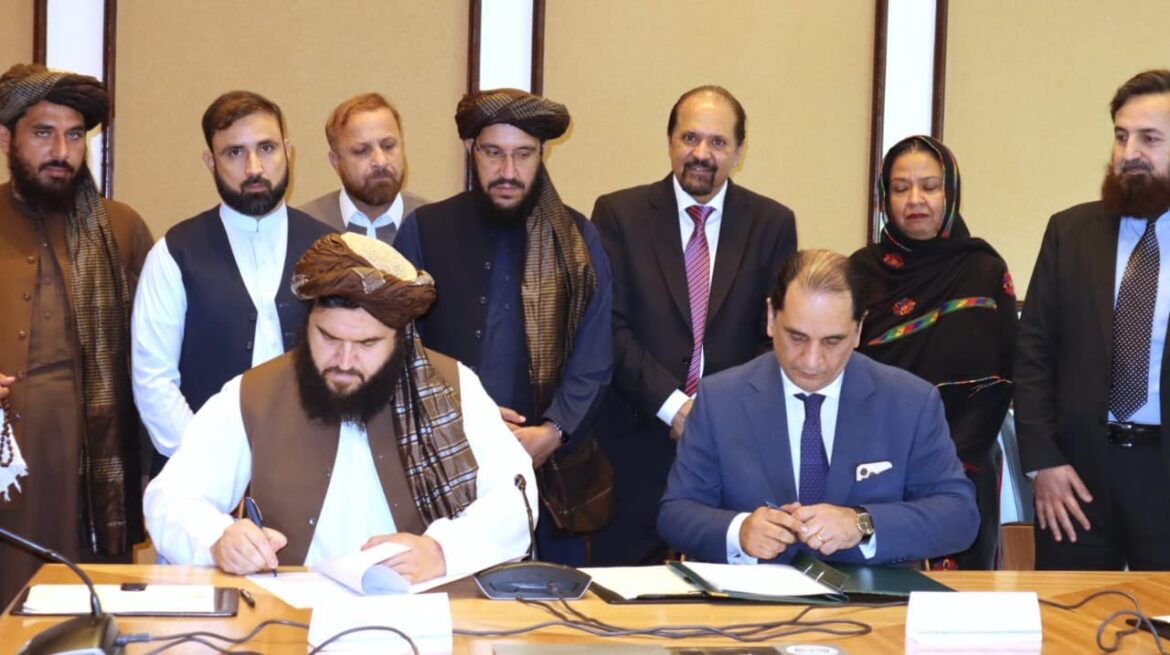
The pact marks a rare moment of economic cooperation between the two neighbors, whose relations have often been strained by political and security tensions. The EHP, set to take effect on August 1, was formalized by Pakistan’s Commerce Secretary, Jawad Paul, and Afghanistan’s Deputy Minister of Industry and Commerce, Mullah Ahmadullah Zahid. Zahid arrived in Islamabad on Monday night with a delegation of senior technical officials for intensive negotiations with Pakistan’s Ministry of Commerce.
The agreement will remain in force for one year, with options for renewal and the potential to expand to additional items in the future. Under the deal, tariffs on four Afghan agricultural exports to Pakistan, grapes, pomegranates, apples, and tomatoes, and four Pakistani exports to Afghanistan, mangoes, kinnows, bananas, and potatoes, will drop to 27 percent, down from over 60 percent previously.
The tariff reductions aim to boost trade in key commodities, offering a lifeline to farmers and traders on both sides of the border. A senior official at Pakistan’s Ministry of Commerce, speaking to Dawn newspaper, underscored the deal’s significance. “This will serve as a catalyst for reviving formal PTA negotiations, which had been dormant for nearly a decade,” the official said. “We will now resume talks to discuss the details of the PTA.”
The EHP represents the first concrete progress in trade talks since 2014, when both countries agreed to pursue a PTA and Pakistan shared a draft proposal. Those discussions faltered when Afghanistan, then led by President Ashraf Ghani, tied further negotiations to Pakistan permitting Indian goods to transit through the Wagah border, a condition Islamabad flatly rejected.
The impasse left trade talks in limbo for years. In the intervening period, Pakistan has introduced measures to ease bilateral commerce amid Afghanistan’s economic challenges. These include allowing transactions in Pakistani rupees and permitting limited barter trade to circumvent Afghanistan’s banking crisis, which has crippled formal financial channels since the Taliban’s return to power in 2021.
Wednesday’s agreement comes as trade between the two nations shows signs of revival. Official figures reveal Pakistan’s exports to Afghanistan climbed 38.68 percent to $773.89 million in fiscal year 2025, up from $558.03 million the previous year. Imports from Afghanistan surged even more dramatically, rising 116.47 percent to $25.89 million from $11.96 million in FY24.
Pakistan’s standout export this year has been sugar, with over 700,000 tonnes shipped to Afghanistan in the past four months alone—a reflection of growing demand in its landlocked neighbor.
The EHP is expected to make these agricultural goods more competitive in each other’s markets, potentially deepening economic ties at a time when both countries face domestic pressures. For Pakistan, the deal offers a chance to bolster its export sector, while for Afghanistan, it provides access to a vital trade partner amid ongoing isolation from global markets.
Copyright © 2021 Independent Pakistan | All rights reserved