By Staff Reporter
ISLAMABAD: Devastating floods in Pakistan’s northern region of Gilgit-Baltistan have claimed at least 10 lives and caused widespread destruction, prompting urgent appeals for federal aid as the area grapples with the escalating impacts of climate change.
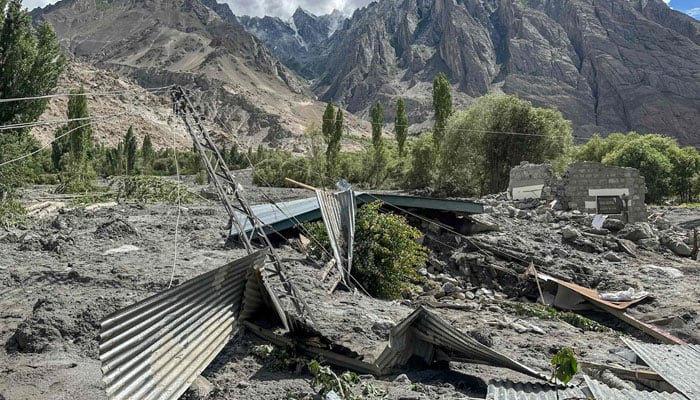
The floods, triggered by unprecedented heatwaves, erratic weather patterns, and rapid glacial melting, have swept across the region since Monday, leaving a trail of landslides, damaging over 500 homes, and stranding countless residents and tourists.
The death toll, which stood at four on Monday, rose to 10 by Sunday, according to Faizullah Faraq, spokesperson for the Gilgit-Baltistan government. In a statement, Faraq reported that seven fatalities occurred in the Babusar area, where 15 people were initially reported missing after floods inundated the scenic valley. Two additional deaths were recorded in Diamer’s Thore Valley, and one in the Astore district.
The body of an unidentified woman, believed to be one of the missing tourists from Babusar, was recovered from the Indus River near Chilas’s Minar area. “The body could be that of one of the tourists swept away at the Babusar Highway,” Faraq said. “Search operations are underway on Babusar Highway by personnel of the Pakistani Army, district administration, and other institutions.”
Rrescue and relief efforts were also ongoing in Ghanche, Ghizer, and Gilgit districts. Most tourists trapped in Fairy Meadows, a popular trekking destination near Nanga Parbat, have been rescued and relocated to safer areas. The Silk Road, a vital lifeline for the region, has been restored for all types of traffic.
The floods have laid bare Gilgit-Baltistan’s vulnerability to climate-induced disasters, with glacial melting and cloudbursts exacerbating the destruction. The region has suffered an estimated Rs20 billion in damages, Faraq said. “The province runs on grants and aid; it will be difficult for the provincial government alone to address this,” he warned. “The federal government should announce a separate reasonable grant for the relief of flood disasters.”
Gilgit-Baltistan Chief Minister Haji Gulbar Khan has appealed to the federal government for Rs7 billion in emergency funds to tackle the crisis, emphasizing that the local administration lacks the resources to cope with the scale of the disaster.
Speaking at a press conference on Saturday at the CM House in Gilgit, alongside Home Minister Shams Lone, Assembly member Jamil Ahmed, and Disaster Management Authority representative Muhammad Ali Quaid, Khan described the floods as “unprecedented,” with seven of the region’s districts affected and Diamer suffering the most severe damage.
“People in GB are facing daily flood events. At least one flood occurs every day,” Khan said. The chief minister detailed the toll: 300 homes completely destroyed, 200 partially damaged, 40 water channels in 30 villages swept away, and 15 kilometers of roads, bridges, agricultural land, crops, and public and private infrastructure severely impacted.
Khan highlighted the region’s financial constraints, noting that only Rs1 billion was allocated in the Gilgit-Baltistan budget for emergencies, while the government is already saddled with Rs3 billion in liabilities from past disaster rehabilitation efforts. “I appeal to the prime minister of Pakistan to immediately release at least Rs7 billion to restore roads, electricity, water channels, and to undertake other essential relief efforts,” he said, urging Prime Minister Shehbaz Sharif to visit the region.
The chief minister also criticised the previous administration for allegedly misusing Rs3 billion provided by the federal government during the 2022 floods, though he acknowledged the establishment of a model village in Ghizer’s Bubor area for flood victims. “This year’s disasters are beyond our resources. I urge the federal government to help the people of GB,” Khan said, adding that a formal request has been sent to Islamabad. He also called on non-governmental and international organisations for support.
The destruction extends beyond Babusar and Diamer. In Fairy Meadows, a flash flood swept away over 200 goats and sheep, along with surrounding greenery. Rescue 1122 reported multiple flash floods in Shigar district on Saturday, affecting crops and infrastructure in Qaimabad Tisar, Chatron, and Garam Chashma, and disrupting road access, mobile networks, and electricity. In Ghanche’s Kondus village, a landslide destroyed over 50 homes, leaving survivors in desperate need of shelter, food, medical care, and internet access.
Flood-affected communities, particularly in Diamer, are facing severe shortages of clean drinking water and essential supplies. The Karakoram Highway, blocked at Chilas on Saturday, reopened on Sunday, but flash floods continue to threaten stability across the region.
Meanwhile, thousands of residents across Punjab were displaced on Saturday as widespread flooding inundated low-lying areas. In Rajanpur’s Rojhan tehsil, villagers resorted to hiring private boats after failing to receive government assistance. Communities in Bhakkar, Layyah, Multan, and Muzaffargarh were forced to evacuate as floodwaters submerged homes and ruined crops. Along the Sindh and Chenab rivers, hundreds migrated with their cattle, struggling to find fodder and shelter, and protested the government’s lack of relief efforts.
In Layyah, a third flood wave in the Indus River raised water levels to 450,000 cusecs, causing a protective embankment near the under-construction Taunsa Bridge to collapse. The breach flooded adjacent villages and farmlands, putting rescue machinery, including a multimillion-rupee excavator, at risk. Dera Ghazi Khan Commissioner Chaudhry Ashfaq told reporters that the situation was under control and the excavator would be recovered once water levels receded. Seven relief camps have been established in Taunsa, though no mass evacuations have occurred yet, according to Deputy Commissioner Usman Khalid.
Punjab Senior Minister Marriyum Aurangzeb visited flood-hit areas in Pindi Bhattian and Hafizabad, where dozens of villages remain submerged. She announced one-month rations for affected families and pledged transparent financial assistance following a damage assessment survey. The Provincial Disaster Management Authority (PDMA) Punjab has issued flood warnings for the Chenab and Jhelum rivers, anticipating rising water levels from July 28 to 31, and urged residents to cooperate with evacuation efforts.
Copyright © 2021 Independent Pakistan | All rights reserved