By Staff Reporter
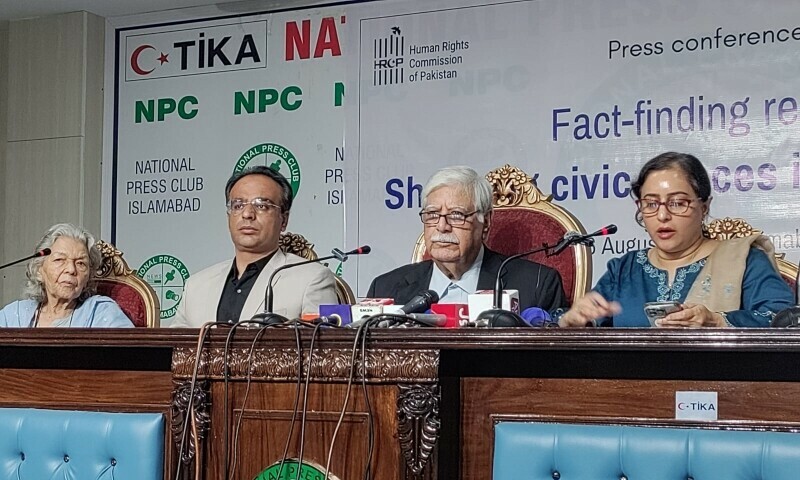
ISLAMABAD: The Human Rights Commission of Pakistan (HRCP) warned on Wednesday that enforced disappearances, and a raft of human rights abuses are driving public alienation and political instability in Balochistan, unveiling a damning report following a fact-finding mission to the restive province.
The report, titled Balochistan’s Crisis of Trust, accuses the state of normalising a practice deemed a crime against humanity, urging sweeping reforms to avert further deterioration. The HRCP conducted its mission from July 9-12, to probe escalating concerns over fundamental rights and civic freedoms in Balochistan amid ongoing conflict and militarisation.
In a press release accompanying the report, the commission said the mission’s findings reveal a disturbing pattern of continued enforced disappearances, shrinking civic space, erosion of provincial autonomy and unchecked impunity, conditions that continue to fuel public alienation and political instability.
The report identifies enforced disappearances as the “most urgent and widespread human rights concern” in Balochistan, describing the practice as “systematic” and corrosive to the rule of law. “Accounts suggest that the phenomenon, far from being isolated or exceptional, has become systematic, thereby undermining the rule of law and severely eroding public trust in state institutions,” it states.
Citing police data, the HRCP reported 356 documented cases of enforced disappearances in the province, with 116 individuals traced, 36 removed from records due to incomplete information, 12 killed in police encounters, and 192 cases still unresolved. In 2025 alone, 46 new cases were registered.
The report also referenced claims by Balochistan National Party-Mengal leader Sardar Akhtar Mengal that 5,000 people had disappeared, with around 1,300 recovered. The mission highlighted a chilling shift in the pattern of disappearances, noting “allegations of an increasingly common ‘kill-and-dump’ approach” replacing prolonged detentions.
Families of victims, meanwhile, face “harassment, intimidation and denial of justice,” with some subjected to surveillance, detention, or loss of professional credentials when seeking redress, the report said.
The HRCP criticised the state’s framing of the issue, warning it “risks normalising what international human rights law considers a crime against humanity.” Balochistan Chief Minister Sarfraz Bugti acknowledged the problem but called it “complex” and “contested,” pointing to abductions by militant groups like the Baloch Liberation Army, claims the mission could not independently verify.
Governor Sheikh Jaffar Khan Mandokhail, meanwhile, described disappearances as a byproduct of insurgency, a stance the report said dodges accountability.
The HRCP slammed the Anti-Terrorism (Balochistan Amendment) Act, 2025, which permits 90-day detentions without judicial oversight, as “deeply problematic.” “The law permits 90-day detentions without meaningful judicial oversight, raising concerns about the potential for torture and abuse,” the commission said. While condemning terrorist attacks on civilians as “indefensible,” the report warned the law is “counter-productive” and likely to stoke resentment.
Respondents from the Balochistan High Court likened the act to measures in Khyber Pakhtunkhwa’s tribal districts, arguing it violates due process and risks custodial torture. The HRCP called for compliance with human rights standards in counterterrorism efforts and an end to indefinite detentions.
The report painted a grim picture of democratic decay, citing “electoral manipulation and political sidelining of nationalist parties” as key drivers of distrust. “The mission recommends that the state ensure transparency, fairness and accountability in all electoral processes by investigating credible allegations of rigging and depoliticising administrative structures to avoid further political disaffection,” the press release stated.
Civil society, including the Baloch Yakjehti Committee (BYC), faces delegitimisation, with peaceful advocacy often branded as militancy. “Equating human rights advocacy with militancy only deepens alienation, especially among the youth,” the HRCP warned, urging the state to affirm and protect defenders like Dr. Mahrang Baloch.
The HRCP demanded the “demilitarisation of civilian law enforcement,” advocating for a unified civilian police force trained in “community-based, rights-compliant policing” to replace reliance on paramilitary and military units. It also called for reinstating constitutional protections under the 18th Amendment, particularly over natural resources, spotlighting contentious projects like Saindak and amendments to the Balochistan Mines and Mineral Act. Media censorship, internet shutdowns, and threats to journalists further choke civic life, the report said, urging an end to “violence, intimidation, and restrictions on news coverage” to uphold freedom of expression.
The HRCP proposed a raft of recommendations, including an immediate halt to enforced disappearances and implementation of the 2022 domestic law against the practice. It called for disbanding the ineffective Commission of Inquiry on Enforced Disappearances and establishing a new body with prosecutorial teeth to pursue state actors.
The commission also urged transparent elections, withdrawal of the anti-terrorism act, and an end to arbitrary detentions, alongside credible trials for militants. It recommended a national truth and reconciliation commission to rebuild trust and open border trade with Iran and Afghanistan to ease economic woes.
The report said without a “transparent, inclusive and rights-based political solution,” Balochistan’s insurgency will persist, and “the risk of ethnic reprisals beyond the province is real and growing, threatening national cohesion.” The HRCP urged principled leadership to avoid further securitisation, warning that time is running out to stem the province’s slide into deeper crisis.
Copyright © 2021 Independent Pakistan | All rights reserved