By Staff Reporter
ISLAMABAD: A former member of India’s Hindu extremist Rashtriya Swayamsevak Sangh (RSS) has accused senior leaders of the right-wing group, along with affiliates including the ruling Bharatiya Janata Party (BJP), and militant Vishwa Hindu Parishad (VHP), and Bajrang Dal, of masterminding a series of deadly bombings across India between 2004 and 2008 to inflame communal tensions and secure political power.
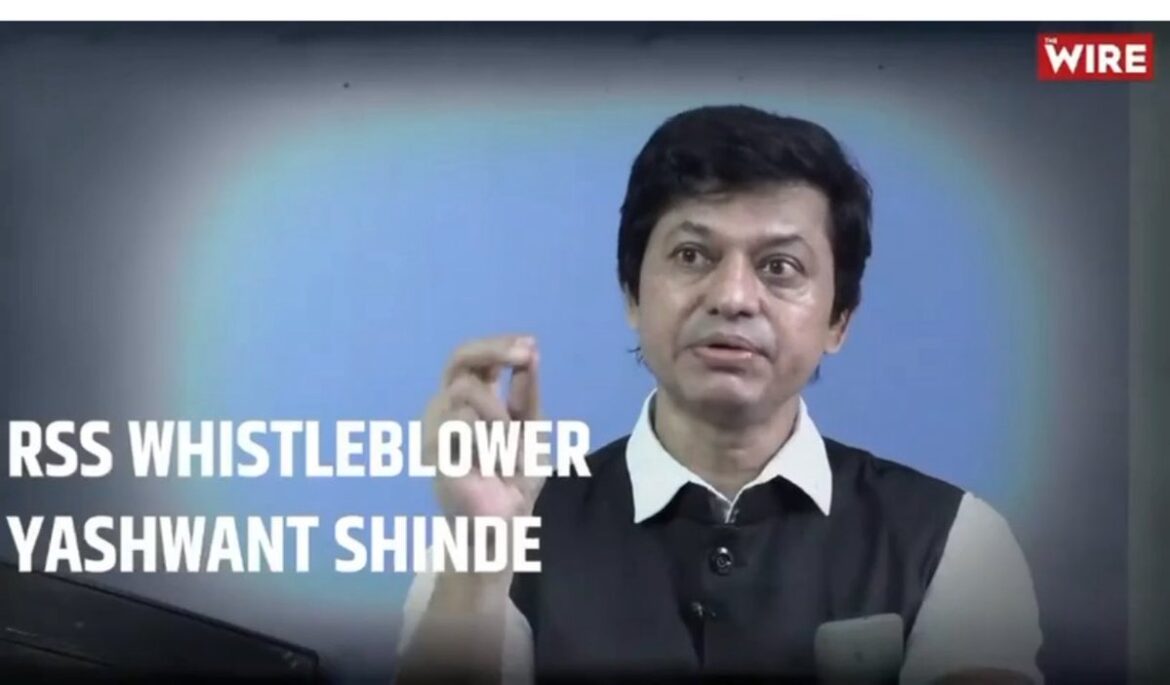
Yashwant Shinde, a former RSS pracharak who joined the organisation in 1994, told The Wire, an independent news platform, that the attacks were a deliberate attempt to polarise voters along religious lines ahead of the 2004 general elections.
“This was a conspiracy by some people in the RSS, VHP, Bajrang Dal and BJP with extremely vile and perverse mindsets, solely for the sake of power,” Shinde said in a detailed interview. “They wanted to set the country on fire so that power would always remain with them.”
Shinde, who also served as the Mumbai unit head of the Bajrang Dal in 1999, said the plot was spearheaded by senior RSS leader Indresh Kumar and VHP leader Milind Parande. He was introduced around 2000 to a group in Nanded, Maharashtra, which underwent weapons training, including from the army, with plans to attack civilians in Pakistan.
“The bomb being made in Nanded went off in 2006, killing people. But before that, they had already carried out attacks in three places. Their goal was to incite large-scale communal violence ahead of the 2004 elections,” Shinde said. The group was trained to build time bombs, with instructions to target public gatherings such as Muslim weddings, and executed attacks in the Maharashtra towns of Parbhani, Jalna, and Purna in 2003 and 2004.
Shinde said the group conducted reconnaissance of a mosque in Aurangabad as a potential target. One such incident, Shinde recalled, was a bomb that exploded accidentally on the night of April 4-5, 2006, at the residence of Laxman Rajkondwar, an alleged RSS worker in Nanded. The blast killed Rajkondwar’s son, Naresh, and Himanshu Panse, a VHP activist. The Central Bureau of Investigation (CBI), which took over the case from the Maharashtra Anti-Terrorism Squad, said the two were assembling a device possibly intended for a mosque in Aurangabad.
Shinde named Rakesh Dhawde and Ravi Dev, who he said operated under the alias Mithun Chakravarty, as key figures in the conspiracy, with Dhawde also linked to the Malegaon and Purna-Jalna bombing cases. He described operatives like Pragya and Purohit as “pawns” who could be sacrificed to protect the real masterminds, including Kumar and Parande.
Shinde said he attended a bomb-making training camp in Sinhagad Talathi, near Pune, with 20-25 others from Maharashtra. “At that camp, I warned several people that this would destroy the country. Their plan was to kill thousands of Hindus and Muslims to create a narrative,” he said.
In a series of four interviews in September 2022 to The Caravan magazine, Shinde said he was trained to carry out covert operations in Pakistan and conduct bombings in India that could be blamed on Muslims.
His fellow trainees bombed mosques in Jalna, Purna, and Parbhani in 2003 and 2004, and others tied to the conspiracy were linked to a bombing campaign that killed more than 120 people over five years.
“Politically in coma, they exploited Ayodhya for 82-84 seats in 1989, their eyes lit up and then Kashmir to repeatedly boost Atal Bihari Vajpayee to prime minister,” Shinde said. “The Hindu-Muslim riots, attacks in Pakistan, and unrest in Kashmir were part of a broader plan to gain political power.”
Shinde, who joined the RSS inspired by the situation in occupied Jammu and Kashmir, said a 1995 arrest under the Public Safety Act for allegedly attacking then-Chief Minister Farooq Abdullah earned him credibility within the RSS. However, he grew disillusioned over time. “If I had never left Mumbai, I’d probably still be a blind follower. But I travelled, worked in different places, and saw what was really going on. That’s when I realised the truth.”
Shinde said he tried to derail the conspiracy from within but feared for his life if he opposed it openly. In 2022, he filed an affidavit in a Nanded court, seeking to become a witness in the 2006 Nanded blast case under Section 311 of the Code of Criminal Procedure, which allows courts to summon witnesses at any stage of a trial.
He claimed prior knowledge of training camps and individuals involved, citing a senior VHP worker who told him about a terror training camp aimed at carrying out blasts across India. The CBI opposed his application, and the court rejected it, a decision Shinde attributed to political pressure. “Judge Dhamecha was under pressure. His face looked hopeless,” he said of the court proceedings. “Then they brought another judge, Marathe, who rejected two petitions from inside his cabin.”
Shinde said Indian investigative agencies and parts of the judiciary were complicit in covering up the conspiracy, shielding influential leaders while scapegoating lower-level operatives. “They are calling others masterminds just to break the chain leading to top leaders like Indresh Kumar and Milind Parande.”
After the Supreme Court dismissed his petition for a new investigation, Shinde decided to speak publicly, despite receiving no security. “I filed a petition, and still, I got no protection. They can have me killed anywhere. Meanwhile, they increase the security of someone like Kangana Ranaut,” he said, referring to the Bollywood actor and politician.
Shinde said he remained silent for years due to threats to his life. “He said his conscience no longer allows him to stay silent,” his lawyer, Sangameshwar Delmade, told The Wire.
Copyright © 2021 Independent Pakistan | All rights reserved