By Staff Reporter
ISLAMABAD: The United States on Tuesday reaffirmed its dedication to combating terrorism in all its manifestations alongside Pakistan, a commitment highlighted by the recent addition of the Balochistan Liberation Army (BLA) to Washington’s Foreign Terrorist Organisation list, as the two nations navigate a period of markedly strengthened bilateral relations.
The US State Department’s move on Monday to designate the BLA, a proscribed group in Pakistan, and its alias, the Majeed Brigade, as foreign terrorists was described by US officials as a demonstration of their resolve to counter terrorism.
Long desired by Islamabad, the action signals enhanced cooperation between the two countries and underscores the importance of international coordination in addressing such threats.
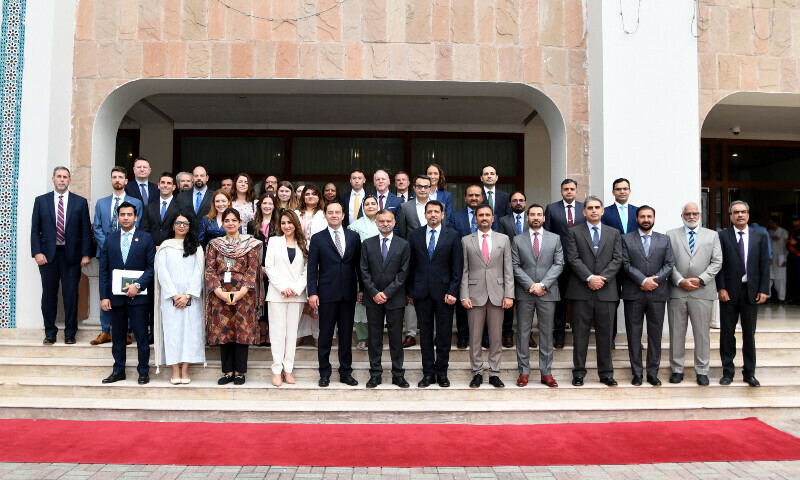
In a post on X, the US Embassy in Islamabad detailed the participation of Acting Coordinator for Counterterrorism Gregory LoGerfo and Chargé d’Affaires Natalie Baker in the US-Pakistan Counterterrorism Dialogue, noting that the talks advanced the shared resolve of both nations to confront the global menace. “We remain committed to countering terrorism in all its forms,” the embassy stated.
According to a statement from Pakistan’s Foreign Office (FO), the dialogue was co-chaired by Special Secretary (UN) Ambassador Nabeel Munir and LoGerfo. The delegations emphasised the critical need to develop effective strategies against terrorist threats, specifically those emanating from the BLA, Islamic State-Khorasan (IS-K), and Tehreek-i-Taliban Pakistan (TTP).
“The US applauded Pakistan’s continued successes to contain terrorist entities that pose a threat to the peace and security of the region and the world. Furthermore, the US expressed condolences for the loss of civilians and members of law enforcement agencies in terrorist incidents in Pakistan, including the barbaric Jaffar Express terrorist attack and the bombing of a school bus in Khuzdar,” the FO said. “Both delegations emphasised the importance of building stronger institutional frameworks and developing capabilities to respond to security challenges and to counter the use of emerging technologies for terrorist purposes.”
The sides also reaffirmed their intention to collaborate closely in multilateral fora, including the United Nations, to promote effective and enduring approaches to counterterrorism. “Reaffirming the long-standing partnership between Pakistan and the US, both sides emphasised that sustained and structured engagement remains vital to countering terrorism and promoting peace and stability,” the FO statement continued.
LoGerfo’s itinerary included a call on Deputy Prime Minister and Foreign Minister Ishaq Dar, during which the US official briefed Dar on the dialogue’s proceedings. Dar, in turn, encouraged sustained and structured bilateral engagement on counterterrorism between the two countries as a “vital contributor to peace and stability in the region and beyond”, according to the statement.
This latest dialogue builds on the previous US-Pakistan Counterterrorism Dialogue held in May of last year, where both countries reaffirmed their commitment to continuing counterterrorism cooperation aimed at advancing regional and global security and stability. The counterterrorism talks cap a flurry of high-level interactions that point to a revitalised partnership.
On Sunday, Pakistan’s Chief of Army Staff (COAS) Field Marshal Asim Munir concluded a visit to the United States, describing the trip, his second in just one-and-a-half months, as a “new dimension” in ties between the two nations. Munir had previously visited the US in June for a five-day official engagement, during which he met US President Donald Trump over luncheon. This marked a historic milestone, as Munir became the first serving Pakistani army chief to hold an official face-to-face meeting with a sitting US president.
The two leaders discussed joint counterterrorism efforts and opportunities for expanding bilateral trade in their “cordial” meeting in Washington. Trump “lauded Pakistan’s ongoing efforts for regional peace and stability, and appreciated the robust counterterrorism cooperation between the two states”.
Adding to the momentum, Foreign Minister Dar met US Secretary of State Marco Rubio last month, where they addressed topics including trade, investment, counterterrorism cooperation, and the clash between India and Pakistan in May, according to officials from both countries.
The meeting represented the first such engagement between the foreign ministers of the two nations in three years and was widely regarded as a breakthrough in US-Pakistan diplomacy. Rubio recognised Pakistan’s “unparalleled sacrifices” in the fight against terrorism and described Islamabad as a “constructive actor” in efforts to ensure regional stability.
In a further endorsement, United States Central Command chief Army General Michael Kurilla in June praised Pakistan as a “phenomenal partner in the world of counter-terrorism”, citing the nation’s ongoing struggles against terrorism in Balochistan and against groups such as IS-K. Of late, Islamabad and Washington appear to be in lockstep, with positive signals that began emanating soon after Trump’s inauguration evolving into full-blown bonhomie.
From acknowledging Pakistan’s counterterror cooperation in the arrest of an IS-Khorasan operative to claiming credit for stopping a nuclear war in South Asia, the country has perhaps featured more prominently in this US president’s day-to-day media interactions than under any past commander-in-chief. On the economic front, Pakistan has secured what appears to be a major discount in tariff negotiations, attracted US investor interest in its oil and mineral reserves, and signalled that its currency market is receptive to digital assets and cryptocurrencies—developments that position Islamabad firmly in the driving seat as far as South Asia is concerned.
Copyright © 2021 Independent Pakistan | All rights reserved