By Staff Reporter
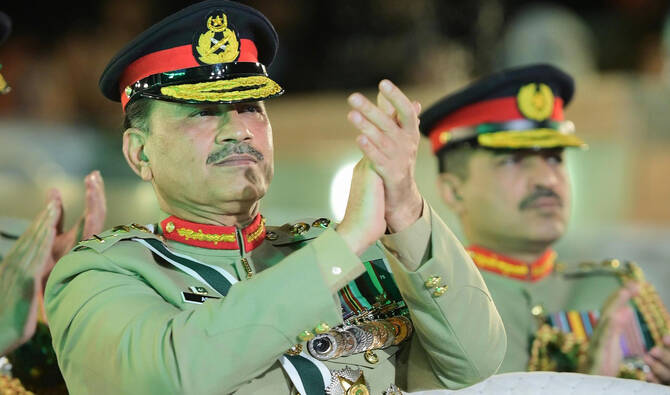
ISLAMABAD: Pakistan’s powerful army chief has dismissed rumours of imminent changes to the country’s presidency or premiership as the handiwork of elements bent on sowing political chaos, insisting he has no ambition for higher office.
Field Marshal Asim Munir made the remarks in a conversation with a senior journalist in Brussels, where he stopped over on his return from a visit to the United States last week, according to a column published on Saturday in the Daily Jang newspaper.
“The talk started with politics, especially on rumours that there is some effort to change the president of Pakistan as well as the prime minister,” wrote Suhail Warraich, the newspaper’s senior editor, who met the army chief for a two-hour discussion.
“Field Marshal Munir clearly said, during both the Brussels gathering and in his two-hour discussion with me, that the rumours about a change were completely false,” the column said.
“When informed that this ‘news’ had been circulated by both civil and military agencies, he said this could not be possible. ‘In fact, there are elements behind this who oppose both the government and the authorities and wish to create political anarchy,'” the army chief was quoted as saying.
Speculation had swirled last month that President Asif Ali Zardari might step down, clearing the path for Field Marshal Munir to take the presidency, with social media reports suggesting a shift from the current parliamentary system to a presidential one.
Some accounts claimed Zardari had stipulated a prominent role for his son, Bilawal Bhutto-Zardari, as a condition for his departure.
Similar rumours emerged in July, alleging Zardari could be ousted to make way for the army chief, but these were swiftly rejected by top officials.
Prime Minister Shehbaz Sharif said Field Marshal Munir “has never expressed any desire to become the president, nor is there any such plan in the offing”, while Interior Minister Mohsin Naqvi, who dismissed the claims twice, branded them a “malicious campaign” targeting Zardari, the premier and the army chief.
Military spokesman Lt Gen Ahmed Sharif Chaudhry also rubbished the reports as “nonsense”.
“God made me this country’s guardian,” Field Marshal reiterated in his exchange with Warraich, adding he harboured no desire for any other role.
Munir heaped praise on Prime Minister Shehbaz Sharif for his dedication, including 18-hour workdays during the May conflict with India, and commended the federal cabinet and government for their “determination and courage” amid those challenges.
He lauded the administration’s resolve during trying times, describing it as remarkable.
On domestic politics, the army chief said reconciliation was possible “only if there is a sincere apology”, without specifying the parties involved, though the reference appeared aimed at the opposition Pakistan Tehreek-e-Insaf (PTI) party and its jailed founder, Imran Khan.
Turning to foreign affairs, Field Marshal Munir voiced confidence in Pakistan’s ability to balance ties with the United States and China.
“We will not sacrifice one friend for the other,” he was quoted as saying, highlighting the country’s long experience in managing such relations.
Relations with Washington have warmed since US President Donald Trump returned to office, marked by Trump’s recent White House lunch for the army chief — a gesture that rattled India and underscored a diplomatic thaw.
The army chief described Trump’s peace initiatives as “genuine”, noting Pakistan had pioneered his nomination for the Nobel Peace Prize, with other nations following suit.
On regional tensions, Field Marshal Munir warned India against using proxies to undermine Pakistan’s stability, especially after New Delhi’s defeat in the days-long “Marka-e-Haq” clash between the nuclear-armed neighbours.
India has since ramped up its proxy activities, employing groups dubbed Fitna-al-Khawarij and Fitna-al-Hindustan to pursue disruptive aims, according to Pakistani assessments.
Munir also urged Afghanistan to cease policies that drive Taliban elements into Pakistan, warning of repercussions if such actions persisted.
“We have shown kindness and favours to Afghans for years, but instead of repaying them, a conspiracy is being hatched against us in collaboration with India,” the column quoted him as saying.
The nuclear-armed nation of over 240 million people has been ruled directly by its all-powerful army for over 30 years of its history, and even when not in power, the military remains the invisible guiding hand of politics, with an outsized role in decision making related to foreign affairs, national security and the economy. Though, the army says it no longer interferes in political affairs.
Copyright © 2021 Independent Pakistan | All rights reserved