By Staff Reporter
ISLAMABAD: The communications minister invited Saudi Arabia’s leading business council on Friday to take a financial stake in three major highway projects, including a 306-kilometer motorway through Sindh that has languished in planning documents for the better part of three decades, as Islamabad pressed to close a persistent gap in its national road network and draw Gulf capital into an infrastructure push central to its economic recovery.
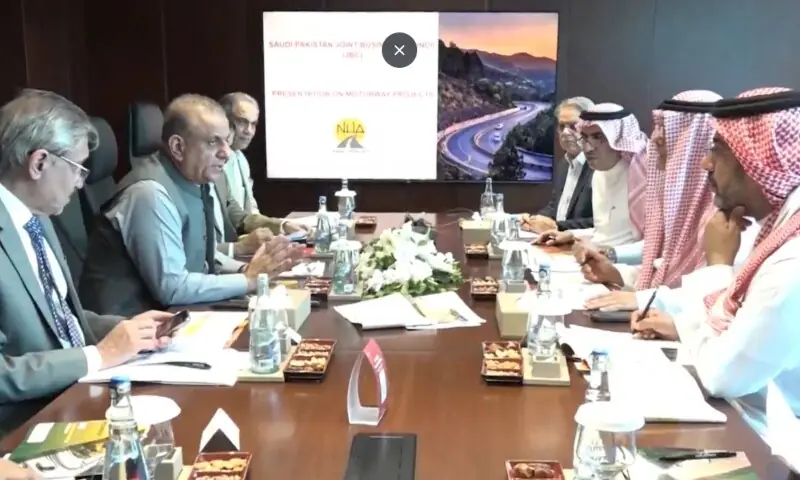
The invitation was extended by Federal Minister Abdul Aleem Khan during a meeting in Islamabad with Prince Mansour bin Muhammad Al Saud, chairman of the Saudi-Pakistan Joint Business Council, who arrived in the capital this week at the head of a high-powered business delegation. The two men discussed, according to Pakistan’s Press Information Department, the promotion of bilateral economic ties and the concrete investment opportunities that Islamabad believed it could offer.
Khan placed three projects before the Saudi delegation: the M6 Sukkur-Hyderabad Motorway, the M10 connecting Karachi Port, and the M13 linking Kharian to Rawalpindi. He described them as commercially attractive, strategically situated, and capable of generating durable long-term returns — language calibrated, officials acknowledged, to an audience that has heard Pakistan’s investment pitches before and arrived with its own due diligence.
Prince Mansour responded with what the PID characterized as strong interest, saying the council was well-positioned to explore partnership arrangements in Pakistan’s communications and infrastructure sectors. No agreements were announced and no figures were disclosed.
The centerpiece of the pitch was the M6. At 306 kilometers, the six-lane motorway would run between Sukkur and Hyderabad, threading through a stretch of Sindh that currently forces freight and passenger traffic onto aging roads ill-suited to the volume passing between Karachi’s port and the country’s interior. The project would include 15 interchanges and 10 service areas, and officials say its completion would, for the first time, provide uninterrupted motorway-grade connectivity from Karachi all the way north to Peshawar and on to Gilgit.
Khan has called the M6 the missing link in the Karachi-Peshawar corridor. The description is accurate in a narrow technical sense and pointed in its political implication: successive governments sketched the route, allocated funds, and moved on, leaving the gap intact. In April, the National Highway Authority and the Asian Development Bank signed a financing agreement for two sections of the motorway — an arrangement Khan said at the time would allow construction to begin within two years. That agreement lent some credibility to the Friday pitch. Whether Saudi private capital would supplement ADB financing, or compete with it, remained unclear.
The Saudi delegation’s visit to Islamabad carried weight beyond any single infrastructure deal. Saudi Arabia has been one of Pakistan’s most reliable financial backers in periods of balance-of-payments stress, extending deposits and deferred payment arrangements when Islamabad’s foreign exchange reserves have run thin. The kingdom’s commercial investors have been slower to commit, and Pakistani officials have long sought to translate the political relationship into durable investment flows rather than episodic emergency support.
On Thursday, the delegation met Prime Minister Shehbaz Sharif, whose office said the discussions covered trade and investment across infrastructure, energy, and technology. The Saudi embassy, in a post on X on Friday, noted that the meeting with Sharif also included the kingdom’s ambassador to Pakistan, Nawaf bin Said Al-Malki, and focused on expanding trade relations. The delegation was scheduled to continue meetings with senior government officials and private-sector representatives throughout the week.
For Pakistan, the timing of the outreach reflects a government that believes it has more to offer than it did two years ago. Inflation has eased, the rupee has stabilized, and an IMF program has restored a measure of fiscal credibility. Road construction, in particular, has moved from rhetoric to ground activity on several fronts, giving officials a set of projects they can point to rather than merely describe. Whether that is enough to convert a Saudi prince’s expressed interest into signed agreements — and eventually into asphalt — is a question Islamabad has been trying to answer for a very long time.
Copyright © 2021 Independent Pakistan | All rights reserved