By Staff Reporter
ISLAMABAD: Prime Minister Shehbaz Sharif urged fellow members of the Shanghai Cooperation Organization on Monday to engage in a “structural” dialogue to resolve longstanding disputes, pointedly raising concerns over the Indus Waters Treaty in an apparent jab at India amid escalating tensions over water rights and security.
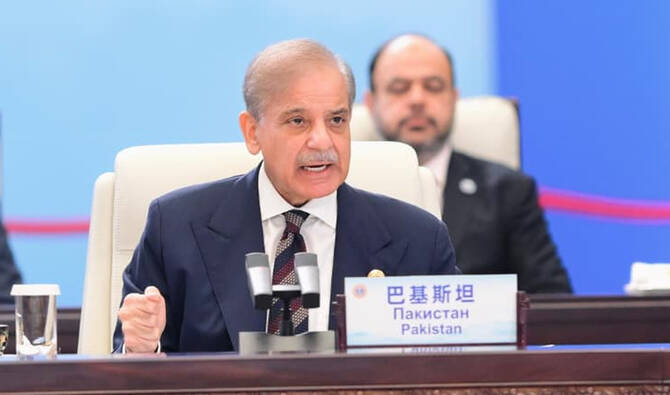
Speaking at the SCO’s Council of Heads of State summit here in this bustling port city Tianjin, China, Sharif emphasized the need for uninterrupted access to water shares under existing agreements, warning that adherence to such pacts is essential for the bloc’s smooth functioning and broader objectives.
“We respect all international and bilateral treaties and expect similar principles to be followed by all SCO members,” Sharif said, in what appeared to be a reference to India’s decision in April to hold the 1960 treaty in abeyance following a deadly attack in Kashmir that New Delhi attributed to Pakistan.
“Uninterrupted access to due share of water as per existing treaties among SCO members will strengthen the SCO working smoothly and will support the achievement of broader goals for which the SCO was established,” he added.
The summit, held from Aug. 31 to Sept. 1, brought together leaders from the SCO’s 10 full members — including China, India, Russia, Iran, Kazakhstan, Kyrgyzstan, Tajikistan, Uzbekistan, Belarus and Pakistan — along with representatives from 16 observer and dialogue partner nations. Sharif arrived in China on Saturday for the gathering, hosted under Beijing’s chairmanship.
The Indus Waters Treaty, brokered by the World Bank more than six decades ago, allocates water from the Indus River system between India and Pakistan. India suspended its participation after an April 22 attack in occupied Kashmir’s Pahalgam area that killed 26 people, an incident New Delhi blamed on Islamabad without providing evidence. Pakistan has denounced the move as an “act of war.”
Earlier this month, the Permanent Court of Arbitration in The Hague ruled in a “Supplemental Award of Competence” that India cannot unilaterally suspend the treaty.
Sharif called for a “comprehensive and structural dialogue to discuss all outstanding disputes,” saying, “I will request your consideration to lead this dialogue under your sagacious leadership so that they can have its dividends as early as possible.”
He reaffirmed Pakistan’s commitment to peaceful relations, noting that the country sought a “normal and stable relationship with all its neighbours” and favored “dialogue and diplomacy over conflict and confrontation.”
“Pakistan has always believed in the power of multilateralism, dialogue and diplomacy, and shunning unilateralism,” Sharif said. “And yet, to our shock and deep disappointment, the region witnessed extremely disturbing developments during the last few months.”
“Pakistan supports and respects the sovereignty and integrity of all SCO members and its neighbours,” he added. “We will continue our efforts, along with all SCO members and the chairman of SCO, to promote progress and prosperity in the entire region and to ensure lasting peace in South Asia.”
Sharif pledged that Pakistan would abide by the U.N. and SCO charters, reiterating, “As a peace-loving nation, Pakistan has always advocated dialogue and diplomacy, consultation over confrontation.”
In his address, Sharif also drew attention to the devastating floods ravaging his country, describing “unprecedented torrential rains, cloudbursts and massive devastation due to consequent flooding in three of our major rivers.” He highlighted the toll in lives, livestock, infrastructure and crops.
“We deeply appreciate the international community’s, including China’s, solidarity, sympathy and support with us,” Sharif said, praising the “rescue and rebuilding efforts of my brave and resilient people.”
Sharif turned to the persistent threat of terrorism, asserting that Pakistan possessed “irrefutable evidence of involvement of some foreign hands” in recent attacks, including the March hijacking of the Jaffar Express train.
The incident involved militants seizing the train en route from Quetta to Peshawar near Balochistan’s Sibi area, resulting in at least 26 deaths, including 18 security personnel. Military forces neutralized all 33 terrorists in a two-day operation.
“We have irrefutable evidence of involvement of some foreign hands in the devastating Jaffar Express train hostage incident, as well as countless other terrorist attacks against us in Balochistan and KP provinces of Pakistan,” Sharif said. “Those who have long used terrorism for advancing their political interests must know that the world no longer buys this fictitious narrative.”
Days after the hijacking, Pakistan’s military accused India of sponsoring the attack, and in April, the country’s UN mission cited “credible evidence” of external involvement by regional adversaries.
“The menace of terrorism, separatism, [and] extremism continues to pose a grave threat to Pakistan and endanger peace and security of the entire SCO region and the SCO family,” Sharif said. “We condemn terrorism in all its forms and manifestations with the fullest force at our command, including state terrorism in clear and ambiguous terms.”
He recalled Pakistan’s heavy sacrifices in the fight against terrorism, including more than 90,000 lives lost and economic damages exceeding $152 billion — “a sacrifice which has no parallel in history.” Sharif described this as evidence of Pakistan’s “unwavering commitment to defeat terrorism with the cooperation of all SCO members and global powers around the globe.”
On Afghanistan, Sharif expressed hope for a “peaceful and stable” neighbor, saying it served the interests of Pakistan and the wider region. “While we remain engaged in building our ties with the Afghan leadership to leverage them as economic partners and good neighbours, we hope that this cooperation with Afghanistan and our trilateral meetings between China, Pakistan and Afghanistan will have positive results in times to come,” he said.
Sharif stressed the importance of regional connectivity, noting that SCO leaders have repeatedly affirmed the need for efficient transport corridors to bolster supply chains. He pointed to the expansion of the China-Pakistan Economic Corridor as a way to advance the bloc’s goals for integration.
The prime minister also condemned Israel’s actions, including its June attacks on Iran and the ongoing violence in Gaza.
“Israel’s unjustified aggression against our fellow brotherly member country Iran, a fellow SCO state, is condemnable and therefore unacceptable,” Sharif said.
“The suffering and starvation unfolding in Gaza is a festering wound on our collective conscience,” he added. “We reiterate our call for an immediate end to gruesome violence and heart-wrenching bloodshed in Gaza.”
Sharif reiterated Pakistan’s support for a two-state solution, with an independent Palestine based on pre-1967 borders and Al-Quds Al-Sharif as its capital.
At the start of his remarks, Sharif praised Tianjin as a symbol of “China’s core values as a connector and bridge of cultures and civilisation.” He thanked President Xi Jinping and the Chinese government for their hospitality and arrangements, and congratulated Uzbekistan and Kyrgyzstan on their national days.
“For us, the SCO is a platform that best represents Pakistan’s abiding commitment to regional cooperation and integration,” Sharif said. “China’s successful tenure as chair of the SCO is reflective of President Xi’s sagacious and visionary leadership.”
Copyright © 2021 Independent Pakistan | All rights reserved