By Staff Reporter
ISLAMABAD: Leaders of the Shanghai Cooperation Organization, a powerful Eurasian security bloc, on Monday adopted a joint statement condemning recent terrorist attacks in Pakistan and India, marking a rare consensus amid escalating accusations between the two nuclear-armed neighbors over alleged involvement in militant violence.
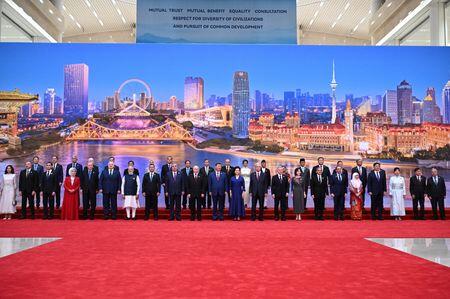
The declaration, issued at the conclusion of a two-day summit hosted by Chinese President Xi Jinping in this northern port city, explicitly denounced three deadly incidents that have heightened tensions in South Asia. It highlighted the April 22 assault in Pahalgam, a popular tourist destination in Indian-administered Kashmir, where gunmen killed at least 26 people — all men from various parts of India except one Nepali national — and wounded 17 others. The attack was the deadliest on civilians in the region since 2000.
The statement also addressed two strikes in Pakistan: the March 11 hijacking of the Jaffar Express train, in which Balochistan Liberation Army militants ambushed a Peshawar-bound service carrying 440 passengers, opened fire and took hostages, prompting a two-day security operation that ended on March 12; and the May 21 bombing of a school bus near Zero Point in Khuzdar on the Quetta-Karachi highway, which killed at least six people, including three students, and injured more than 40 others, mostly students en route to the Army Public School in Khuzdar Cantonment.
In each case, Islamabad and New Delhi have traded blame, with each side accusing the other of complicity. The friction spilled into earlier SCO deliberations; a June meeting of defense ministers failed to produce a joint statement after India refused to endorse a draft that omitted mention of the Pahalgam attack, according to reports in The Times of India.
The Tianjin Declaration, as the document is known, stated: “Member states strongly condemned the terrorist attack in Pahalgam on April 22 2025.
“Member states also strongly condemned the terrorist attacks on Jaffar Express on March 11 and in Khuzdar on May 21, 2025.”
The leaders extended their “deepest sympathy and condolences” to the victims’ families and the injured, insisting that “the perpetrators, organisers and sponsors of such attacks must be brought to justice.”
Reaffirming their anti-terrorism stance, the declaration added: “The member states, while reaffirming their firm commitment to the fight against terrorism, separatism and extremism, stress the inadmissibility of attempts to use terrorist, separatist and extremist groups for mercenary purposes. They recognise the leading role of sovereign states and their competent authorities in countering terrorist and extremist threats.”
The SCO, a 10-member grouping that includes China, Russia, Pakistan, India and Iran, encompasses about 24 percent of the world’s land area and 42 percent of its population. Its economies represent roughly one-quarter of global gross domestic product, with trade among members surging nearly 100-fold over the past two decades. China’s commerce with SCO members, observers and dialogue partners hit a record $890 billion in 2024, accounting for 14.4 percent of its total foreign trade.
This summit, the largest in the organization’s history, drew about 20 heads of state and government, along with representatives from international bodies. It was China’s fifth time hosting since the SCO’s founding in 2001, evolving from the earlier “Shanghai Five” mechanism of China, Russia, Kazakhstan, Kyrgyzstan and Tajikistan, later joined by Uzbekistan and expanded further.
Beyond the terrorism condemnations, the leaders pledged to bolster cooperation against broader threats. The declaration emphasized a commitment to “ensuring sustainable international peace” and called for collaborative action on “traditional and new security challenges and threats.”
It continued: “They reaffirmed their determination to continue the joint fight against terrorism, separatism and extremism, as well as against the illicit trafficking of narcotic drugs, psychotropic substances and their precursors, arms smuggling and other forms of transnational organised crime.”
To that end, participants signed the Agreement on the Universal Centre for Countering Challenges and Threats to the Security of SCO Member States and the Agreement on the SCO Anti-Drug Centre. They also noted a proposal to create a Centre for Strategic Studies on security issues and vowed to implement the Programme of Cooperation of SCO Member States in Countering Terrorism, Separatism and Extremism for 2025-2027.
More broadly, the leaders decried “double standards in the fight against terrorism” and urged the international community to combat it comprehensively, “including cross-border movement of terrorists, with the central role of the United Nations, by fully implementing the relevant UN Security Council resolution and the UN Global Counter-Terrorism Strategy in accordance with the UN Charter and the principles of international law, in order to jointly combat all terrorist organisations.”
“They stress the importance of adopting by consensus a comprehensive convention on international terrorism,” the declaration said.
The summit yielded 24 documents enhancing ties in security, economics and culture, including a 10-year SCO Development Strategy through 2035, which “defines the priority tasks and main directions for deepening multifaceted cooperation in the interests of ensuring peace and stability, development and prosperity in the SCO space,” according to a joint statement.
Against the backdrop of U.S. tariffs disrupting global markets, the leaders voiced support for the multilateral trading system. They also commemorated the 80th anniversary of the victory in World War II and the founding of the United Nations.
In a structural shift, the SCO decided to merge its “observer” and “dialogue partner” categories into a single “SCO Partner” status, with Laos accepted as the first under the new designation. The organization now spans 10 members, two observers and 14 dialogue partners across Asia, Europe and Africa.
The gathering also addressed global hotspots. On the Middle East, the leaders expressed “deep concern over the continuing escalation of the Palestinian-Israeli conflict” and “strongly condemned actions that led to numerous casualties among the civilian population and a ‘catastrophic humanitarian situation’ in the Gaza Strip.”
They advocated for “an immediate, complete and sustainable ceasefire, access to humanitarian aid, and intensified efforts to achieve peace, stability and security for all residents of the region.”
“Member states note that the only possible way to ensure peace and stability in the Middle East is through a comprehensive and just settlement of the Palestinian question,” the declaration stated.
Regarding tensions involving Iran, the SCO condemned Israeli and U.S. military strikes against the country in June as a “gross violation of the principles and norms of international law and the UN Charter, and an infringement on the sovereignty of the Islamic Republic of Iran” that jeopardized regional and global security.
Such actions targeted civilian sites, including nuclear infrastructure, resulting in civilian deaths, the statement said. The leaders stressed that “the physical nuclear safety and security of nuclear facilities must be ensured on a permanent basis, including during periods of armed conflict, in order to protect the population and the environment from harm.”
They reaffirmed support for U.N. Security Council Resolution 2231 (2015) on Iran’s nuclear program, calling it “binding” and warning against arbitrary interpretations that could erode the council’s authority. Urging a return to dialogue, they advocated for “jointly seeking solutions that would prevent further escalation of the situation.”
On Afghanistan, the SCO reiterated its backing for the country as “an independent, neutral and peaceful state, free from terrorism, war and drugs,” and pledged support for international efforts toward peace and development.
“Member states reiterated that the formation of an inclusive government with broad participation of representatives of all ethno-political groups of Afghan society is the only way to achieve lasting peace and stability in the country,” the declaration said.
The previous SCO leaders’ summit occurred in Kazakhstan in July 2024, where 25 strategic documents on energy, security, finance and information security were adopted. China will hand the rotating chairmanship to Kyrgyzstan, with the next summit themed “25 years of the SCO: together towards sustainable peace, development and prosperity.”
Copyright © 2021 Independent Pakistan | All rights reserved