By Staff Reporter
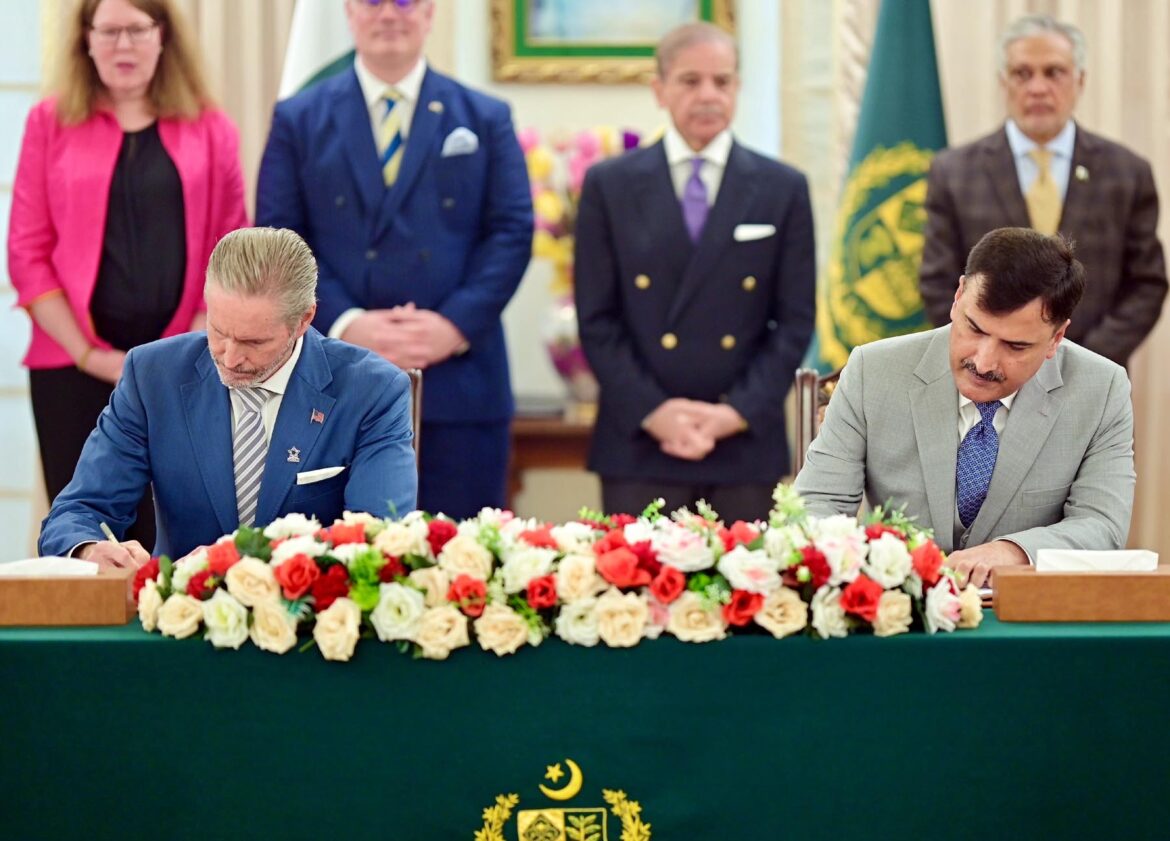
ISLAMABAD: Pakistan and the United States signed a memorandum of understanding (MoU) to advance cooperation in critical minerals, the US Embassy in Islamabad said on Monday, a move aimed at attracting investment and strengthening bilateral ties.
The agreement, signed at the Prime Minister’s House in Islamabad, involves US Strategic Metals (USSM), a Missouri-based firm specialising in extracting and recycling critical minerals like cobalt, nickel, copper, and lithium, and Pakistan’s Frontier Works Organization (FWO), the country’s largest miner of critical minerals. The deal’s first phase is valued at approximately $500 million, according to a statement from the Prime Minister’s Office.
“The partnership will begin immediately with the export of readily available minerals from Pakistan, including antimony, copper, gold, tungsten, and rare earth elements,” the Prime Minister’s Office said, adding that it lays the foundation for a USSM-operated poly-metallic refinery in Pakistan to meet US market demand.
Critical minerals, defined by the US Department of Energy as vital for advanced manufacturing and energy production, are essential for technologies such as solar panels, electric vehicles, and defense systems but face supply chain risks.
“This signing is yet another example of the strength of the US-Pakistan bilateral relationship that will benefit both countries,” US Chargé d’Affaires Natalie Baker said in an embassy statement.
A US delegation, including USSM and global engineering firm Mota-Engil, visited Pakistan from Sept. 7-9 to explore mining expansion and infrastructure development, the Prime Minister’s Office said. The group met Prime Minister Shehbaz Sharif, Chief of Army Staff Field Marshal Syed Asim Munir, Deputy Prime Minister Ishaq Dar, and the petroleum and commerce ministers, who briefed them on Pakistan’s reserves of copper, gold, and rare earth elements.
A second MoU was signed between Pakistan’s National Logistics Corporation and Mota-Engil, focusing on logistics to support the minerals sector. “The current survey of opportunities in Pakistan aims to identify priority markets where Mota-Engil can align with government visions and private sector initiatives,” the Prime Minister’s Office said, noting the firm seeks partnerships for job creation, technology transfer, and sustainable development.
The USSM agreement establishes “a framework for collaboration across a range of critical minerals essential for the defense, aerospace, and technology industries,” the statement added. It includes plans for dedicated teams to explore Pakistan’s resource base, prioritize minerals for export, and ensure sustainability and environmental responsibility.
Baker highlighted the deal’s strategic importance, saying the Trump administration prioritises such agreements due to critical minerals’ role in US security and prosperity. “We look forward to future agreements between US companies and their counterparts in Pakistan’s critical minerals and mining sector,” she added.
The deal follows warming US-Pakistan ties. In July, a trade agreement lowered US tariffs on Pakistani goods from 29% to 19%. President Donald Trump also announced collaboration on Pakistan’s oil reserves, signaling deeper economic engagement.
Pakistan’s mineral wealth, including gold, copper, and lithium, is underutilized, contributing just 3.2% to GDP and 0.1% to global exports, official data shows. Islamabad is seeking foreign investment, with April’s international minerals summit drawing firms from the US, Saudi Arabia, and China.
Last month, U.S. Secretary of State Marco Rubio expressed interest in Pakistan’s minerals and hydrocarbons, while talks focused on enhancing railway and infrastructure systems for mineral extraction and transport.
The agreements mark “a milestone in Pakistan’s efforts to attract global investment in the mining & logistics sectors,” the Prime Minister’s Office said, emphasizing benefits in sustainable growth, technology transfer, and job creation.
Copyright © 2021 Independent Pakistan | All rights reserved