By Staff Reporter
ISLAMABAD: Four senior judges of the Supreme Court of Pakistan boycotted a full court meeting on Monday and sharply criticised the process for adopting new procedural rules, calling it a unilateral move by the chief justice that bypassed collective deliberation and lacked legal legitimacy.
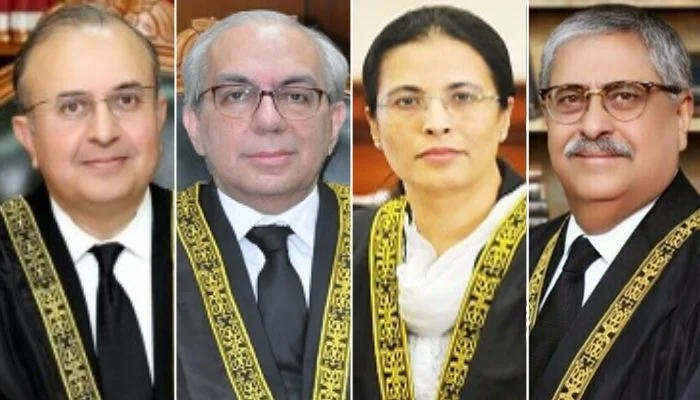
In a letter to Chief Justice Yahya Afridi, the judges — senior puisne judge Justice Mansoor Ali Shah, Justice Munib Akhtar, Justice Ayesha Malik and Justice Athar Minallah — described the session as little more than a “stamp of approval” for rules that had already been decided and approved without input from the full bench. The letter highlighted what the judges termed “substantive and procedural illegality” in the Supreme Court Rules 2025.
“If the full court was not deemed necessary for the adoption of the rules themselves, how can it now be summoned to deliberate upon their amendment?” the judges wrote.
The dispute underscores ongoing tensions within the judiciary over governance and decision-making, coming just a week after Justice Shah sent a separate letter questioning why the historic revision of the 1980 rules was “approved by circulation” rather than through a full court discussion.
The new rules stem from a committee formed in March by Chief Justice Afridi to review the Supreme Court Rules of 1980. The panel was tasked with drafting updates aimed at enhancing transparency, efficiency and overall effectiveness in judicial proceedings. But when the draft was circulated among judges, some senior members opposed approving it without a full court meeting, and the legal fraternity raised concerns about certain provisions.
According to the letter, the chief justice informed judges on Aug. 12 that the rules had been approved through circulation and notified in the Gazette on Aug. 9. Yet, he then sought suggestions “for further amendments” to the same rules. The four judges questioned the legality, noting that the “present Supreme Court rules were never placed before, nor approved by, the full court.”
Citing Article 191 of the Constitution, which grants the Supreme Court power to make rules regulating its practice and procedure, they argued that this authority “is exercised collectively by the court as an institution.” Rules established “without deliberation and approval of the full court” lack approval and cannot acquire “binding legal status,” they said.
The judges took particular issue with the use of circulation, calling it “an administrative convenience to deal with routine or minor procedural matters; it is not, and cannot be, the vehicle for laying down the constitutional architecture of this court’s governance.” “Unless the full court had itself had expressly resolved to adopt circulation for this purpose, the chief justice alone could not unilaterally resort to it,” they added.
Further confusion arose from the meeting’s working paper, which invoked Rule 1(4) of the new rules, allowing the chief justice to “remove any difficulty in giving effect to the said rules” based on committee recommendations. The judges said this was invoked only “to defend or justify the unilateral process already undertaken.” “Instead of clarifying the legitimacy of the rules, this only exposes their infirmity: if no difficulty exists, why place such a point before the full court?,” they asked.
The letter termed the purpose “puzzling and fallacious,” questioning why a full court was convened after the rules were notified as “approved” on Aug. 9, only for the chief justice to seek amendment suggestions three days later. “This sequence tacitly acknowledges that the full court is the correct forum for such deliberation,” the judges wrote, but noted it came after the “fait accompli of unilateral approval.”
“This amounts to putting the cart before the horse — first declaring the Rules valid, and then calling the full court merely to consider patchwork amendments.”
The judges expressed regret that the meeting was being used “to give a veneer of legitimacy to an otherwise invalid process,” reducing the full court’s role to “cosmetic.” They claimed it aimed to ratify “what has already been done rather than discharging its true constitutional function under Article 191.”
Recommending that the rules be placed in their entirety before the full court for genuine discussion and approval, the judges called for abandoning the meeting, which they said was “designed to merely serve as a stamp of approval.” Proceeding, they warned, would reduce the “full court to an afterthought — convened not for decision-making but for damage control,” and “undermines the collective authority of this court.”
Citing these reservations, the four judges refused to attend unless a “constitutional course of action is adopted”. “We see no point in attending a meeting that is premised on amending rules which, in our respectful view, already suffer from illegality both in substance and in process.”
The letter also requested that their objections be recorded in the meeting minutes and made public. “People are entitled to know how rules governing the internal life of the court came to be notified without discussion or deliberation amongst its judges.” It described the meeting as a ploy to “cloak” the process in a “semblance of legitimacy”. “By opening our deliberations to the gaze of the people we serve, we reinforce the trust without which no constitutional court can function.”
The full court meeting proceeded later Monday without the four judges. A Supreme Court press release said Chief Justice Afridi welcomed participants and commended the committee’s “exhaustive work,” undertaken with input from fellow judges and the legal fraternity, resulting in a comprehensive draft.
The chief justice briefed the full court on the rules, the release said. After detailed deliberations, participants unanimously agreed that the Supreme Court Rules, 2025, were a “living document” and should be subject to ongoing review and amendment as required.
The full court “unanimously decided to postpone the implementation of amendments to the extent of enhancement of court fees and securities for the time being,” the release added. “The committee shall consider the suggestions from honourable judges, the bar representatives or other stakeholders in this regard for placement before the full court for decision in light of the committee’s recommendations.”
The chief justice called the development “a significant milestone, reflecting the judiciary’s commitment to strengthening institutional frameworks and ensuring that the Supreme Court Rules remain dynamic, responsive and in line with contemporary needs,” according to the press release.
Copyright © 2021 Independent Pakistan | All rights reserved