By Staff Reporter
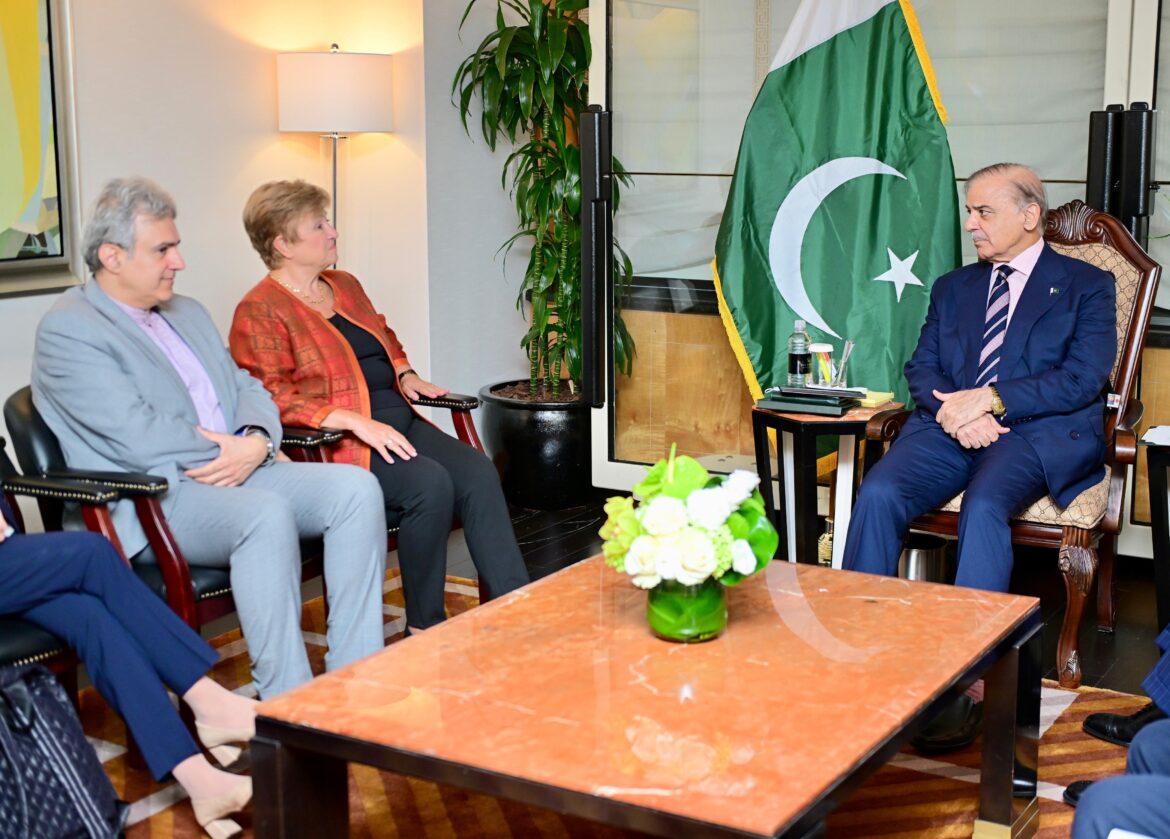
KARACHI: Prime Minister Shehbaz Sharif urged the International Monetary Fund to consider the economic toll of recent floods in its program review during talks with the lender’s chief on Wednesday, as the country pushes reforms to sustain a fragile economic recovery.
The IMF team is due to arrive in Pakistan on Sept. 25 for the second semi-annual review of its $7 billion Extended Fund Facility program and to evaluate the nation’s progress under the arrangement, focusing on economic targets for the March-June quarter.
Analysts say Pakistan is likely to meet the IMF’s quantitative performance criteria, including targets related to net international reserves and swap positions. The primary balance numbers for fiscal year 2025 are also well within the IMF’s projections.
Sharif’s discussions with IMF Managing Director Kristalina Georgieva and World Bank President Ajay Banga occurred on the sidelines of the 80th U.N. General Assembly session.
The prime minister told Georgieva he appreciated the IMF’s “longstanding constructive partnership with Pakistan, which under Ms. Georgieva’s leadership, had strengthened further,” according to a statement from his office.
He highlighted the fund’s support through a $3 billion Stand-By Arrangement in fiscal 2024, followed by a $7 billion Extended Fund Facility and $1.4 billion Resilience and Sustainability Facility. “Today, with the institution of deep-rooted structural reforms, Pakistan’s economy was showing positive signs of stabilization and was now moving towards recovery,” Sharif said, crediting the IMF’s guidance in the reform push.
Pakistan’s economy expanded by 2.5% in fiscal year 2024 after contracting 0.2% the previous year, with growth projected at 2.6% in fiscal 2025, according to World Bank data. The IMF projects real GDP growth of 2.7% for 2025. Inflation is seen easing to 6.0% in fiscal 2025, while the current account is expected to post a surplus of 0.1% of GDP, the World Bank said. The fiscal deficit is estimated at 6.7% of GDP for fiscal 2025. Poverty remains elevated, with the lower-middle income poverty rate holding at 42.3% in fiscal 2025.
Sharif stressed Pakistan’s progress on program targets but added that the “impact of the recent floods on Pakistan’s economy must be factored into the IMF’s review.”
Georgieva offered sympathy to flood victims and stressed the need for damage assessments to shape recovery efforts. She praised Sharif’s focus on sound macroeconomic policies and pledged ongoing IMF backing for reforms aimed at “sustainable long term economic growth.”
In his meeting with Banga, Sharif hailed the World Bank’s transformation under his leadership into a “faster, more efficient and impactful development partner,” with emphasis on streamlining operations and tapping private funds.
He thanked the bank for aid during the COVID-19 crisis and 2022 floods, and outlined Islamabad’s reform plans covering revenue boosts, energy overhauls, privatisation and climate defences.
Sharif said these steps had driven “macroeconomic stabilization, restored investor confidence and promoted sustainable and inclusive economic growth.”
“The Prime Minister expressed appreciation for the World Bank’s new Country Partnership Framework (2026–2035), under which the World Bank has committed an unprecedented US$ 40 billion for Pakistan,” the statement said.
Banga commended Pakistan’s reforms and affirmed support for its agenda, including long-term climate resilience projects under the framework. Both agreed to deepen ties to advance Pakistan’s priorities.
Copyright © 2021 Independent Pakistan | All rights reserved