Staff Reporter
ISLAMABAD: Pakistan’s large-scale manufacturing sector, a cornerstone of the country’s industrial base, posted a 4.44 percent increase in the first two months of the fiscal year, offering a tentative sign of stabilisation even as monthly production dipped in August.
The data by the Pakistan Bureau of Statistics on Friday reflects a mixed picture for an economy still grappling with inflation, energy shortages and the lingering effects of last year’s devastating floods. While output rose 0.54 percent in August from the same month a year earlier, it contracted by 2.75 percent from July, when the sector had surged by a robust 9 percent year-over-year.
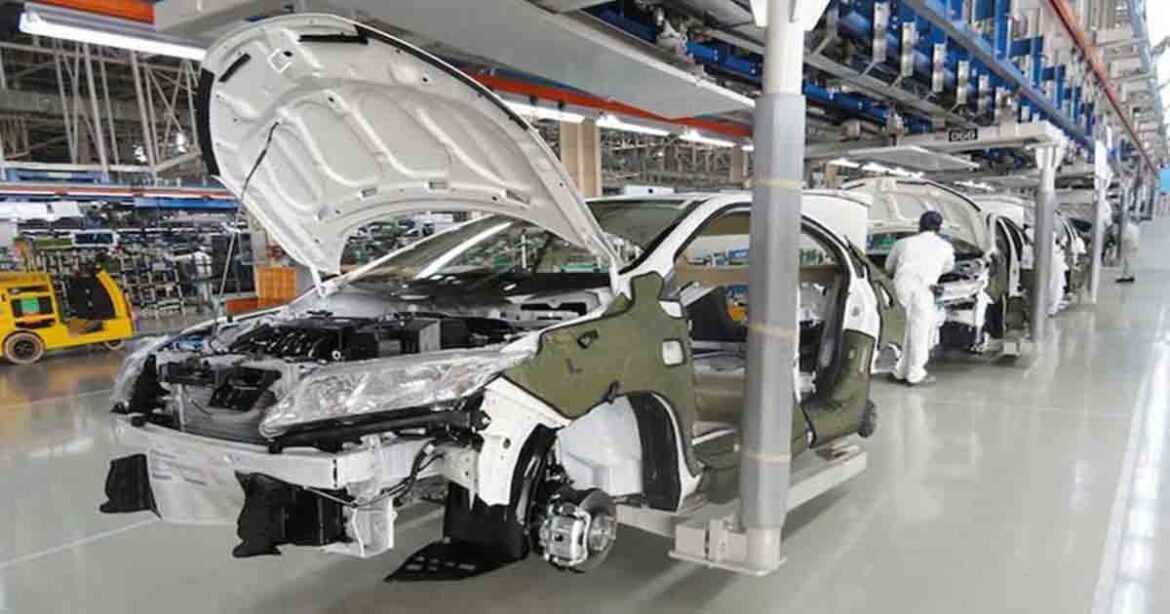
The overall growth for July and August of fiscal 2025-26, when measured against the prior year’s corresponding period, underscores a fragile rebound in a sector that contracted sharply in recent years. Automobiles emerged as the standout driver, accounting for 1.83 percentage points of the total 4.44 percent gain, fueled by pent-up demand and improved supply chains. Cement followed closely with 0.98 percentage points, benefiting from reconstruction efforts in flood-hit areas. Garments added 0.84 points, while food processing contributed 1.02 points and other transport equipment 0.23 points.
Less encouraging were drags from energy-intensive industries. Petroleum products subtracted 0.21 percentage points, chemicals 0.13 points and pharmaceuticals 0.11 points. Iron and steel products pulled back 0.16 points, machinery and equipment 0.11 points, and furniture 0.17 points. Textiles, a traditional export engine, offered a negligible offset of just 0.03 points, while paper and board added a modest 0.21 points and electrical equipment 0.08 points. Tobacco rounded out the positive contributors with 0.17 points.
On a broader year-over-year basis for the July-August period, nine subsectors posted gains, led by automobiles at an eye-popping 90.4 percent — a testament to recovering consumer confidence and easier access to imported components after currency stabilization measures took hold earlier this year. Other transport equipment climbed 44.47 percent, rubber products soared 24.9 percent, and non-metallic mineral products rose 17.31 percent. Food processing expanded 7.77 percent, other manufacturing — including footwear — grew 19.35 percent, paper and board increased 8.41 percent, tobacco advanced 11.06 percent, and wearing apparel edged up 4.92 percent.
Counterbalancing these advances declined across 10 categories. Machinery and equipment suffered the steepest drop, plunging 33.84 percent, likely hampered by high borrowing costs and import restrictions. Iron and steel products fell 3.44 percent, furniture declined 10.84 percent, and pharmaceuticals eased 1.77 percent. Beverages dipped 2.68 percent, coke and petroleum products 2.69 percent, chemicals — encompassing chemical products and fertilizers — 1.47 percent, wood products 1.65 percent, fabricated metal products 0.19 percent, and textiles a slim 0.15 percent.
Copyright © 2021 Independent Pakistan | All rights reserved