By Staff Reporter
ISLAMABAD: Pakistan has asked the trade-finance arm of the Islamic Development Bank Group to lower the cost of its lending, arguing that borrowing terms should reflect the country’s stronger position in the markets.
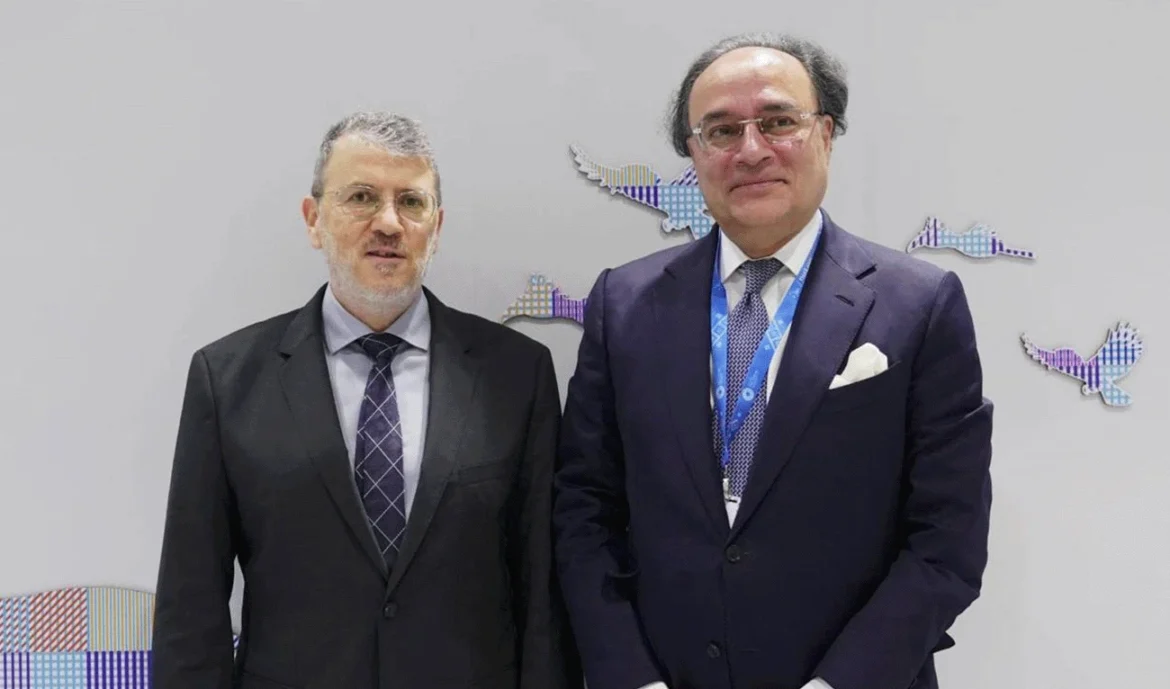
Finance minister Muhammad Aurangzeb raised the request on Thursday in a meeting with Adeeb Y Al Aama, chief executive of the International Islamic Trade Finance Corporation (ITFC), the Finance Division said. The talks took place on the sidelines of the World Bank Group–IMF annual meetings in Bangkok. Mr Aurangzeb is leading Pakistan’s delegation to the gathering, which runs until 18 October.
“Both sides reviewed the remaining financing tranche and discussed aligning borrowing costs with improved market conditions,” the Finance Division said. “They agreed that technical teams would explore pricing and financing-volume adjustments to find a mutually acceptable solution.”
The statement did not say which facility the discussion concerned. The ITFC signed a $513m syndicated Murabaha facility with Islamabad in July 2025 to fund oil and gas imports, but the Finance Division did not say whether the remaining tranche referred to that agreement or to another.
The ITFC was established to advance trade among Muslim nations. Since January 2008 it has provided $92bn in financing to member states of the Organisation of Islamic Cooperation, making it the leading provider of trade solutions for those countries.
Aurangzeb told the ITFC chief about the country’s economic progress, stronger reserves and renewed access to international capital markets. He also described efforts to replace costly short-term borrowing with longer-maturity financing without adding to external debt.
The two men also discussed digital product passports to support textile exports to the European Union, and single-window connectivity to ease trade with the Association of Southeast Asian Nations. Both sides reaffirmed their long-term partnership and commitment to strengthening Pakistan’s export competitiveness, the Finance Division said.
The meeting is one of dozens on Aurangzeb’s schedule. The finance ministry said he would hold more than 60 high-level engagements with international financial institutions, finance ministers, development partners, investors, banks, credit rating agencies, think tanks and media. The programme includes presentations on Pakistan’s reform progress to Fitch Ratings, Moody’s and S&P Global. On Thursday he also met IMF deputy managing director Nigel Clarke, pointing to three consecutive years of primary surpluses, stronger foreign exchange reserves and a declining debt-to-GDP ratio.
The trip follows a significant step with the IMF. Last Thursday the Fund reached a staff-level agreement with Pakistan on the fourth review of its Extended Fund Facility and the third review of its Resilience and Sustainability Facility. The agreement came a year after Pakistan secured the $7bn Extended Fund Facility in September 2024. It was followed by a $1.4bn, 28-month Resilience and Sustainability Facility in May last year.
The deal is subject to approval by the IMF’s executive board. If approved, it would give Pakistan access to about $1bn under the first facility and about $210m under the second, taking total disbursements under the two arrangements to about $5.7bn. Reports said Pakistan could draw the money within four to five weeks of approval.
Iva Petrova, who led the IMF team, said Pakistan had navigated the impact of the Middle East conflict and preserved macroeconomic stability. She said sovereign rating upgrades and renewed market access pointed to stronger policy credibility.
Growth forecast
In a separate conversation in Bangkok with Michael Kugelman of the Atlantic Council, Aurangzeb said Pakistan expected its economy to grow by about 4% in the 2026-27 fiscal year. He said that would be driven by a recovery in industry and agriculture.
He said gross domestic product grew by 3.7% in the 2025-26 fiscal year, against 3.2% the year before. The IMF’s own estimate for 2025-26 growth is slightly lower, at 3.6%. The State Bank of Pakistan has projected growth of between 3.5% and 4.5% for the current year, citing a rebound in large-scale manufacturing and better performance in agriculture, particularly livestock.
Aurangzeb said the government was closely monitoring the effect of the continuing Middle East conflict on inflation and growth. He said external shocks had weighed on economic activity in the final quarter of the previous fiscal year.
He said the twin deficits, fiscal and external, had fallen from 12.5% of GDP to 2.6% over three years, and that reserves had improved. He expected the current account balance to remain between zero and 1% of GDP.
Pakistan wanted to avoid the boom-and-bust cycles of the past, he said. In those cycles, consumption-led growth lifted import demand and eventually produced balance-of-payments pressures. “This time the focus is very much on sustainable,” he said.
Exports and tax
The government has cut tax burdens on exporters, lowered the cost of imported raw materials and intermediate goods, and provided subsidised financing, he said. IT services exports earned $4.6bn in the last fiscal year, and he expects about $5.5bn in 2026-27.
Tax revenues have risen by 40% over two fiscal years, according to the minister. The tax-to-GDP ratio has climbed to about 10.3% from below 9% when the reform drive began. He credited stronger enforcement, digital monitoring, electronic invoicing and efforts to plug revenue leaks. The government is also using integrated databases and artificial intelligence in assessments and audits to reduce discretionary powers in tax administration, he said.
On privatisation, Aurangzeb said the government was advancing the sale of power distribution companies and the outsourcing of airports. Further transactions involving insurers and other financial institutions are in the pipeline. Three Turkish companies are conducting due diligence on the first three distribution companies under consideration, he said, and domestic investors had shown confidence in the reform programme.
He said Rs838bn had been allocated to the Benazir Income Support Programme, with an increase in cash assistance under its Kafaalat scheme planned for January. Nearly Rs80bn has been disbursed for affordable housing, while banks have approved Rs430bn. The government is also widening targeted fuel subsidies and moving welfare payments to digital wallets to improve transparency, he said.
On external financing, Aurangzeb said Pakistan had tapped China’s capital market through a Panda bond at an interest rate of 2.5%. It returned to the Eurobond market in September. The government plans to diversify its funding sources, replace costlier external debt where possible and lengthen maturities rather than add to the overall stock of external debt, he said.
Pakistan will take over the chairmanship of the G-24 group of developing economies on 1 November. Mr Aurangzeb said this would give it a platform to press the concerns of developing countries in debates on the international financial architecture. He said the lasting answer to poverty and other structural problems lay in sustainable growth, job creation, education, healthcare and skills development.
Meanwhile, Pakistan also pressed the Islamic Development Bank to convert a $5.6bn financing framework into a pipeline of approved projects with firm deadlines, as its economy minister lobbied two of the country’s largest lenders at the World Bank–IMF meetings in Bangkok.
Ahad Khan Cheema, the federal minister for economic affairs, met Dr Muhammad Sulaiman Al Jasser, chairman of the IsDB Group, on the sidelines of the annual meetings on Thursday, according to an official statement. They discussed Pakistan’s Member Country Partnership Strategy for 2026–2030, which envisages about $5.6bn in “indicative” financing from the group. That figure is a ceiling for planning rather than money committed to specific projects, a distinction Mr Cheema stressed.
The minister called for the envelope to be turned into “well-prepared projects”, with clear timelines for approvals, disbursements and implementation, the statement said. He congratulated Dr Al Jasser on his re-election to a second five-year term.
Cheema thanked the bank for $475m towards the M-6 Sukkur–Hyderabad Motorway. Pakistan and the bank signed that loan in January, alongside two smaller agreements, in a package worth $603m, according to state broadcaster Radio Pakistan. He also welcomed the recent approval of $100m for the fifth phase of Pakistan’s polio eradication programme.
He sought greater IsDB support for the ML-1 railway upgrade and urged close coordination with the Asian Development Bank and other co-financiers to speed up preparation. The project would modernise the country’s main rail line and improve connectivity, he said.
Cheema also asked the bank’s institutions to work together, calling for a “coordinated, whole-of-Group approach” spanning the IsDB, its trade finance arm ITFC, the private sector arm ICD, the insurer ICIEC and the IsDB Institute. He said this should expand export finance, small business lending, infrastructure, public-private partnerships and energy transition work.
He noted that ITFC had mobilised more than $1bn in trade financing for Pakistan in the 2025–26 financial year. He asked for more competitive terms on future facilities, citing the country’s improving macroeconomic and credit profile.
Dr Al Jasser praised the government’s economic development vision and affirmed the group’s commitment to Pakistan’s priorities, the statement said. Both sides agreed on the need for a “results-oriented partnership”, it added.
Cheema, who is also Pakistan’s governor to the World Bank Group, separately met Anna Bjerde, the bank’s managing director of operations, to discuss the Country Partnership Framework for 2026–2035.
He called for stronger project preparation through dedicated project readiness facilities, predictable financing and more implementation support to speed up approvals. He also urged that concessional funds be used efficiently while protecting debt sustainability. He called for digital systems to track progress and measure results.
The talks covered human development, climate resilience, water and sanitation, and sectors with high job-creation potential. Mr Cheema again raised ML-1, including the idea of an “Economic Railway Corridor” along the roughly 1,800km line, and a proposed Minerals Compact for the mining sector.
Bjerde reaffirmed the bank’s commitment to Pakistan’s priority sectors and to helping the government improve efficiency and speed up delivery, the statement said.
Copyright © 2021 Independent Pakistan | All rights reserved